Crazyrouter
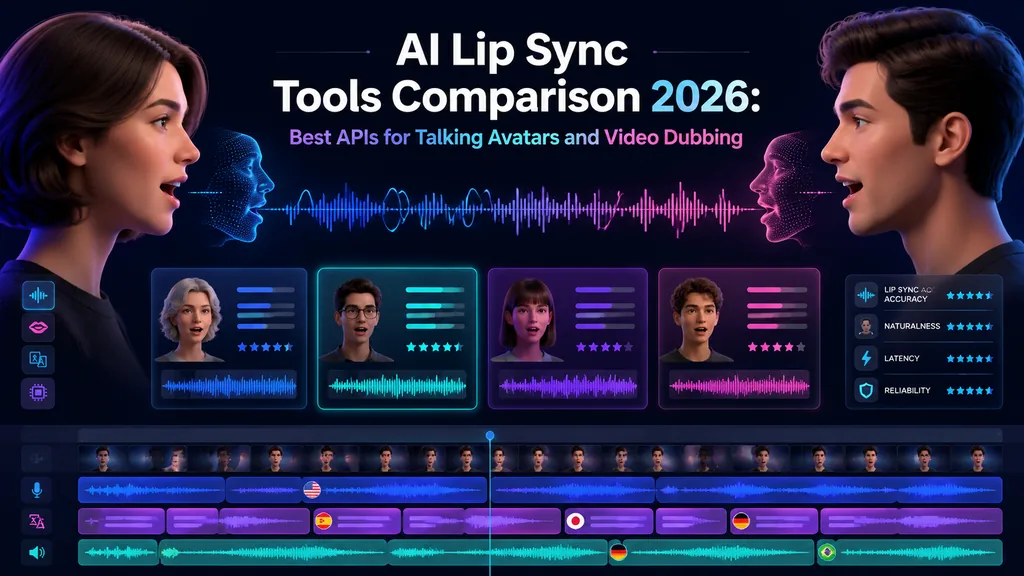
AI Lip Sync Tools Comparison 2026: Best APIs for Talking Avatars and Video Dubbing
"Compare the top AI lip sync tools in May 2026 including Sync Labs, Hedra, Wav2Lip, and D-ID. Pricing, API access, quality benchmarks, and integration guides."
AI Lip Sync Tools Comparison 2026: Best APIs for Talking Avatars and Video Dubbing#
AI lip sync technology has exploded in 2026. Whether you're building talking avatar products, dubbing videos into multiple languages, or creating personalized video messages at scale, there's now a mature ecosystem of APIs to choose from.
This comparison covers the top AI lip sync tools available in May 2026, with real benchmarks on quality, latency, pricing, and API integration complexity.
What Is AI Lip Sync?#
AI lip sync uses deep learning to synchronize mouth movements in video with audio input. The technology takes:
- Input: A source video (or image) + target audio
- Output: A new video where the subject's lips match the audio naturally
Use cases include:
- Multilingual video dubbing (translate once, lip sync to any language)
- Talking avatar generation from a single photo
- Virtual spokesperson videos for marketing
- Personalized video messages at scale
- Film/TV post-production dubbing
Top AI Lip Sync Tools Compared (May 2026)#
| Tool | Quality (1-10) | Latency | API Available | Price | Best For |
|---|---|---|---|---|---|
| Sync Labs | 9.5 | 3-8s | ✅ REST API | $0.08/sec | Production dubbing |
| Hedra | 9.0 | 5-15s | ✅ REST API | $0.05/sec | Talking avatars |
| D-ID | 8.5 | 2-5s | ✅ REST API | $0.03/sec | Quick prototyping |
| Wav2Lip (open source) | 7.5 | 1-3s | Self-hosted | Free (GPU costs) | Budget/custom |
| HeyGen | 8.8 | 10-30s | ✅ REST API | $0.10/sec | Enterprise video |
| Pika Lip Sync | 8.0 | 5-10s | ❌ (UI only) | $8/month plan | Creators |
| MuseTalk (open source) | 8.0 | 2-5s | Self-hosted | Free (GPU costs) | Research |
Sync Labs: Best Overall Quality#
Sync Labs leads the market in lip sync quality. Their model handles:
- Multiple face angles (not just frontal)
- Emotion preservation from the original video
- Teeth and tongue detail
- Natural jaw movement
API Integration#
import requests

SYNC_LABS_API_KEY = "your-api-key"

# Submit a lip sync job
response = requests.post(
    "https://api.synclabs.so/lipsync",
    headers={
        "x-api-key": SYNC_LABS_API_KEY,
        "Content-Type": "application/json"
    },
    json={
        "videoUrl": "https://your-bucket.s3.amazonaws.com/source.mp4",
        "audioUrl": "https://your-bucket.s3.amazonaws.com/target-audio.mp3",
        "model": "sync-2.0",  # Latest model as of May 2026
        "webhookUrl": "https://your-app.com/webhook/lipsync-done"
    }
)

job = response.json()
print(f"Job ID: {job['id']}, Status: {job['status']}")
Polling for Results#
import time

def wait_for_result(job_id):
    while True:
        resp = requests.get(
            f"https://api.synclabs.so/lipsync/{job_id}",
            headers={"x-api-key": SYNC_LABS_API_KEY}
        )
        data = resp.json()
        if data["status"] == "COMPLETED":
            return data["outputUrl"]
        elif data["status"] == "FAILED":
            raise Exception(f"Job failed: {data.get('error')}")
        time.sleep(2)

output_url = wait_for_result(job["id"])
print(f"Result: {output_url}")
Pricing#
- Pay-per-second of output video
- $0.08/second for sync-2.0 model
- Volume discounts available (50K+ seconds/month)
- No minimum commitment
Hedra: Best for Talking Avatars from Photos#
Hedra specializes in generating talking head videos from a single photo. You provide a portrait image and audio, and it creates a realistic talking avatar.
API Integration#
import requests

HEDRA_API_KEY = "your-hedra-key"

# Generate talking avatar from photo + audio
response = requests.post(
    "https://api.hedra.com/v1/generate",
    headers={
        "Authorization": f"Bearer {HEDRA_API_KEY}",
        "Content-Type": "application/json"
    },
    json={
        "portrait_url": "https://example.com/headshot.jpg",
        "audio_url": "https://example.com/speech.mp3",
        "aspect_ratio": "16:9",
        "resolution": "1080p"
    }
)

result = response.json()
print(f"Video URL: {result['video_url']}")
Strengths#
- Single photo → talking video (no source video needed)
- Excellent emotion expression
- Supports multiple aspect ratios
- Fast iteration for marketing teams
Limitations#
- Less accurate than Sync Labs for video-to-video dubbing
- Limited to head/shoulders framing
- Occasional artifacts on extreme head turns
D-ID: Best for Quick Prototyping#
D-ID offers the fastest integration path with a simple API and generous free tier. Quality is slightly below Sync Labs but sufficient for most use cases.
Node.js Integration#
const axios = require('axios');

const DID_API_KEY = 'your-did-key';

async function createTalkingHead(imageUrl, audioUrl) {
  const response = await axios.post(
    'https://api.d-id.com/talks',
    {
      source_url: imageUrl,
      script: {
        type: 'audio',
        audio_url: audioUrl
      },
      config: {
        stitch: true,
        result_format: 'mp4'
      }
    },
    {
      headers: {
        'Authorization': `Basic ${DID_API_KEY}`,
        'Content-Type': 'application/json'
      }
    }
  );

  return response.data.id;
}

// Poll for result
async function getResult(talkId) {
  const response = await axios.get(
    `https://api.d-id.com/talks/${talkId}`,
    { headers: { 'Authorization': `Basic ${DID_API_KEY}` } }
  );
  return response.data;
}
Wav2Lip: Best Open Source Option#
Wav2Lip remains the go-to open source lip sync model. Self-hosting gives you full control and zero per-video costs.
Self-Hosting with Docker#
# Clone and build
git clone https://github.com/Rudrabha/Wav2Lip.git
cd Wav2Lip

# Docker setup (requires NVIDIA GPU)
docker build -t wav2lip .
docker run --gpus all -p 8000:8000 wav2lip

# Process a video
curl -X POST http://localhost:8000/lipsync \
  -F "video=@input.mp4" \
  -F "audio=@speech.wav" \
  -o output.mp4
Cost Analysis: Self-Hosted vs API#
| Scenario | Sync Labs API | Self-Hosted Wav2Lip |
|---|---|---|
| 100 videos/month (30s each) | $240/month | ~$50/month (GPU) |
| 1,000 videos/month (30s each) | $2,400/month | ~$200/month (GPU) |
| 10,000 videos/month (30s each) | $24,000/month | ~$800/month (GPU) |
Self-hosting makes sense above ~500 videos/month, but you sacrifice quality (Wav2Lip scores 7.5 vs Sync Labs' 9.5).
Building a Production Lip Sync Pipeline#
For production use, combine multiple tools with an AI API gateway:
import asyncio
from openai import OpenAI

# Use Crazyrouter for TTS + orchestration
client = OpenAI(
    api_key="your-crazyrouter-key",
    base_url="https://crazyrouter.com/v1"
)

async def create_dubbed_video(video_url, target_language):
    # Step 1: Transcribe original audio (Whisper via Crazyrouter)
    # Step 2: Translate text to target language (GPT-4o)
    # Step 3: Generate speech in target language (TTS)
    # Step 4: Lip sync with Sync Labs

    # Translation
    translation = client.chat.completions.create(
        model="gpt-4o",
        messages=[{
            "role": "user",
            "content": f"Translate to {target_language}: {original_text}"
        }]
    )

    # TTS
    tts_response = client.audio.speech.create(
        model="tts-1-hd",
        voice="alloy",
        input=translation.choices[0].message.content
    )

    # Save audio, then send to Sync Labs for lip sync
    # ... (lip sync API call as shown above)

    return final_video_url
FAQ#
What is the best AI lip sync tool in 2026?#
Sync Labs offers the highest quality lip sync for video-to-video dubbing. For photo-to-video talking avatars, Hedra leads. For budget-conscious teams, Wav2Lip (open source) provides decent quality at zero API cost.
How much does AI lip sync cost?#
Commercial APIs range from 0.10 per second of output video. A 60-second video costs 6.00 depending on the provider. Self-hosted open source options cost only GPU compute (~$0.01/second on cloud GPUs).
Can AI lip sync work in real-time?#
Not yet for high quality. Current best latency is 2-5 seconds for D-ID and Wav2Lip. Sync Labs takes 3-8 seconds. Real-time lip sync at production quality is expected by late 2026.
Is AI lip sync legal?#
Using AI lip sync on your own content or with consent is legal in most jurisdictions. Using it to create deepfakes of others without consent may violate laws in many countries. Always obtain proper rights and disclose AI-generated content.
Which lip sync API has the best developer experience?#
D-ID has the simplest API with the fastest time-to-first-video. Sync Labs has the best documentation and webhook support for production pipelines. Hedra sits in between with a clean REST API.
Summary#
The AI lip sync market in 2026 offers mature options for every budget and use case. For production quality, Sync Labs is the clear leader. For talking avatars from photos, Hedra excels. For cost-sensitive pipelines, self-hosted Wav2Lip or MuseTalk work well.
Combine these tools with Crazyrouter for affordable TTS, translation, and orchestration — building a complete multilingual video dubbing pipeline at a fraction of enterprise pricing.