 简体中文
简体中文 繁體中文
繁體中文 English
 Français
 Русский
 日本語
日本語 Tiếng Việt
 한국어
한국어 Deutsch
 Español
 Italiano
 Português
 العربية
 ไทย
ไทย Bahasa Indonesia
 Bahasa Melayu
 Türkçe
 Polski
 Nederlands
 Dansk
Dansk Norsk
Norsk Қазақша
Qwen2.5-Omni Guide 2026: Real-Time Voice, Vision, and Agent Workflows
A developer-focused qwen2.5-omni guide article covering what it is, alternatives, API examples, pricing, FAQs, and when to use Crazyrouter for unified routing.
Qwen2.5-Omni Guide 2026: Real-Time Voice, Vision, and Agent Workflows#
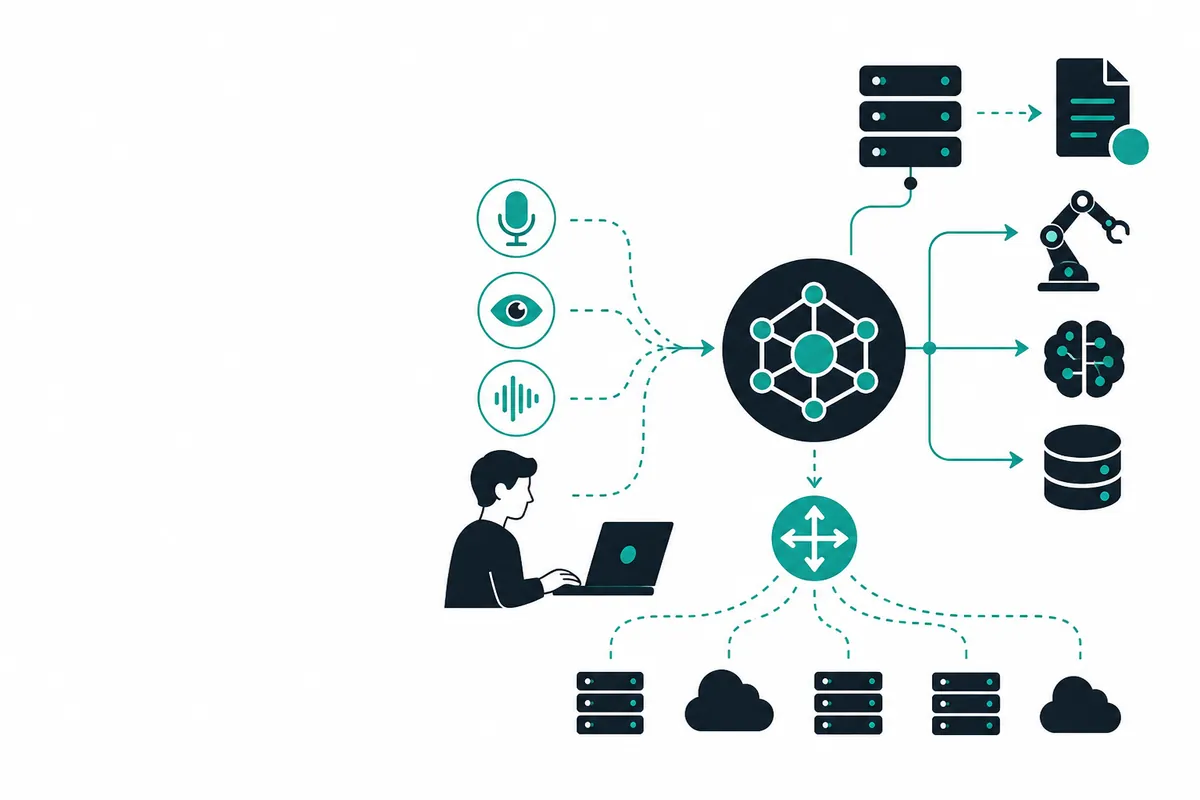
If you searched for qwen2.5-omni guide, you probably do not want another surface-level feature list. You want to know what Qwen2.5-Omni is, how it compares with alternatives, how to use it in a real application, and how the pricing works once prototypes become production traffic. This June 2026 guide focuses on real-time multimodal app architecture for developers.
For developer teams, the key question is rarely “which model is best?” The real question is “which workflow gives us enough quality, predictable cost, and an escape hatch when a provider changes limits?” That is where a unified API gateway such as Crazyrouter becomes useful: you can experiment with multiple models without rewriting the entire application every time the market changes.
What is Qwen2.5-Omni?#
Qwen2.5-Omni is best understood as a capability layer for voice assistants, vision chatbots, meeting copilots, and multimodal agents. Instead of treating it as a magic product, treat it as one component in a production pipeline: prompt design, input validation, API calls, retries, logging, human review, and cost tracking.
A good qwen2.5-omni guide workflow should answer four questions:
- What input format does the model accept?
- How long does a normal request take?
- What happens when a request fails or quality is not good enough?
- How much does the full workflow cost after retries, drafts, and QA?
That final point is where many teams underestimate AI spending. A single demo may look cheap, but production traffic includes failed calls, prompt experiments, staging runs, evaluation jobs, and user-triggered retries.
Qwen2.5-Omni vs alternatives#
| Option | Best for | Watch out for |
|---|---|---|
| Qwen2.5-Omni | voice assistants, vision chatbots, meeting copilots, and multimodal agents | Pricing, access, and output quality must be tested against your data |
| GPT-4o-style multimodal models, Gemini multimodal models, Claude vision, and local speech pipelines | Comparing quality, latency, and availability | Each provider has different auth, SDKs, and billing |
| Single official API | Simple prototypes and vendor-specific features | Lock-in and harder fallback planning |
| Crazyrouter unified API | Multi-model routing, budget control, and fast experiments | You still need clear evaluation criteria |
The practical recommendation: benchmark at least three providers before committing. Use the same prompt, same inputs, and same scoring rubric. If Qwen2.5-Omni wins on quality but another model is cheaper for routine jobs, route premium tasks to qwen2.5-omni and use cheaper models for drafts, classification, or retries.
How to use Qwen2.5-Omni with code examples#
The exact official endpoint may vary, but most modern AI apps can be wrapped behind an OpenAI-compatible client. With Crazyrouter, the integration pattern stays consistent while models change.
Python example#
from openai import OpenAI

client = OpenAI(
    api_key="CRAZYROUTER_API_KEY",
    base_url="https://crazyrouter.com/v1"
)

response = client.chat.completions.create(
    model="qwen2.5-omni",
    messages=[
        {"role": "system", "content": "You are a production AI assistant. Be precise."},
        {"role": "user", "content": "Create a step-by-step plan for voice assistants, vision chatbots, meeting copilots, and multimodal agents."}
    ],
    temperature=0.3,
)

print(response.choices[0].message.content)
Node.js example#
import OpenAI from "openai";

const client = new OpenAI({
  apiKey: process.env.CRAZYROUTER_API_KEY,
  baseURL: "https://crazyrouter.com/v1"
});

const result = await client.chat.completions.create({
  model: "qwen2.5-omni",
  messages: [
    { role: "system", content: "Return concise, testable engineering advice." },
    { role: "user", content: "Compare options for voice assistants, vision chatbots, meeting copilots, and multimodal agents." }
  ]
});

console.log(result.choices[0].message.content);
cURL example#
curl https://crazyrouter.com/v1/chat/completions \
  -H "Authorization: Bearer $CRAZYROUTER_API_KEY" \
  -H "Content-Type: application/json" \
  -d '{
    "model": "qwen2.5-omni",
    "messages": [
      {"role":"user","content":"Build a checklist for Qwen2.5-Omni production evaluation."}
    ]
  }'
For production, add request IDs, structured logs, per-user rate limits, and a fallback model list. Never ship a workflow that has only one provider and no timeout policy.
Pricing breakdown#
| Route | Pricing model | Developer impact |
|---|---|---|
| Official provider | direct model access can be fragmented across text, audio, and vision endpoints | Good for direct access, but costs and limits are provider-specific |
| Marketplace or aggregator | Bundled access to many models | Useful, but compare markup, reliability, and model coverage |
| Crazyrouter | centralize multimodal experiments behind Crazyrouter so apps can compare model quality without rewriting clients | Better for teams that want one key, one base URL, and flexible routing |
A simple cost-control pattern is to split traffic into three tiers:
- Draft tier: cheap model, low temperature, aggressive caching.
- Quality tier: stronger model such as
qwen2.5-omnifor user-visible output. - Escalation tier: premium model only when automated checks fail.
This routing pattern usually beats “send everything to the most expensive model.” It also makes your product less fragile when a provider has downtime, changes limits, or modifies a model.
FAQ#
Is Qwen2.5-Omni worth using in 2026?#
Yes, if it improves quality or speed for voice assistants, vision chatbots, meeting copilots, and multimodal agents. Do a small benchmark before migrating a whole product.
What is the best alternative to Qwen2.5-Omni?#
The best alternative depends on the task. Compare GPT-4o-style multimodal models, Gemini multimodal models, Claude vision, and local speech pipelines using the same prompts, latency targets, and budget assumptions.
Can I use Crazyrouter for qwen2.5-omni guide workflows?#
Yes. Crazyrouter provides an OpenAI-compatible gateway for many model workflows, which helps teams test and route across providers with less integration work.
How should I estimate production cost?#
Count successful calls, retries, failed generations, staging jobs, evaluations, and human QA. Demos undercount real spend.
Should I use official APIs or a router?#
Use the official API when you need provider-specific features. Use a router when you want faster model switching, unified billing logic, and fallback options.
Summary#
Qwen2.5-Omni can be valuable, but the winning production architecture is not just one model. It is a measurable workflow: clear prompts, consistent API calls, logging, fallback routing, and cost controls. If you are building AI features for a real product, try the official provider and compare it with a unified gateway like Crazyrouter. The team that can switch models quickly usually ships faster and spends less.