 Crazyrouter
AI API Caching and Context Optimization: Lower Latency and Cost
Learn how prompt caching, semantic caching, context pruning, and retrieval reduce AI API latency and spend without sacrificing answer quality.
September 19, 20265 viewsEnglishTips
Practical guides for using AI APIs in production, from model selection and integration patterns to pricing, reliability, and workflow design.
Learn how prompt caching, semantic caching, context pruning, and retrieval reduce AI API latency and spend without sacrificing answer quality.
A benchmark that tests only accuracy will miss latency, cost, refusal behavior, schema validity, and regression risk. Build a versioned evaluation set from
A provider abstraction should hide transport and lifecycle differences, not erase useful capabilities. Define a stable core for messages, tools, usage, err
AI observability connects model behavior to business outcomes. Log request IDs, model, latency, token counts, status, safety decisions, and user or tenant
AI APIs fail in recognizable ways: timeouts, rate limits, invalid requests, provider outages, and malformed model output. Production clients should classif
Compare open-weight and commercial AI models across cost, quality, privacy, operations, licensing, and API integration.
A practical guide to launching an AI SaaS with usage quotas, model routing, caching, observability, and predictable unit economics.
A developer checklist for securing AI APIs against leaked keys, prompt injection, sensitive-data exposure, unsafe tools, and runaway spend.
Learn how to design portable function calling across OpenAI-compatible, Anthropic, Gemini, and open-model APIs with schemas, validation, retries, and routing.
A practical Qwen2.5-Omni guide for real-time voice-and-vision apps with barge-in, turn detection, latency budgets, and API cost controls.
Build reliable Kimi K2 Thinking applications with explicit reasoning budgets, tool-call validation, evaluation sets, and cost controls.
A developer guide to Seedance video AI integration with asynchronous queues, cost controls, prompt versioning, and model fallbacks.
Learn a production-friendly WAN 2.2 Animate workflow for reference poses, shot manifests, asynchronous jobs, and visual QA.
Compare AI lip sync tools for developers using phoneme drift, frame alignment, multilingual dubbing, API control, and production QA.
Install Codex CLI reproducibly across developer machines and CI with version pinning, isolated credentials, and container checks.
A secure setup guide for obtaining and using a Claude API key across local development, devcontainers, and CI without committing secrets.
Compare AI API pricing by successful task, latency, caching, retries, and routing policy instead of token price alone.
A developer-focused Gemini Advanced review covering long-context analysis, RAG prototyping, subscription versus API economics, and production handoff.
A practical developer guide to estimating Claude Code costs by repository, workflow, seat, and CI job, with budget controls and API routing patterns.

29 graded items, real API calls. claude-fable-5-1 scored 29/29, gpt-6-astra 16/29. astra emits 0.38-0.77x the output characters, but much of that gap is incompleteness rather than concision — on a three-way tie it named one answer in 5 of 6 runs, and 2 of those named a rule that is factually wrong. On a planted false premise it went along with the premise 5 times out of 6. Includes the three preconditions for valid cross-family comparison.
Compare open source and commercial AI models across cost, privacy, quality, latency, operations, licensing, and API integration.
Learn how to launch an AI SaaS economically using model routing, usage limits, caching, asynchronous jobs, and a unified AI API.
Implement robust error handling for AI APIs with timeout budgets, exponential backoff, idempotency, validation, streaming recovery, and provider fallbacks.
Build reliable multi-model AI systems with task routing, fallbacks, cost controls, evaluation, and a unified API layer.
Design portable function calling across OpenAI-compatible, Claude, Gemini, and open-model APIs with schemas, validation, retries, and fallbacks.
Protect AI API keys, tenant data, prompts, logs, and budgets with practical controls for production applications.
Install and evaluate Gemini CLI, compare it with Claude Code and Codex CLI, and connect reliable Gemini API workflows to your developer tools.
A developer-focused Pika 2.2 review covering video generation use cases, alternatives, API integration patterns, pricing questions, and production tips.
A practical GLM-4.6 API guide for developers covering capabilities, alternatives, OpenAI-compatible requests, pricing decisions, and production safeguards.
Learn what Qwen2.5-Omni is, how it compares with GPT-4o and Gemini, how to call a multimodal model, and how to control API cost in production.
A developer guide to Qwen2.5-Omni for voice, vision, interruption handling, streaming, and production cost controls.
Use Kimi K2 Thinking for auditable reasoning tasks with bounded tool calls, evaluation sets, and cost-aware routing.
Build a reliable Google Veo3 API integration with async jobs, audio-aware prompts, webhooks, retries, and budget controls.
A practical WAN 2.2 Animate tutorial for controlled character motion, reference images, asynchronous jobs, and production retries.
Compare AI lip sync tools for developers building dubbing, avatar, and localization pipelines with measurable QA gates.
Learn how to get a Claude API key, configure it safely, test the first request, and avoid leaking credentials in Git or CI logs.
Compare AI API pricing by tokens, cached context, retries, latency, and routing instead of relying on headline input rates.
A developer-focused Gemini Advanced review covering research, coding, context, subscription value, API economics, and practical alternatives.
A practical Claude Code pricing guide for solo developers and teams, covering subscriptions, API usage, CI budgets, and routing controls.
Design reliable asynchronous AI jobs for image, video, audio, and long-running agent tasks using queues, polling, webhooks, and idempotency.
Build a practical test and evaluation system for AI APIs with fixtures, schema checks, regression sets, latency budgets, and human review.
Reduce AI API spending with prompt budgeting, response caching, model cascades, batching, and usage-based cost attribution.
Implement production AI streaming with Server-Sent Events, cancellation, backpressure, reconnects, and usage tracking.
Compare open source and commercial AI models by cost, quality, deployment, privacy, latency, and maintenance burden.
A practical blueprint for launching an AI SaaS with usage limits, model routing, caching, tenant isolation, and predictable margins.
Design resilient AI API clients with timeout budgets, error classification, exponential backoff, fallback models, and observable request IDs.
Build portable tool calling across OpenAI-compatible, Anthropic, and Gemini-style APIs with schemas, adapters, validation, and retries.
An AI API is an external boundary, even when it sits behind a friendly SDK. Your application sends prompts, files, tool definitions, and sometimes personal data to a model provider. A leaked key can c...
"A developer-focused Kimi K2 Thinking guide covering reasoning prompts, tool calling, evaluation, latency, and cost-aware routing."
"Understand Seedance and ByteDance video AI, compare it with Veo3 and Kling, and design an API pipeline for controlled production."
"Learn how to integrate Google Veo3 API workflows with async jobs, webhooks, audio-aware prompts, retries, and a pricing model."
"Build a reliable WAN 2.2 Animate workflow with image inputs, motion prompts, asynchronous jobs, retries, and cost controls."
"Compare AI lip sync tools for developers by API design, timing quality, multilingual support, and automated production QA."
"Learn how to get a Claude API key, configure it safely, rotate credentials, and use an OpenAI-compatible router for team deployments."
"Compare AI API pricing in 2026 using effective cost per task, including cache hits, retries, fallback models, and Crazyrouter routing."
"Review Gemini Advanced for coding, research, and API workflows in 2026. Compare subscription value with usage-based API access and multi-model routing."
"A practical Claude Code pricing guide for solo developers and teams, covering subscriptions, API usage, CI agents, budgeting, and routing strategies."
AI API security best practices for teams: protect keys, isolate tenants, reduce prompt-injection risk, audit routing, and operate a safer multi-model application.
Function calling across providers explained: normalize tool schemas, validate arguments, handle retries, prevent unsafe actions, and keep OpenAI-compatible code portable.
Design production-ready multi-model orchestration with routing policies, fallbacks, evaluation gates, observability, and one OpenAI-compatible integration.
AI API pricing comparison 2026 for developers: compare official provider billing with gateway economics across text, vision, audio, and video workloads.
Learn how Seedance video AI fits into a developer pipeline, including prompt contracts, asynchronous jobs, quality checks, pricing considerations, and API alternatives.
A practical Google Veo3 API guide covering asynchronous video generation, audio-aware prompts, webhook design, idempotency, pricing, and fallback routing.
WAN 2.2 Animate tutorial for developers: prepare assets, submit image-to-video jobs, poll safely, handle errors, and control production costs with an API gateway.
Pika 2.2 review for developers: evaluate text-to-video and image-to-video workflows, compare alternatives, estimate costs, and connect through Crazyrouter.
Build with the GLM 4.6 API using function calling, structured JSON, retries, and a provider-neutral gateway. Includes Python, Node.js, and cURL examples.
Qwen2.5-Omni developer guide: learn how to design multimodal audio, vision, and text workflows, compare routing options, and integrate an OpenAI-compatible API.
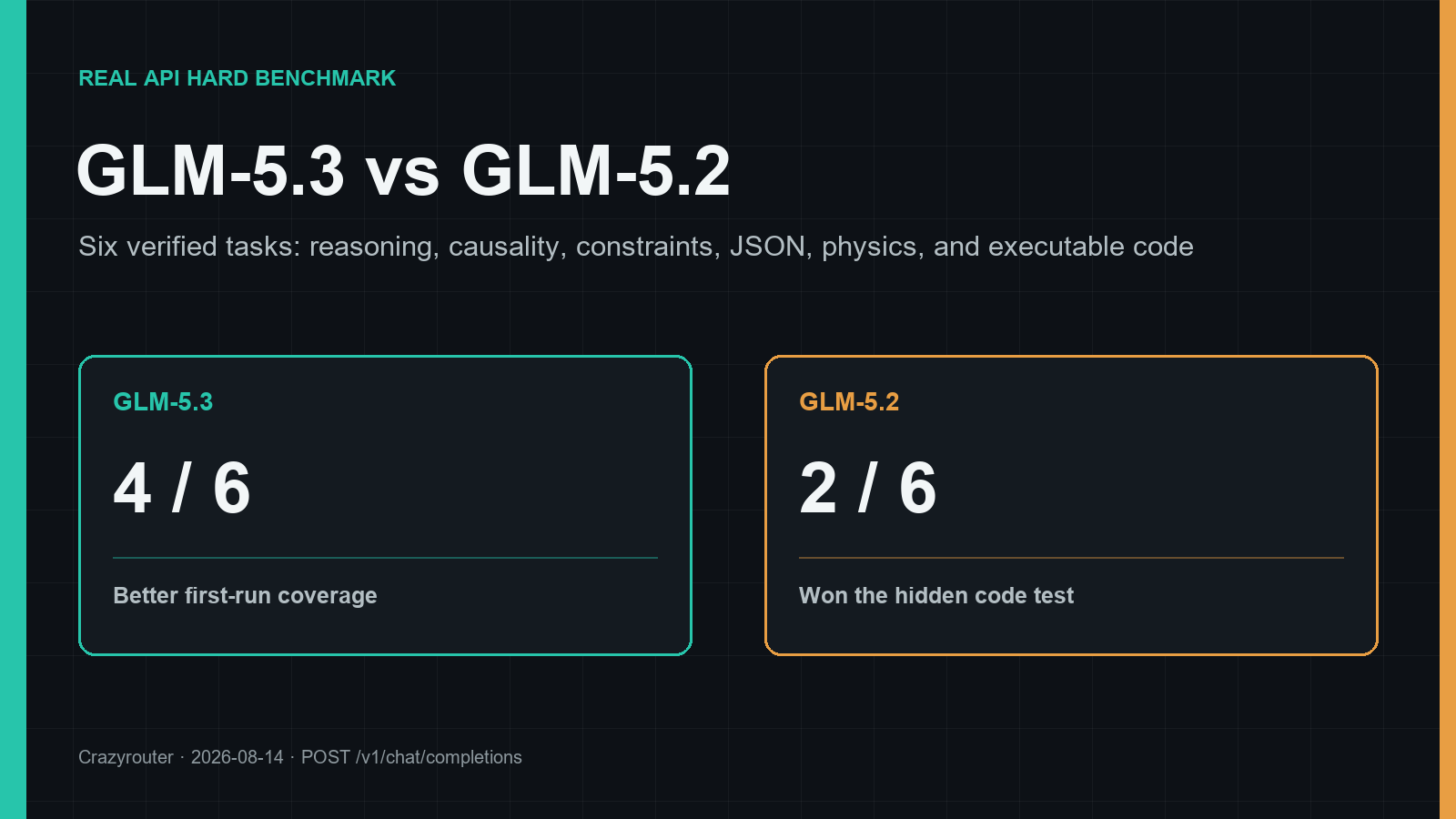
Six hard, verifiable API tasks comparing GLM-5.3 and GLM-5.2. GLM-5.3 led first-delivery coverage 4/6 to 2/6, while GLM-5.2 won the hidden code test.
A developer-focused Seedream 4.0 API tutorial guide covering architecture, code, alternatives, cost controls, and production rollout.
A developer-focused GLM 4.6 API guide guide covering architecture, code, alternatives, cost controls, and production rollout.
A developer-focused qwen2.5-omni guide guide covering architecture, code, alternatives, cost controls, and production rollout.
A developer-focused kimi-k2-thinking guide guide covering architecture, code, alternatives, cost controls, and production rollout.
A developer-focused Luma Ray 2 review guide covering architecture, code, alternatives, cost controls, and production rollout.
A developer-focused Pika 2.2 new features review guide covering architecture, code, alternatives, cost controls, and production rollout.
A developer-focused Google Veo3 API guide covering architecture, code, alternatives, cost controls, and production rollout.
A developer-focused codex cli installation guide covering architecture, code, alternatives, cost controls, and production rollout.
A developer-focused gemini advanced review guide covering architecture, code, alternatives, cost controls, and production rollout.
A developer-focused claude code pricing guide covering architecture, code, alternatives, cost controls, and production rollout.
Understand Seedance video AI from a developer perspective: prompt design, async generation, evaluation, pricing, and fallback models.
Integrate Google Veo3-style video generation with asynchronous jobs, webhooks, retries, audio validation, and budget controls.
A developer tutorial for WAN 2.2 Animate pipelines, including reference assets, asynchronous queues, retries, and consistency checks.
Compare AI lip sync tools by API quality, latency, dubbing workflow, avatar support, pricing model, and production controls.
Learn how to obtain, store, rotate, and proxy a Claude API key without leaking secrets into source control or logs.
A practical Gemini Advanced review that separates subscription value from API economics for coding and research workflows.
Estimate Claude Code costs in large repositories with context budgets, CI controls, and provider fallback strategies.
A practical AI API pricing comparison for developers building long-context, RAG, and agent workloads in 2026.
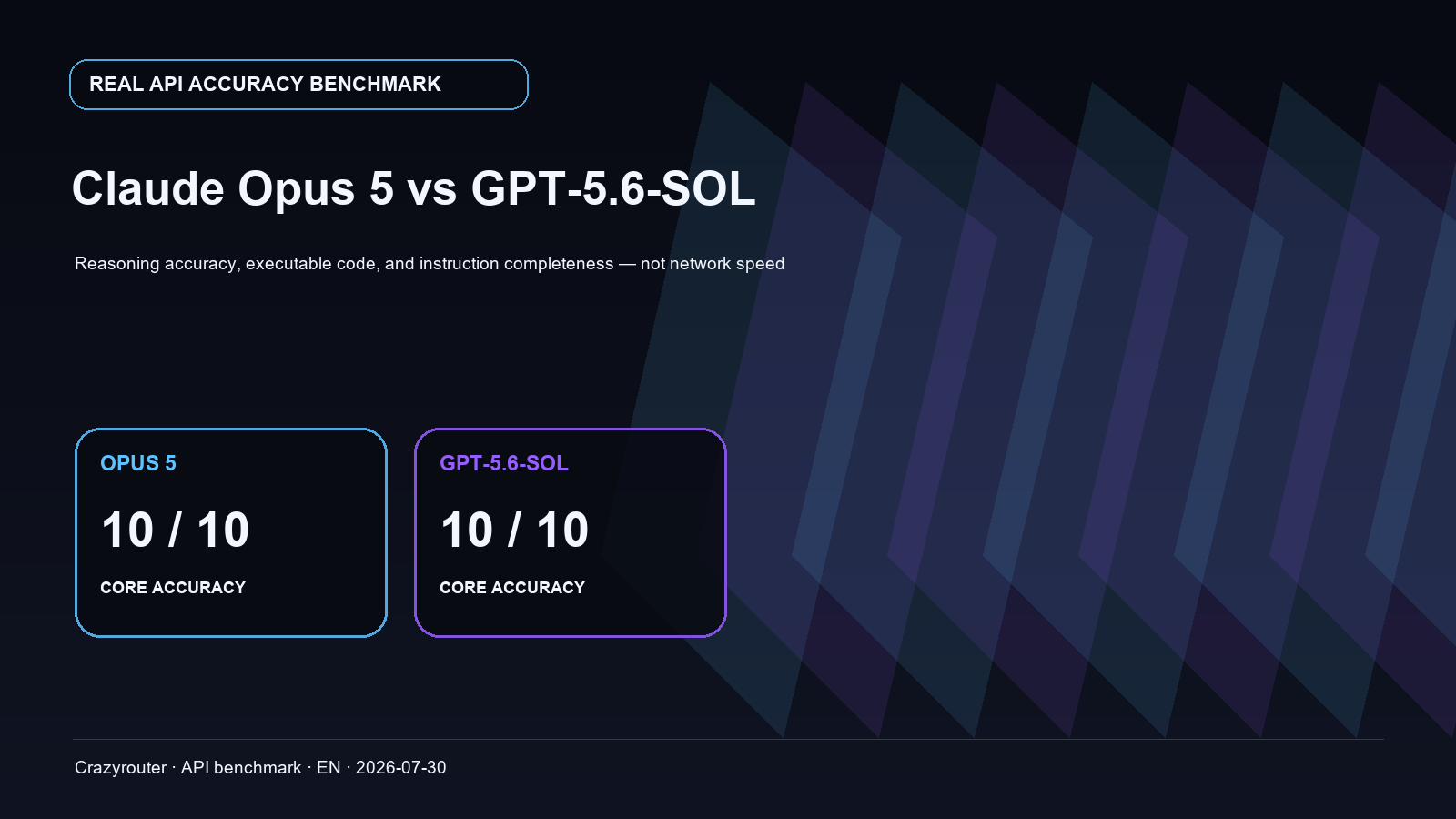
An evidence-led evaluation of Claude Opus 5 and GPT-5.6-SOL through the same Crazyrouter OpenAI-compatible API, covering 10 mathematics, physics, logic, statistics, and executable coding tasks. Both models scored 10/10 on core-answer accuracy. The analysis also examines complete task success, executable validation, hidden-test results, and compliance with strict JSON instructions. Network-dependent response speed is not treated as a comparison dimension.
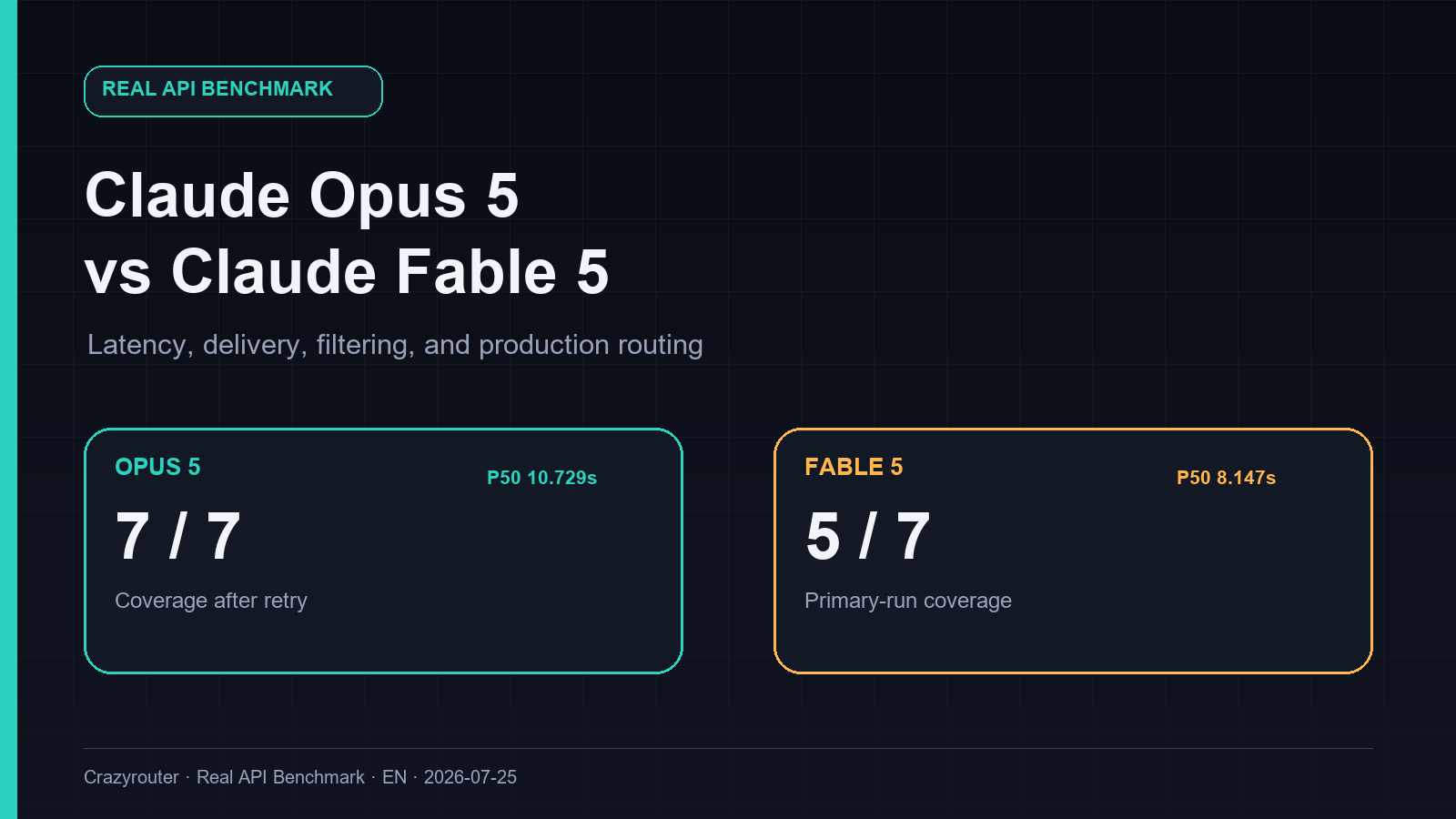
A controlled comparison of Claude Opus 5 and Claude Fable 5 through the same OpenAI-compatible API, using identical prompts and parameters across math, physics, constrained reasoning, code review, strict JSON, and experimental-design tasks, with results tracked for delivery rate, content filtering, latency, token usage, and retries.
Explore Kimi K2 Thinking for reasoning-heavy agents, coding, research, and structured tasks, with practical routing, evaluation, and API examples.
A practical guide to launching AI SaaS economically with model routing, quotas, caching, queues, observability, and a realistic cost-per-user model.
Design multi-model AI systems that route by task, budget, latency, and risk while preserving a stable API contract and measurable quality.
Implement responsive streaming AI interfaces with Server-Sent Events and WebSockets, including buffering, cancellation, reconnects, usage accounting, and code examples.
Secure AI API integrations with key isolation, least privilege, prompt-injection defenses, data minimization, logging controls, and provider-independent architecture.
A production playbook for handling rate limits, timeouts, malformed output, provider outages, and partial failures in AI APIs without runaway cost.
Compare open source and commercial AI models across cost, privacy, latency, quality, deployment, licensing, and API operations for real software teams.
Learn how to integrate GLM-4.6 in developer workflows, including structured output, function calling, provider comparison, cost planning, and resilient API code.
A practical Qwen2.5-Omni API guide for developers building audio, image, video, and text applications with Python, Node.js, cURL, pricing controls, and production safeguards.
A Kimi K2 Thinking guide for developers evaluating long-context reasoning, tool use, latency, and cost before production deployment.
A Google Veo3 API guide for developers building asynchronous video generation with webhooks, retries, prompt versioning, and budget controls.
A production-minded WAN 2.2 Animate tutorial covering inputs, asynchronous queues, retries, shot consistency, and cost control.
Compare AI lip sync tools for developers building dubbing, avatar, localization, and batch video pipelines with measurable QA.
A practical Codex CLI installation guide for macOS, Linux, WSL, dev containers, GitHub Actions, and secure API key management.
Learn how to get a Claude API key safely, verify billing, configure local development, and deploy it to CI without leaking secrets.
A practical AI API pricing comparison for SaaS teams, covering tokens, caching, routing, retries, and the real cost per active user.
A practical Gemini Advanced review for developers comparing the subscription with API access for coding, research, long-context files, and team workflows.
A developer-focused Claude Code pricing guide for July 2026 covering seats, usage metering, team budgets, CI agents, and API fallback design.
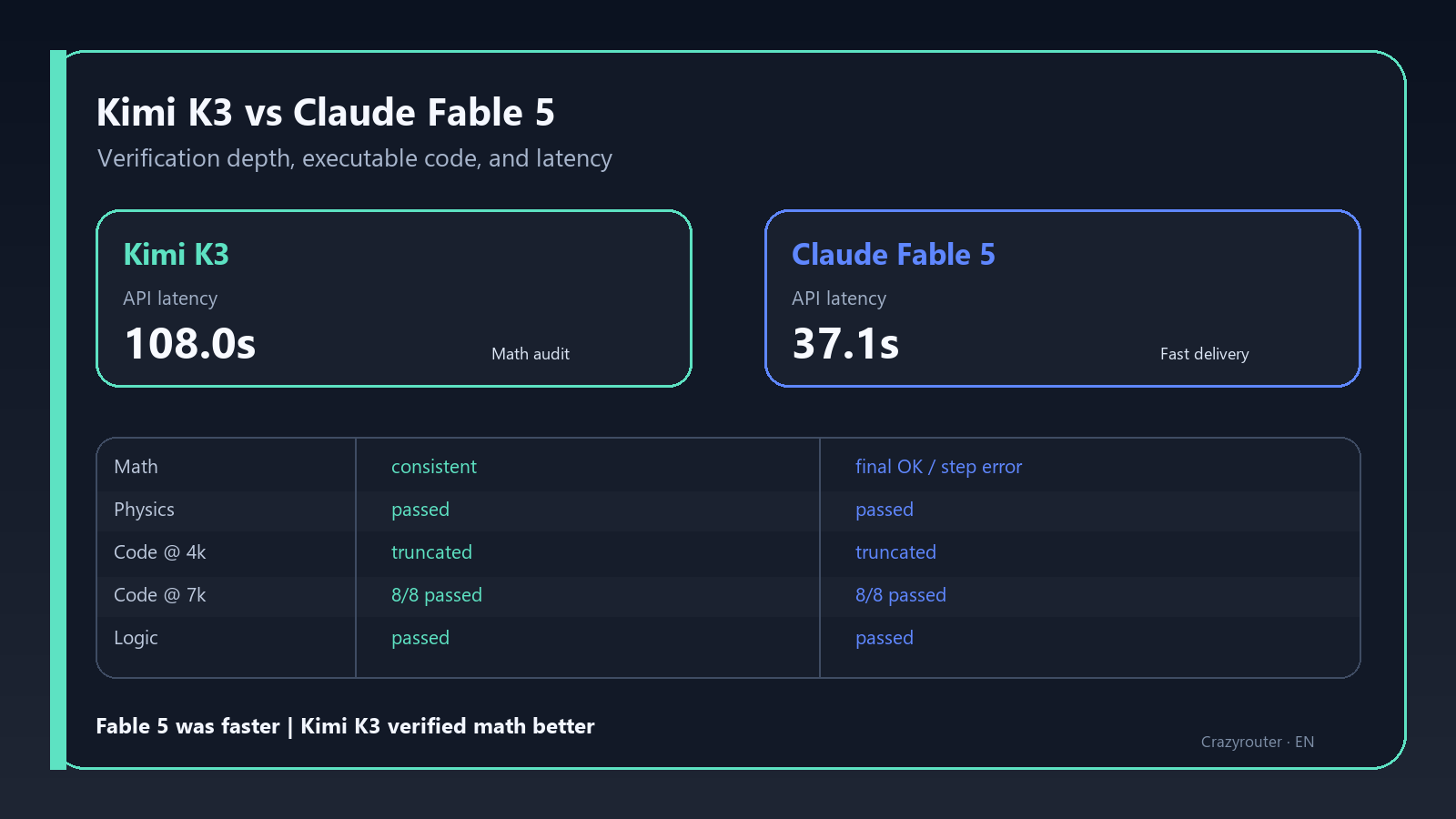
A seven-dimension comparison of Kimi K3 and Claude Opus 4.8 across exact mathematics, physics modeling, constrained reasoning, statistical anti-induction, code review, strict JSON compliance, and uncertainty calibration, measuring correctness, first visible answer, total latency, and reasoning-token efficiency.
A practical architecture for launching an AI SaaS without locking the product to one provider.
Build bilingual assistants with GLM-4.6 using chat requests, retrieval context, function calling, and error handling.