Crazyrouter
AI API Pricing Comparison 2026: GPT, Claude, Gemini, Video, and Agent Workloads
Compare AI API pricing in 2026 for chat, coding agents, image, video, caching, and multi-model routing with Crazyrouter.

AI API Pricing Comparison 2026: GPT, Claude, Gemini, Video, and Agent Workloads#
Developers usually search for AI API pricing comparison 2026 when they are no longer just curious. They are trying to ship something: a coding assistant, a video workflow, an internal automation tool, a SaaS feature, or an agent pipeline that cannot break whenever one vendor changes pricing or rate limits. This guide takes a practical view of AI API pricing comparison: what it is, how it compares with alternatives, how to use it with code, what it costs, and where Crazyrouter can simplify production deployments.
What is AI API pricing comparison?#
AI API pricing comparison is best understood as a capability layer rather than a single checkbox. For agentic SaaS workloads, the important question is not only “does it work in a demo?” but “can I call it reliably, monitor the cost, and swap providers when the default path is unavailable?” A good implementation needs three things: a clean API interface, predictable latency, and pricing that does not surprise the finance team after a launch week.
In practice, teams use AI API pricing comparison in four common situations:
- building AI features inside an existing web or mobile product;
- running background jobs such as enrichment, generation, review, or moderation;
- adding an internal developer or support assistant;
- comparing model quality and cost before committing to one provider.
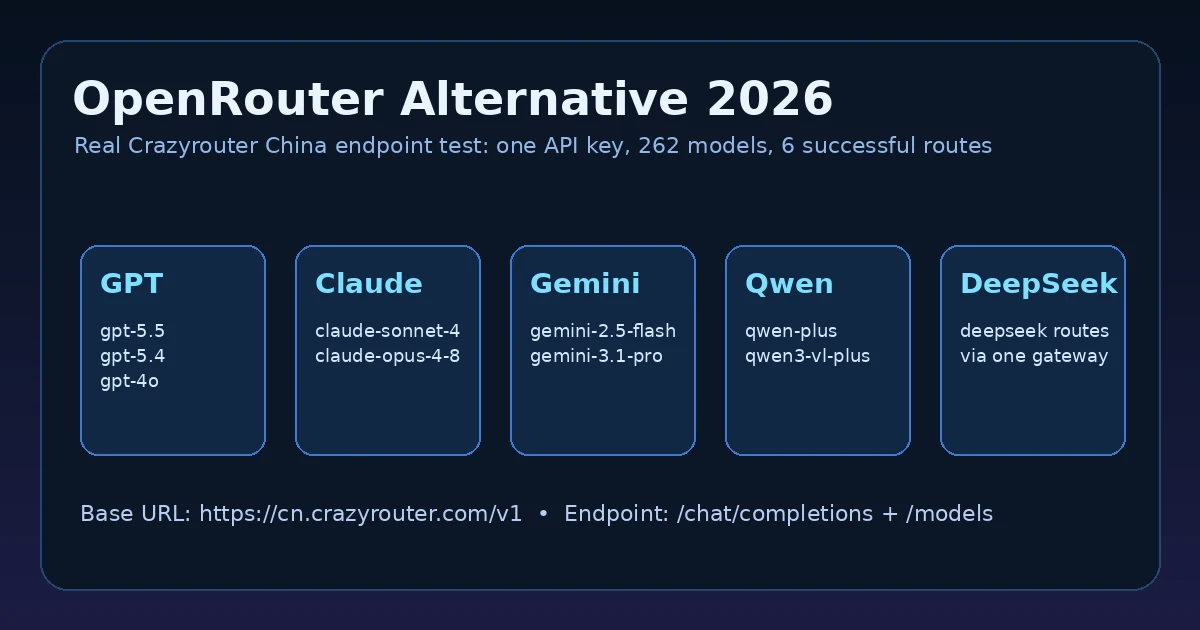
That is why the winning setup is rarely a single direct provider account. It is usually a router, fallback layer, and usage dashboard. Crazyrouter gives developers one OpenAI-compatible endpoint for multiple models, which makes experiments and migrations much easier.
AI API pricing comparison vs alternatives#
The simplest alternative is to use the official API directly. That works well for early experiments, but the trade-offs become obvious in production: separate keys, separate billing dashboards, provider-specific errors, different SDK quirks, and no unified fallback path. Another option is to self-host an open-source gateway. That gives control, but it adds DevOps work, incident response, provider integrations, and security maintenance.
| Option | Best for | Main limitation |
|---|---|---|
| Official provider API | Quick proof of concept | One provider, one billing model, limited fallback |
| Self-hosted gateway | Large infra teams | Requires maintenance and provider integrations |
| Crazyrouter | Startups, agents, SaaS teams | You still need sensible model selection and monitoring |
For most developer teams, the practical answer is hybrid: use a unified API for day-to-day traffic, keep direct provider accounts only for special cases, and design the app so the model name is configuration rather than hard-coded business logic.
How to use AI API pricing comparison with code examples#
Crazyrouter uses an OpenAI-compatible API style, so you can usually keep the same client and change the base URL plus API key.
Python example#
from openai import OpenAI

client = OpenAI(
    api_key="CRAZYROUTER_API_KEY",
    base_url="https://crazyrouter.com/v1"
)

response = client.chat.completions.create(
    model="gpt-5.5",
    messages=[
        {"role": "system", "content": "You are a careful production assistant."},
        {"role": "user", "content": "Explain AI API pricing comparison in three implementation steps."}
    ],
    temperature=0.3,
)

print(response.choices[0].message.content)
Node.js example#
import OpenAI from "openai";

const client = new OpenAI({
  apiKey: process.env.CRAZYROUTER_API_KEY,
  baseURL: "https://crazyrouter.com/v1",
});

const completion = await client.chat.completions.create({
  model: "gpt-5.5",
  messages: [
    { role: "system", content: "Return concise implementation advice." },
    { role: "user", content: "Create a rollout checklist for AI API pricing comparison." }
  ],
});

console.log(completion.choices[0].message.content);
cURL example#
curl https://crazyrouter.com/v1/chat/completions \
  -H "Authorization: Bearer $CRAZYROUTER_API_KEY" \
  -H "Content-Type: application/json" \
  -d '{
    "model": "gpt-5.5",
    "messages": [{"role":"user","content":"Give me a production checklist for AI API pricing comparison."}]
  }'
The most important production habit is to wrap calls with timeouts, retries for transient errors, and cost-aware model selection. Do not retry blindly on every error. Retry network timeouts and 5xx responses with exponential backoff, but fail fast on authentication, quota, or malformed request errors.
Pricing breakdown#
Pricing changes quickly in AI. Instead of memorizing a single number, design around unit economics: input tokens, output tokens, image/video duration, cache hit rate, and fallback frequency.
| Route | Billing experience | Operational cost |
|---|---|---|
| Official direct API | Separate invoices per provider | Medium to high when using many vendors |
| Direct plus custom gateway | Provider cost + engineering time | High unless traffic is large |
| Crazyrouter | Unified balance and one endpoint | Lower integration cost and easier switching |
A useful rule: if you are testing more than two providers, or if your product needs fallback, the hidden engineering cost of direct integrations often exceeds the visible API price difference. Crazyrouter helps by centralizing access and reducing vendor lock-in.
Implementation checklist#
- Put the model name in configuration, not code.
- Log request IDs, latency, model, token usage, and user-facing errors.
- Add per-feature budgets so one feature cannot drain the whole account.
- Create a fallback chain for important paths.
- Test with realistic prompts, not only happy-path demos.
- Review prompt injection, data retention, and secrets handling before launch.
FAQ#
Is AI API pricing comparison only for large teams?#
No. Small teams benefit even more from simple routing because they do not have time to maintain many provider integrations.
Can I keep using the OpenAI SDK?#
Yes. With Crazyrouter, most chat completion workflows can keep the OpenAI SDK and change the base_url to https://crazyrouter.com/v1.
What is the best model for AI API pricing comparison?#
It depends on latency, context length, quality, and price. Start with a strong general model, benchmark against cheaper alternatives, then route routine traffic to the lowest-cost model that passes your quality bar.
Should I use direct provider billing or a router?#
Use direct billing for a one-off experiment. Use a router when you need multiple providers, unified billing, fallback, or faster model switching.
How do I avoid surprise AI API bills?#
Set budgets, cap output tokens, cache repeat requests, monitor usage daily, and separate development keys from production keys.
Summary#
AI API pricing comparison is not just a feature decision; it is an architecture decision. The safest path for developers is to keep the API surface simple, monitor costs from day one, and avoid building a product that depends on one provider staying cheap and reliable forever. If you want one endpoint for GPT, Claude, Gemini, DeepSeek, Qwen, video, image, and more, try Crazyrouter and build with fewer provider-specific headaches.