Crazyrouter
AI API Pricing Comparison July 2026: Effective Cost per User for SaaS Teams
A practical AI API pricing comparison for SaaS teams, covering tokens, caching, routing, retries, and the real cost per active user.

AI API Pricing Comparison July 2026: Effective Cost per User for SaaS Teams#
An AI API pricing comparison that only lists input and output token rates is incomplete. SaaS teams pay for retries, long system prompts, tool calls, embeddings, image or video jobs, and idle capacity around queues. The metric that matters is effective cost per active user: total model spend divided by users who actually complete a valuable workflow.
What Is AI API Pricing Comparison July 2026?#
AI API pricing is usually metered by tokens, seconds, images, or video credits. Text models may have different input, output, cached-input, and batch rates. Multimodal models add image or audio units. Your application converts those rates into a workflow cost through context length, number of turns, and failure behavior.
AI API Pricing Comparison July 2026 vs Alternatives#
Direct provider APIs provide the clearest first-party relationship, but each provider has separate keys, dashboards, and semantics. A gateway can make comparison easier by normalizing the endpoint and routing policy. Open-source gateways add control but require hosting and maintenance. For a small team, a managed router can be cheaper operationally even when the inference price is not the absolute lowest.
| Decision factor | Direct provider | Managed gateway | Self-hosted stack |
|---|---|---|---|
| Integration | Provider-specific | Compatible shared endpoint | Your adapter |
| Model switching | Manual | Configuration or routing | Custom |
| Operations | Lower platform work | Centralized controls | Highest ownership |
| Best for | Single-provider apps | Teams and multi-model apps | Compliance and deep customization |
How to Use It with Code#
Instrument every request with tenant ID, workflow ID, model, input tokens, output tokens, latency, retry count, and result status. Calculate cost per successful workflow, not request. Add caching for stable instructions, truncate irrelevant history, and route low-risk steps to cheaper models. Set a per-user quota before launch so a prompt loop cannot destroy margins.
from decimal import Decimal

def workflow_cost(input_tokens, output_tokens, in_rate, out_rate, retries=0):
    calls = 1 + retries
    return calls * (Decimal(input_tokens) / 1_000_000 * Decimal(str(in_rate)) +
                    Decimal(output_tokens) / 1_000_000 * Decimal(str(out_rate)))

print(workflow_cost(12000, 1800, 1.0, 5.0, retries=1))
Pricing Breakdown#
| Pricing path | What you compare | Operational cost |
|---|---|---|
| Official provider | Published model unit rates | Multiple keys and dashboards |
| Crazyrouter | Current model rate plus routing policy | One endpoint, quotas, fallbacks |
| Self-hosted open model | GPU or hosted inference cost | Infrastructure and maintenance |
| Batch or cached route | Lower-cost eligible requests | Higher latency or cache design |
Rates, quotas, supported model IDs, and media billing can change. Treat the table as an architecture comparison and verify the live official provider page or the current Crazyrouter model catalog before committing to a budget. The practical advantage of a gateway is usually not a magic universal discount; it is the ability to centralize credentials, apply quotas, compare models, and route routine work to a better-cost option.
FAQ#
What is the cheapest AI API?#
There is no universal cheapest API. The answer depends on task quality, context size, retries, and whether the model supports caching or batch pricing.
How do I calculate AI cost per user?#
Add all model, embedding, media, and retry costs for a completed workflow, then divide by successful active users.
Does a gateway always lower API prices?#
Not automatically. A gateway can lower total cost through routing, fallbacks, caching, and fewer integration overheads; verify live rates.
How much should an AI SaaS budget for retries?#
Measure your own failure rate. Start with a separate retry budget and alert when it exceeds the expected percentage of spend.
Should startups use one model?#
Usually not. A small model mix improves cost and resilience when paired with evaluation tests.
Summary#
Choose the access path that matches your workload: a first-party product for interactive use, a direct API for a focused integration, or a managed gateway when your application needs several models, centralized limits, and safer fallback behavior. Start with a small benchmark, instrument every request, and promote only the routes that meet your quality and margin targets.
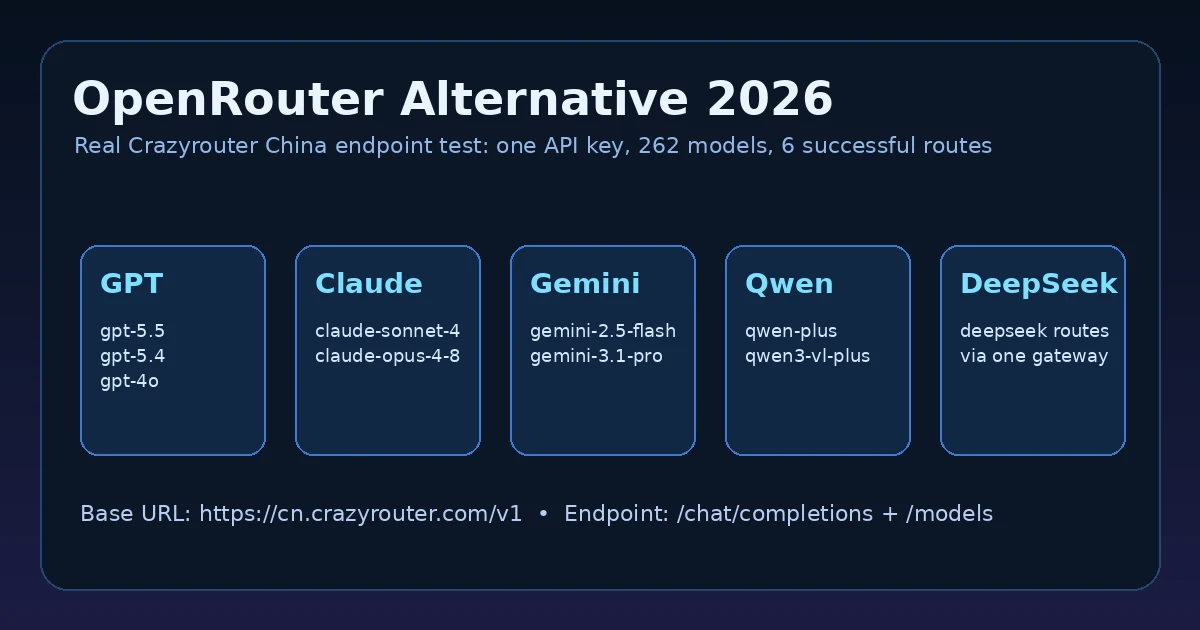
If you want to test multiple models behind one OpenAI-compatible endpoint, try Crazyrouter and verify the current model list and pricing before production rollout.