Crazyrouter
Qwen3 VL 235B vs GPT-5 Vision: Multimodal AI Comparison 2026
In-depth comparison of Qwen3 VL 235B and GPT-5 Vision for image understanding, document analysis, and multimodal tasks. Includes benchmarks, pricing, and code examples.
Qwen3 VL 235B vs GPT-5 Vision: Multimodal AI Comparison 2026#
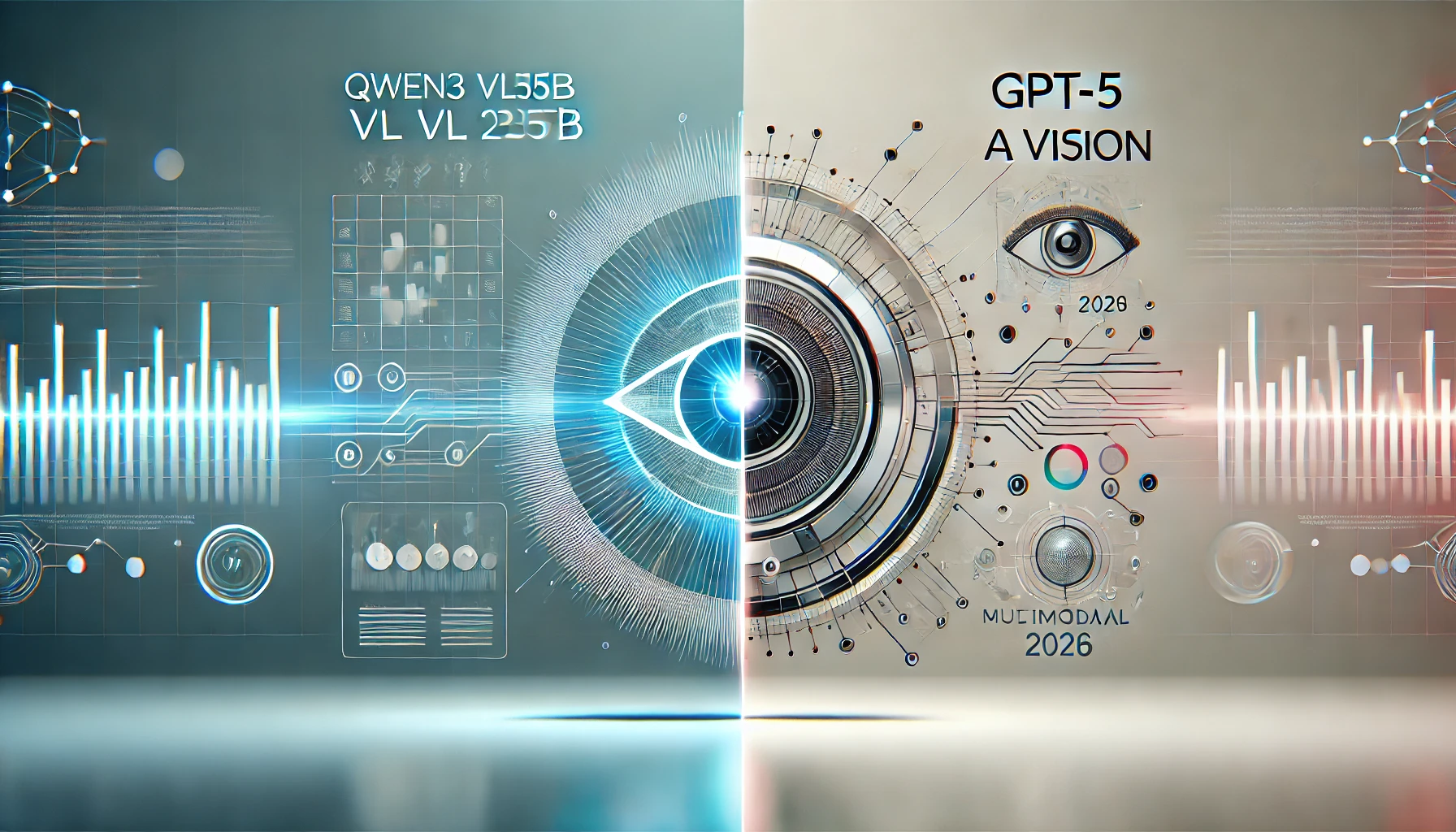
Multimodal AI — models that understand both text and images — is one of the fastest-growing areas in AI. Two standout vision-language models in March 2026 are Qwen3 VL 235B from Alibaba Cloud and GPT-5 Vision from OpenAI. Both handle image understanding, document analysis, and visual reasoning, but they differ significantly in architecture, pricing, and capabilities.
This guide compares them head-to-head to help you choose the right model for your application.
What is Qwen3 VL 235B?#
Qwen3 VL 235B is Alibaba Cloud's latest vision-language model released in early 2026. It's part of the Qwen (通义千问) family and represents a major leap in open-weight multimodal AI.
Key specifications:
- Parameters: 235B total, 22B active (Mixture of Experts)
- Architecture: MoE with 128 experts, 8 active
- Context Window: 128K tokens (text + images)
- Image Resolution: Up to 4K (3840×2160)
- Video Support: Up to 30 seconds at 2 FPS
- Languages: 100+ languages, best-in-class Chinese
- License: Apache 2.0 (open-weight)
What makes it special:
- Open-weight with commercial use license
- Exceptional Chinese language understanding
- Strong document and chart analysis
- Native video understanding
- Can run locally on high-end hardware
What is GPT-5 Vision?#
GPT-5.2 (with Vision) is OpenAI's flagship multimodal model, the latest in the GPT series. It processes text, images, audio, and (to a limited extent) video.
Key specifications:
- Parameters: Undisclosed (estimated 1T+)
- Architecture: Dense transformer (proprietary)
- Context Window: 128K tokens (text + images)
- Image Resolution: Up to 2048×2048
- Video Support: Limited (frame extraction only)
- Languages: 90+ languages, English-dominant
- License: Proprietary (API-only)
What makes it special:
- State-of-the-art general reasoning
- Best instruction following
- Excellent at creative tasks
- Strong spatial understanding
- Audio input support
Head-to-Head Comparison#
Performance Benchmarks#
| Benchmark | Qwen3 VL 235B | GPT-5 Vision | Winner |
|---|---|---|---|
| MMMU (multidisciplinary) | 72.1 | 74.8 | GPT-5 |
| DocVQA (document) | 96.2 | 93.5 | Qwen3 |
| ChartQA (charts) | 89.7 | 86.3 | Qwen3 |
| MathVista (math) | 71.5 | 75.2 | GPT-5 |
| RealWorldQA (real images) | 73.8 | 76.1 | GPT-5 |
| TextVQA (text in images) | 85.3 | 82.1 | Qwen3 |
| OCRBench (OCR) | 882 | 845 | Qwen3 |
| Video-MME (video) | 72.4 | 68.2 | Qwen3 |
| Chinese VQA | 92.1 | 78.5 | Qwen3 |
Score summary:
- Qwen3 VL: Wins 5/9 benchmarks (documents, charts, OCR, video, Chinese)
- GPT-5 Vision: Wins 4/9 benchmarks (general reasoning, math, real-world)
Pricing Comparison#
| Model | Input (per 1M tokens) | Output (per 1M tokens) | Image Cost |
|---|---|---|---|
| GPT-5 Vision (OpenAI) | $15.00 | $60.00 | ~$0.01/image |
| Qwen3 VL 235B (Alibaba) | $2.00 | $6.00 | ~$0.003/image |
| GPT-5 Vision (Crazyrouter) | $10.50 | $42.00 | ~$0.007/image |
| Qwen3 VL 235B (Crazyrouter) | $1.40 | $4.20 | ~$0.002/image |
Qwen3 VL is 7-10x cheaper than GPT-5 Vision for identical tasks.
Feature Comparison#
| Feature | Qwen3 VL 235B | GPT-5 Vision |
|---|---|---|
| Max Image Resolution | 4K (3840×2160) | 2048×2048 |
| Multi-image Input | ✅ (up to 20) | ✅ (up to 10) |
| Video Understanding | ✅ (30s native) | ⚠️ (frames only) |
| Document OCR | ✅✅✅ (best-in-class) | ✅✅ (good) |
| Chinese Support | ✅✅✅ (native) | ✅ (good) |
| Audio Input | ❌ | ✅ |
| Open Weight | ✅ (Apache 2.0) | ❌ (API-only) |
| Self-hosting | ✅ | ❌ |
| Structured Output | ✅ (JSON mode) | ✅ (JSON mode) |
| Function Calling | ✅ | ✅ |
Code Examples#
Example 1: Image Analysis with GPT-5 Vision#
import openai

client = openai.OpenAI(
    api_key="your-crazyrouter-key",
    base_url="https://api.crazyrouter.com/v1"
)

# Analyze an image with GPT-5 Vision
response = client.chat.completions.create(
    model="gpt-5.2",
    messages=[
        {
            "role": "user",
            "content": [
                {
                    "type": "text",
                    "text": "Describe this image in detail. What objects are present?"
                },
                {
                    "type": "image_url",
                    "image_url": {
                        "url": "https://example.com/photo.jpg",
                        "detail": "high"
                    }
                }
            ]
        }
    ],
    max_tokens=1000
)

print(response.choices[0].message.content)
Example 2: Document OCR with Qwen3 VL#
import openai

client = openai.OpenAI(
    api_key="your-crazyrouter-key",
    base_url="https://api.crazyrouter.com/v1"
)

# Extract text from document image with Qwen3 VL
response = client.chat.completions.create(
    model="qwen3-vl-235b-a22b-instruct",
    messages=[
        {
            "role": "user",
            "content": [
                {
                    "type": "text",
                    "text": "Extract all text from this document. Preserve formatting and structure."
                },
                {
                    "type": "image_url",
                    "image_url": {
                        "url": "https://example.com/document.png",
                        "detail": "high"
                    }
                }
            ]
        }
    ],
    max_tokens=4000
)

print(response.choices[0].message.content)
Example 3: Multi-Image Comparison#
# Compare two images using Qwen3 VL
response = client.chat.completions.create(
    model="qwen3-vl-235b-a22b-instruct",
    messages=[
        {
            "role": "user",
            "content": [
                {"type": "text", "text": "Compare these two product images. What are the differences?"},
                {"type": "image_url", "image_url": {"url": "https://example.com/product-v1.jpg"}},
                {"type": "image_url", "image_url": {"url": "https://example.com/product-v2.jpg"}}
            ]
        }
    ],
    max_tokens=1000
)

print(response.choices[0].message.content)
Example 4: Chart Analysis#
# Extract data from chart with Qwen3 VL
response = client.chat.completions.create(
    model="qwen3-vl-235b-a22b-instruct",
    messages=[
        {
            "role": "user",
            "content": [
                {
                    "type": "text",
                    "text": "Extract the data from this chart into a JSON table. Include all values, labels, and trends."
                },
                {
                    "type": "image_url",
                    "image_url": {"url": "https://example.com/quarterly-revenue-chart.png"}
                }
            ]
        }
    ],
    max_tokens=2000,
    response_format={"type": "json_object"}
)

import json
data = json.loads(response.choices[0].message.content)
print(json.dumps(data, indent=2))
Example 5: Video Analysis with Qwen3 VL#
import base64

# Read video frames
def extract_frames(video_path, fps=2):
    """Extract frames from video at specified FPS"""
    import cv2
    frames = []
    cap = cv2.VideoCapture(video_path)
    frame_rate = cap.get(cv2.CAP_PROP_FPS)
    interval = int(frame_rate / fps)
    count = 0

    while cap.isOpened():
        ret, frame = cap.read()
        if not ret:
            break
        if count % interval == 0:
            _, buffer = cv2.imencode('.jpg', frame)
            frames.append(base64.b64encode(buffer).decode('utf-8'))
        count += 1

    cap.release()
    return frames

# Analyze video
frames = extract_frames("demo.mp4", fps=2)
content = [{"type": "text", "text": "Describe what happens in this video sequence."}]
for frame in frames[:15]:  # Max 15 frames
    content.append({
        "type": "image_url",
        "image_url": {"url": f"data:image/jpeg;base64,{frame}"}
    })

response = client.chat.completions.create(
    model="qwen3-vl-235b-a22b-instruct",
    messages=[{"role": "user", "content": content}],
    max_tokens=2000
)

print(response.choices[0].message.content)
Real-World Cost Comparison#
Scenario 1: E-commerce Product Analysis#
Task: Analyze 10,000 product images per month (descriptions, categories, quality)
| Model | Cost per Image | Monthly Cost | Quality |
|---|---|---|---|
| GPT-5 Vision (OpenAI) | $0.025 | $250 | ⭐⭐⭐⭐⭐ |
| GPT-5 Vision (Crazyrouter) | $0.018 | $175 | ⭐⭐⭐⭐⭐ |
| Qwen3 VL (Alibaba) | $0.005 | $50 | ⭐⭐⭐⭐ |
| Qwen3 VL (Crazyrouter) | $0.004 | $35 | ⭐⭐⭐⭐ |
Winner: Qwen3 VL via Crazyrouter — 86% cheaper with comparable quality.
Scenario 2: Document Processing Pipeline#
Task: Process 5,000 documents (invoices, receipts, contracts) per month
| Model | Cost per Doc | Monthly Cost | OCR Accuracy |
|---|---|---|---|
| GPT-5 Vision (OpenAI) | $0.08 | $400 | 93% |
| GPT-5 Vision (Crazyrouter) | $0.056 | $280 | 93% |
| Qwen3 VL (Alibaba) | $0.012 | $60 | 96% |
| Qwen3 VL (Crazyrouter) | $0.008 | $42 | 96% |
Winner: Qwen3 VL via Crazyrouter — both cheaper AND more accurate for OCR.
Scenario 3: General Visual Q&A Application#
Task: 50,000 visual Q&A requests per month
| Model | Cost per Request | Monthly Cost | Quality |
|---|---|---|---|
| GPT-5 Vision (OpenAI) | $0.015 | $750 | ⭐⭐⭐⭐⭐ |
| GPT-5 Vision (Crazyrouter) | $0.011 | $525 | ⭐⭐⭐⭐⭐ |
| Qwen3 VL (Alibaba) | $0.003 | $150 | ⭐⭐⭐⭐ |
| Qwen3 VL (Crazyrouter) | $0.002 | $105 | ⭐⭐⭐⭐ |
Winner: Depends on quality requirements. Qwen3 for cost-sensitive, GPT-5 for premium.
When to Use Each Model#
Use Qwen3 VL 235B When:#
✅ Budget matters — 7-10x cheaper than GPT-5 Vision ✅ Document OCR — Best-in-class accuracy (96.2 DocVQA) ✅ Chinese content — Native understanding, 92.1 on Chinese VQA ✅ Chart/graph analysis — Outperforms GPT-5 on ChartQA ✅ Video understanding — Native video support (30s) ✅ High-resolution images — 4K support vs 2048×2048 ✅ Self-hosting needed — Open-weight (Apache 2.0) ✅ High volume — Cost-effective at scale
Use GPT-5 Vision When:#
✅ General reasoning — Better MMMU score (74.8 vs 72.1) ✅ Math problems — Stronger MathVista performance ✅ Creative tasks — Better at generating creative descriptions ✅ Audio + vision — Only option for multimodal with audio ✅ English-dominant — Slightly better English quality ✅ Complex spatial reasoning — Better RealWorldQA score ✅ Premium quality required — Marginally better on general tasks
How to Access Both via Crazyrouter#
Crazyrouter provides unified access to both models with 30% savings:
import openai

# Single API key for both models
client = openai.OpenAI(
    api_key="your-crazyrouter-key",
    base_url="https://api.crazyrouter.com/v1"
)

# Use GPT-5 Vision for general tasks
gpt_response = client.chat.completions.create(
    model="gpt-5.2",
    messages=[{
        "role": "user",
        "content": [
            {"type": "text", "text": "What's in this image?"},
            {"type": "image_url", "image_url": {"url": "https://example.com/photo.jpg"}}
        ]
    }]
)

# Use Qwen3 VL for document OCR (cheaper, better at OCR)
qwen_response = client.chat.completions.create(
    model="qwen3-vl-235b-a22b-instruct",
    messages=[{
        "role": "user",
        "content": [
            {"type": "text", "text": "Extract all text from this document"},
            {"type": "image_url", "image_url": {"url": "https://example.com/document.png"}}
        ]
    }]
)
No code changes needed — just switch the model parameter.
Other Vision Models to Consider#
| Model | Input ($/1M) | Output ($/1M) | Strengths |
|---|---|---|---|
| Gemini 2.5 Pro | $1.25 | $5.00 | 1M context, affordable |
| Claude Sonnet 4.5 | $3.00 | $15.00 | Balanced cost/quality |
| Gemini 2.5 Flash | $0.10 | $0.40 | Cheapest option |
| Qwen 2.5 VL 72B | $0.80 | $2.40 | Lighter Qwen option |
All available via Crazyrouter with a single API key.
Frequently Asked Questions#
Which model is better for OCR?#
Qwen3 VL 235B is better for OCR tasks, scoring 882 on OCRBench vs 845 for GPT-5 Vision. It's also 7x cheaper, making it the clear winner for document processing.
Can I run Qwen3 VL locally?#
Yes, Qwen3 VL 235B can be self-hosted. It requires approximately 50GB VRAM (in FP8/INT4 quantization) across multiple GPUs. For easier deployment, use Crazyrouter's API.
Is GPT-5 Vision worth the extra cost?#
For general-purpose visual understanding and creative tasks, yes. For specialized tasks like OCR, charts, or Chinese content, Qwen3 VL delivers equal or better quality at 1/10 the price.
Can I use both models in the same application?#
Yes! With Crazyrouter, route different tasks to different models:
- OCR/documents → Qwen3 VL (cheaper, better)
- Creative/reasoning → GPT-5 Vision (premium quality)
What about Gemini for vision tasks?#
Gemini 2.5 Pro offers good vision capabilities at $1.25/1M input tokens with a massive 1M context window. It's a solid middle-ground option for price-sensitive applications.
How do I handle rate limits?#
Crazyrouter provides higher rate limits through load balancing. For direct access, limits are:
- GPT-5 Vision: 500 RPM (Tier 1)
- Qwen3 VL: 100 RPM (standard)
Conclusion#
For most vision tasks, Qwen3 VL 235B offers better value. It's 7-10x cheaper, leads on document/chart analysis, and has open weights for self-hosting. GPT-5 Vision retains its edge in general reasoning and creative tasks but at a significant price premium.
Best strategy: Use both models through Crazyrouter, routing each task to the most cost-effective option. Documents and charts go to Qwen3 VL; complex reasoning goes to GPT-5 Vision.
Monthly savings (10K vision requests):
- GPT-5 Vision direct: $250
- Qwen3 VL via Crazyrouter: $35
- Savings: $215/month (86%)
Get started with multimodal AI at crazyrouter.com — one API key for all vision models.