 简体中文
简体中文 繁體中文
繁體中文 English
 Français
 Русский
 日本語
日本語 Tiếng Việt
 한국어
한국어 Deutsch
 Español
 Italiano
 Português
 العربية
 ไทย
ไทย Bahasa Indonesia
 Bahasa Melayu
 Türkçe
 Polski
 Nederlands
 Dansk
Dansk Norsk
Norsk Қазақша
7 Best OpenRouter Alternatives in 2026: Per-Model Prices, EU Endpoints and Fallback Compared
Seven OpenRouter alternatives compared on price per model (list vs OpenRouter vs Crazyrouter for 14 models), model coverage, EU / Hong Kong / China access, latency, fallback and payment: Crazyrouter, LiteLLM, Portkey, Vercel AI Gateway, Cloudflare AI Gateway, Helicone, and the cloud providers.

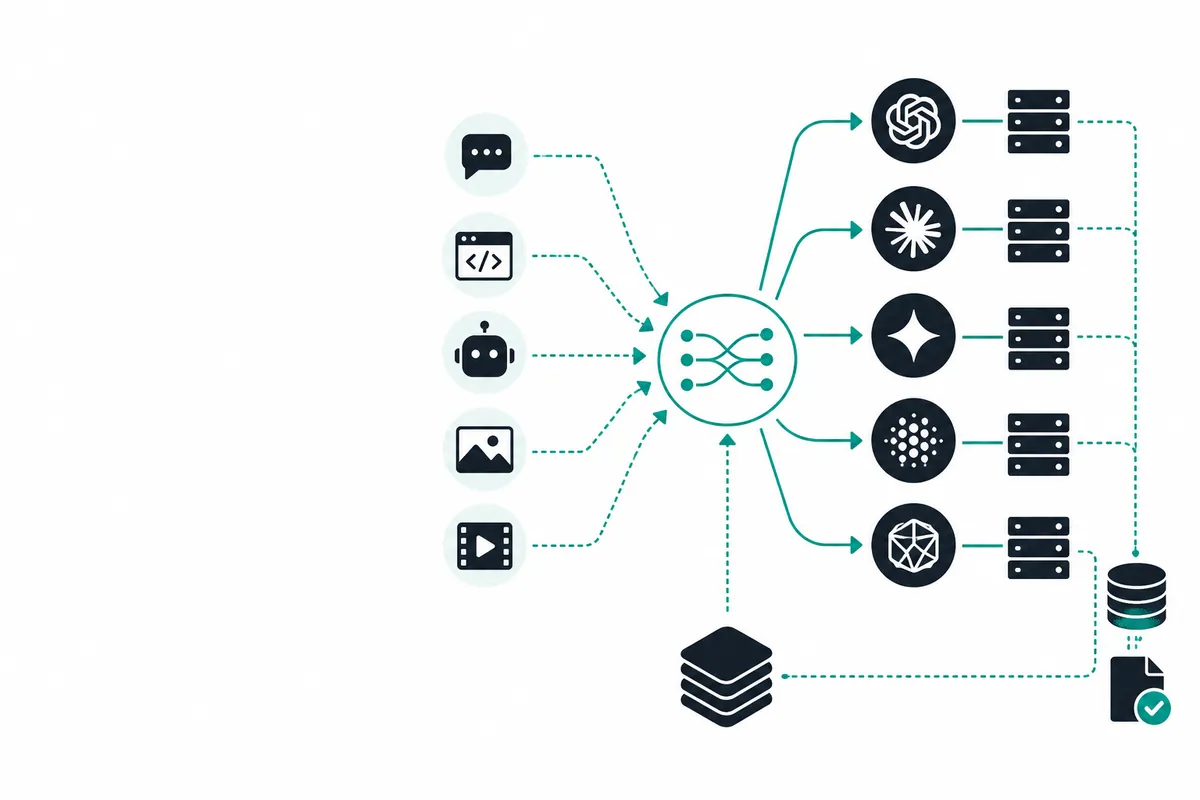
Short answer: The best OpenRouter alternative depends on why you are leaving. If you want one paid endpoint with the widest model coverage including image and video, and payment methods beyond a US card, use Crazyrouter. If you want to keep your own provider keys and self-host, use LiteLLM. If you need enterprise observability and guardrails, look at Portkey or Helicone. If you are already on Vercel or Cloudflare, their gateways are the lowest-friction option. And if procurement matters more than flexibility, go direct to AWS Bedrock, Azure AI Foundry, or Google Vertex AI. The comparison table below puts all seven side by side; the rest of the article explains when each one wins and how to migrate without breaking an agent loop.
Last updated: September 30, 2026. Feature claims are based on each vendor's public documentation on that date; the Crazyrouter numbers come from a live test described below.
Why teams look for an OpenRouter alternative#
OpenRouter is a good product and the default reference point for model routing. The reasons teams still move are consistent:
- Payment and region. OpenRouter takes cards and crypto; teams in China, Southeast Asia, and parts of Europe want Alipay, WeChat Pay, local cards, or invoicing.
- Modality. OpenRouter is a text (and vision-input) router. Products that also generate images, video, or music need a second vendor.
- Markup transparency. A gateway's fee on top of provider list price is not always obvious until the invoice arrives.
- Control. Some teams want to bring their own provider keys, self-host the gateway, and keep logs in their own infrastructure.
- Fallback behaviour. How a router behaves when a route returns HTTP 200 with empty content, or a 429 mid-stream, matters more than the length of its model list.
Comparison table#
| Alternative | Best for | Model coverage | Modalities | Billing | Self-host | Payment |
|---|---|---|---|---|---|---|
| 1. Crazyrouter | One paid endpoint for everything, non-US payment | 300+ across OpenAI, Anthropic, Google, DeepSeek, Qwen, xAI, and more | Text, vision, image, video, music, embeddings | Prepaid, per token / per image, no subscription | No | Card, Alipay, WeChat Pay |
| 2. LiteLLM | Bring-your-own-keys, full control | 100+ providers via adapters | Text, vision, image, embeddings, audio | You pay providers directly | Yes (open source) | Your provider accounts |
| 3. Portkey | Enterprise gateway with guardrails | 250+ models, BYOK or Portkey-billed | Text, vision, image, embeddings | Free tier, then per-request platform fee | Yes (open-source gateway) | Card |
| 4. Vercel AI Gateway | Vercel AI SDK users | Major providers | Text, vision, image | Provider list price, billed on your Vercel invoice | No | Card via Vercel |
| 5. Cloudflare AI Gateway | Caching, rate limiting, analytics in front of your own keys | Any provider you hold keys for, plus Workers AI | Text, vision, image, embeddings | Free tier; you pay providers | No (managed) | Your provider accounts |
| 6. Helicone AI Gateway | Observability-first teams | 100+ providers | Text, vision, embeddings | Open-source gateway + hosted logging tiers | Yes | Your provider accounts |
| 7. Bedrock / Azure AI Foundry / Vertex AI | Procurement, compliance, existing cloud commit | Each cloud's partner catalog | Text, vision, image, embeddings, some video | Cloud invoice at list price | N/A | Existing cloud billing |
Per-model price check: OpenRouter vs Crazyrouter vs list price#
Most "alternatives" lists never show a number. Here are the per-1M-token prices (input / output, USD) for the models people actually route, taken from each vendor's public price list and from OpenRouter's model pages, next to the live Crazyrouter price. Each model links to a page with Azure, Bedrock and Vertex prices and a monthly cost calculator; the whole table is re-verified daily.
| Model | List price (vendor) | OpenRouter | Crazyrouter |
|---|---|---|---|
| Claude Opus 5 | 25.00 | 25.00 | 16.25 |
| Claude Sonnet 5 | 10.00 | 10.00 | 6.50 |
| Claude Fable 5 | 50.00 | 50.00 | 32.50 |
| GPT-6 Astra | 50.00 | 50.00 | 16.25 |
| GPT-5.5 | 30.00 | 30.00 | 19.50 |
| GPT-5 | 10.00 | 10.00 | 6.50 |
| GPT-4.1 | 8.00 | 8.00 | 5.20 |
| Gemini 3.1 Pro | 12.00 | 12.00 | 6.60 |
| Gemini 2.5 Flash | 2.50 | 2.50 | 1.38 |
| DeepSeek V4 Pro | 3.96 | 1.90 | 2.00 |
| Kimi K3 | 15.00 | 15.00 | 15.00 |
| Qwen3.8 Max | 6.00 | 6.00 | 6.00 |
| Grok 4.6 | 6.00 | 6.00 | 5.10 |
| GLM-5 | 3.20 | 1.92 | 3.20 |
Three things the table shows. OpenRouter passes the vendor list price straight through and earns on the fee it adds when you buy credits, so on frontier models it is never cheaper than the vendor. Open-weight models (DeepSeek, GLM) are where OpenRouter's provider marketplace beats list price. Crazyrouter prices the same closed models below list, which is where most of a typical bill sits; see the full model price table for all 35 tracked models.
OpenRouter alternatives by region: EU, UK, Hong Kong and Asia#
Search data shows a lot of people looking for an "OpenRouter alternative in Germany / Spain / Poland / Austria" and so on. What they usually need is one of two things:
- An EU entry point or data residency. OpenRouter is US-hosted with no regional endpoint. If you need traffic to enter in Europe, the options are a self-hosted gateway in your own region (LiteLLM or Portkey's open-source gateway on an EU VM), Cloudflare AI Gateway on the edge, or a hosted gateway with an EU endpoint — Crazyrouter exposes
eu.crazyrouter.comas an EU entry point alongside the globalapi.crazyrouter.com. Note that the model vendor still processes the prompt wherever it runs the model; only Azure, Bedrock and Vertex let you pin the model itself to an EU region, at list price. - Local payment. Card-only billing is the other reason to leave OpenRouter. Crazyrouter takes Alipay and WeChat Pay in addition to cards; the cloud gateways bill through your existing AWS / Azure / GCP account.
For Hong Kong the situation is different: neither the OpenAI nor the Anthropic API is offered there, so a gateway is not an optimisation but the way to get access at all. For mainland China the same applies plus network reachability; Crazyrouter publishes a China entry point for that case.
1. Crazyrouter — widest coverage behind one key, pays like a local service#
Crazyrouter is a hosted gateway that resells 300+ models through an OpenAI-compatible endpoint and an Anthropic Messages-compatible endpoint, so both the OpenAI SDK and Claude Code work with a base-URL change. Coverage goes beyond chat: GPT Image 2, Nano Banana 2, Seedream 5.0, Seedance 2.0 video, Kling, and Suno sit next to GPT-6, Claude Opus 5.5, Gemini 3.1 Pro, and DeepSeek V4. Per-token prices are published per model (for example GPT-6 Astra and Claude Sonnet 5) and payment is prepaid with card, Alipay, or WeChat Pay.
Live test, September 29, 2026. Streaming POST /v1/chat/completions, 64 max tokens, three runs each, median values:
| Model | Success | Time to first token | Total |
|---|---|---|---|
| gpt-5.4 | 3/3 | 1.3 s | 2.1 s |
| claude-sonnet-5 | 3/3 | 2.0 s | 2.8 s |
| gemini-3-flash | 3/3 | 2.3 s | 2.8 s |
| deepseek-v4-pro | 3/3 | 2.7 s | 5.3 s |
| claude-opus-5 | 3/3 | 3.0 s | 4.8 s |
| gpt-6-astra | 3/3 | 12.4 s | 14.5 s |
The GPT-6 Astra number is a reminder that frontier reasoning models spend seconds thinking before the first visible token; that is the model, not the gateway, and it is why agent code should set generous first-token timeouts.
Choose it when: you want to stop stitching together a text router, an image vendor, and a video vendor; you cannot pay OpenRouter or the providers directly; or you want Claude Code, Codex, Cursor, and Cline all pointed at one key. Setup for each tool is in the integrations guides.
Skip it when: you must keep provider relationships and keys in your own name, or you need on-premises deployment.
from openai import OpenAI

client = OpenAI(api_key="YOUR_CRAZYROUTER_API_KEY", base_url="https://api.crazyrouter.com/v1")

resp = client.chat.completions.create(
    model="claude-sonnet-5",
    messages=[{"role": "user", "content": "Return exactly: gateway test OK"}],
    max_tokens=30,
)
choice = resp.choices[0]
if not choice.message.content or choice.finish_reason not in ("stop", "tool_calls"):
    raise RuntimeError(f"unusable output: {choice.finish_reason}")
print(choice.message.content, resp.usage)
2. LiteLLM — the self-hosted default#
LiteLLM is an open-source Python proxy that normalises 100+ providers to the OpenAI format. You run it, you supply provider keys, and it gives you virtual keys, per-team budgets, spend logs, load balancing, and fallbacks. There is no markup because there is no middleman; the cost is operating it (a database, Redis for rate limits, upgrades, and keeping up with provider API changes).
Choose it when: you already have provider accounts, you need data to stay inside your VPC, or you want to pin exact provider behaviour. Skip it when: you do not want to run infrastructure, or you need models you cannot get an account for.
3. Portkey — gateway plus guardrails and observability#
Portkey combines an open-source gateway with a hosted control plane: request logging, prompt management, guardrails, caching, retries, and conditional routing across 250+ models. You can bring your own keys or use Portkey's billing. It is aimed at platform teams who need governance more than raw price.
Choose it when: compliance asks for audit trails, PII filters, or prompt versioning. Skip it when: you are a small team and the platform fee outweighs the tooling.
4. Vercel AI Gateway — if your app is already on Vercel#
Vercel's gateway is built into the AI SDK: one string change selects provider and model, usage appears on your Vercel bill at provider list price, and you get failover and observability in the dashboard. It is the least-effort option for Next.js teams.
Choose it when: you deploy on Vercel and use the AI SDK. Skip it when: you need image or video generation beyond what the SDK exposes, or you are not on Vercel.
5. Cloudflare AI Gateway — a free proxy in front of your own keys#
Cloudflare's gateway sits between your app and any provider you hold keys for, adding caching, rate limiting, retries, logging, and analytics, with a generous free tier. It also fronts Workers AI's open-model catalog.
Choose it when: you already use Cloudflare and want caching and analytics without changing vendors. Skip it when: you want a single bill for model usage; it does not resell models.
6. Helicone AI Gateway — observability first#
Helicone started as an LLM observability layer and now ships an open-source, Rust-based gateway with routing and fallbacks. Its strength is the logging and cost dashboards; the gateway itself is lightweight.
Choose it when: you already log through Helicone or you want a small self-hosted router. Skip it when: you need hosted model billing.
7. AWS Bedrock, Azure AI Foundry, Google Vertex AI — go direct to the cloud#
Each hyperscaler offers a catalog of first- and third-party models under your existing cloud agreement: Claude on Bedrock and Vertex, GPT on Azure, Gemini on Vertex, plus open models everywhere. You get IAM, VPC endpoints, data-residency options, and one invoice.
Choose it when: security review, committed spend, or data residency decide the question. Skip it when: you need models outside that cloud's catalog, or you want to move between clouds freely — each has its own SDK shapes and model IDs.
How to migrate off OpenRouter without breaking production#
- List what you actually call. Export a week of OpenRouter logs and group by model ID. Most teams use fewer than ten.
- Map model IDs. Names differ (
anthropic/claude-sonnet-5on OpenRouter vsclaude-sonnet-5on most gateways). Put the mapping in config, not code. - Run the same prompts through the candidate and check content,
finish_reason,usage, and latency — not just HTTP status. Reasoning models can return 200 with empty content whenmax_tokensis too small. - Shadow 5% of traffic, then canary 20%. Keep rollback on error rate, p95 latency, and empty-output rate.
- Keep OpenRouter as a fallback route for a month. Most gateways, including Crazyrouter and LiteLLM, let you define a secondary endpoint per model.
Frequently asked questions#
What is the best OpenRouter alternative? For most teams that want a hosted, paid endpoint: Crazyrouter for coverage and payment flexibility. For teams that want to self-host with their own keys: LiteLLM. For enterprise governance: Portkey.
Is there an OpenRouter alternative with an EU endpoint?
Not from OpenRouter itself. Self-host LiteLLM or Portkey in an EU region, use Cloudflare AI Gateway at the edge, or use a hosted gateway that publishes an EU entry point (Crazyrouter: eu.crazyrouter.com). For true model-side residency use Azure, Bedrock or Vertex in an EU region.
Is there a free OpenRouter alternative? LiteLLM, Helicone's gateway, and Portkey's gateway are open source; Cloudflare AI Gateway has a free tier. In all four you still pay the model providers directly.
Which alternatives support image and video generation? Crazyrouter exposes image (GPT Image 2, Nano Banana 2, Seedream 5.0), video (Seedance 2.0, Kling), and music (Suno) models behind the same key. Most other gateways are text-first.
Can I use Claude Code or Codex with these? Yes, with any gateway that offers an Anthropic-compatible or OpenAI-compatible endpoint and lets you set a base URL. Crazyrouter documents both in its integrations guides.
Do gateways add latency? Typically tens of milliseconds. In the test above, time to first token on Crazyrouter was 1.3–3 s for non-reasoning models, which is dominated by the upstream model, not the proxy hop.
Is OpenRouter still the right choice for some teams? Yes — if you rely on its community rankings, free model variants, BYOK discounts, or end-user OAuth billing, and you can pay by card or crypto.
Summary#
There is no single best OpenRouter alternative, but there is a best one for each reason to switch: Crazyrouter for coverage and payment, LiteLLM for control, Portkey or Helicone for governance and observability, Vercel and Cloudflare for platform convenience, the hyperscalers for procurement. Whichever you pick, migrate with a shadow-then-canary plan and validate output content, not HTTP status.
→ Start a Crazyrouter pilot · Compare model prices · OpenRouter vs Crazyrouter in detail