 简体中文
简体中文 繁體中文
繁體中文 English
 Français
 Русский
 日本語
日本語 Tiếng Việt
 한국어
한국어 Deutsch
 Español
 Italiano
 Português
 العربية
 ไทย
ไทย Bahasa Indonesia
 Bahasa Melayu
 Türkçe
 Polski
 Nederlands
 Dansk
Dansk Norsk
Norsk Қазақша
Build a World Cup Odds Movement Monitor with Claude Code and claude-fable-5
A second Claude Code project in the World Cup analytics series: build an odds movement monitor, compute implied probability shifts, and use claude-fable-5 through Crazyrouter to generate validated JSON analysis without betting advice.
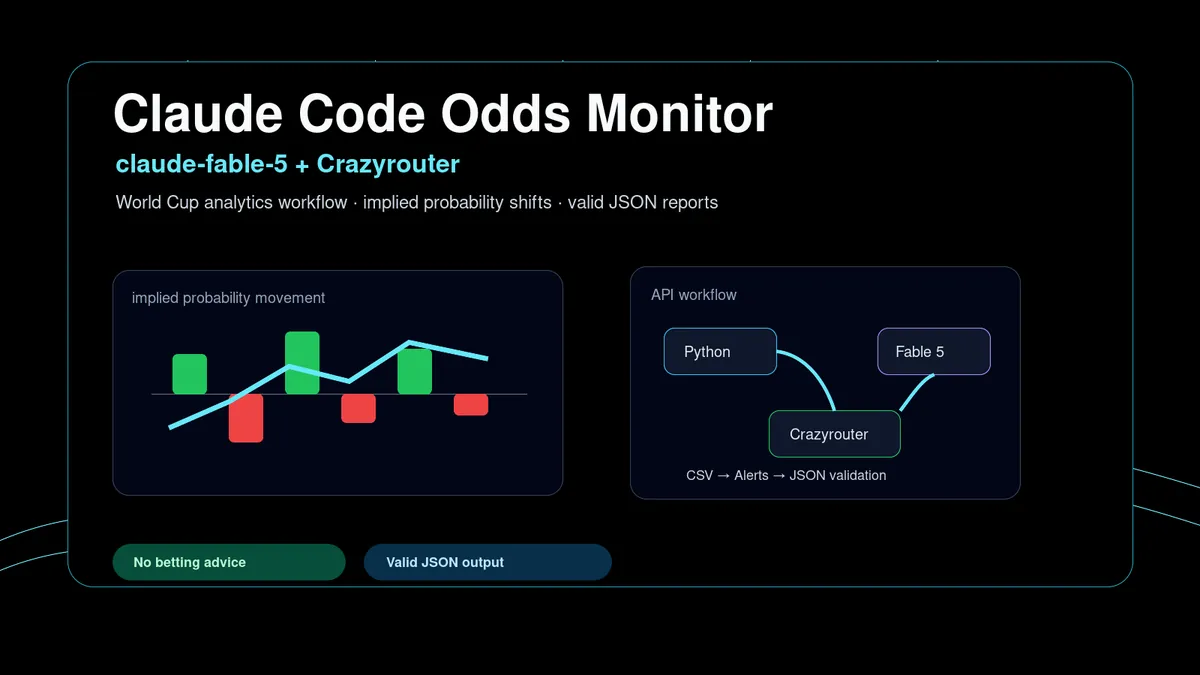
Build a World Cup Odds Movement Monitor with Claude Code and claude-fable-5#
In the first article of this Claude Code project series, I built a small World Cup 2026 match predictor: Python calculated transparent Elo/Poisson probabilities, and Crazyrouter routed multiple LLMs to generate structured match previews.
The second project follows the same principle, but focuses on a different sports analytics workflow:
Can Claude Code build an odds movement monitor, then use
claude-fable-5to summarize market shifts as validated JSON?
This is still an engineering demo. It is not betting advice, and it does not recommend any wager. The purpose is to show how an AI coding agent can build a reproducible monitoring pipeline around numeric signals, alerts, LLM analysis, and validation.
The API layer was tested through Crazyrouter:
Base URL: https://cn.crazyrouter.com/v1
Model tested: claude-fable-5
Task: summarize odds movement alerts as valid JSON
Why odds movement is a good Claude Code project#
Odds movement sounds like a betting topic, but from an engineering perspective it is really a time-series monitoring problem.
You have:
- incoming numeric data;
- opening and latest values;
- derived metrics;
- thresholds;
- anomaly alerts;
- human-readable summaries;
- strict disclaimers and compliance boundaries.
That makes it a useful project for testing an AI coding agent.
The agent should not say “bet on this team.” Instead, it should build a monitoring system that answers safer engineering questions:
- Did the implied probability change significantly?
- Which market moved the most?
- Is the movement mirrored by the opposite market?
- Should we check data quality or news context?
- Can an LLM summarize the alerts without giving betting advice?
That is a much better use of Claude Code than asking a model to guess match outcomes.
Project architecture#
The demo pipeline is intentionally small and reproducible:
sample odds CSV
  ↓
Python parser
  ↓
decimal odds → implied probability
  ↓
movement calculation
  ↓
alert threshold
  ↓
claude-fable-5 analysis through Crazyrouter
  ↓
JSON validation
  ↓
article/chart assets
The generated project lives here:
generated/claude_code_odds_monitor_fable_20260613/
├── build_odds_monitor.py
├── sample_odds_movements.csv
├── odds_monitor_output.json
├── odds_movement_chart.svg
├── crazyrouter_raw_claude-fable-5.json
├── claude_fable_5_test_result.json
└── claude_fable_5_final_test_result.json
The key idea is simple:
Python detects the movement.
claude-fable-5 explains the alert.
JSON validation decides whether the explanation is usable.
Sample odds data#
For a reproducible demo, I used synthetic sample data instead of relying on a paid sportsbook feed.
The CSV contains four early World Cup match examples:
match,market,opening_decimal,latest_decimal,timestamp
USA vs Paraguay,USA win,2.20,2.08,2026-06-12T08:00:00Z
USA vs Paraguay,Draw,3.55,3.65,2026-06-12T08:00:00Z
USA vs Paraguay,Paraguay win,3.10,3.25,2026-06-12T08:00:00Z
Brazil vs Morocco,Brazil win,1.78,1.72,2026-06-13T08:00:00Z
Qatar vs Canada,Canada win,2.08,1.92,2026-06-13T08:00:00Z
Germany vs Curaçao,Germany win,1.20,1.16,2026-06-14T08:00:00Z
A production version would replace this with a real odds API, multiple bookmakers, timestamped snapshots, and data-quality checks.
Converting odds into implied probability#
Decimal odds can be converted into implied probability with a very small function:
def implied_prob(decimal_odds):
    return 1.0 / decimal_odds
Then we compare opening and latest implied probability:
open_p = implied_prob(opening)
latest_p = implied_prob(latest)
delta_pp = (latest_p - open_p) * 100
If the absolute movement exceeds a threshold, the script creates an alert:
if abs(delta_pp) >= 2.5:
    alerts.append({
        "match": match,
        "market": market,
        "direction": movement_direction,
        "delta_pp": round(delta_pp, 2),
        "note": "Large implied-probability movement; review news, lineup, liquidity, and data quality."
    })
This makes the system transparent. The alert is not based on vibes or a black-box LLM. It is based on a deterministic calculation.
Example alert output#
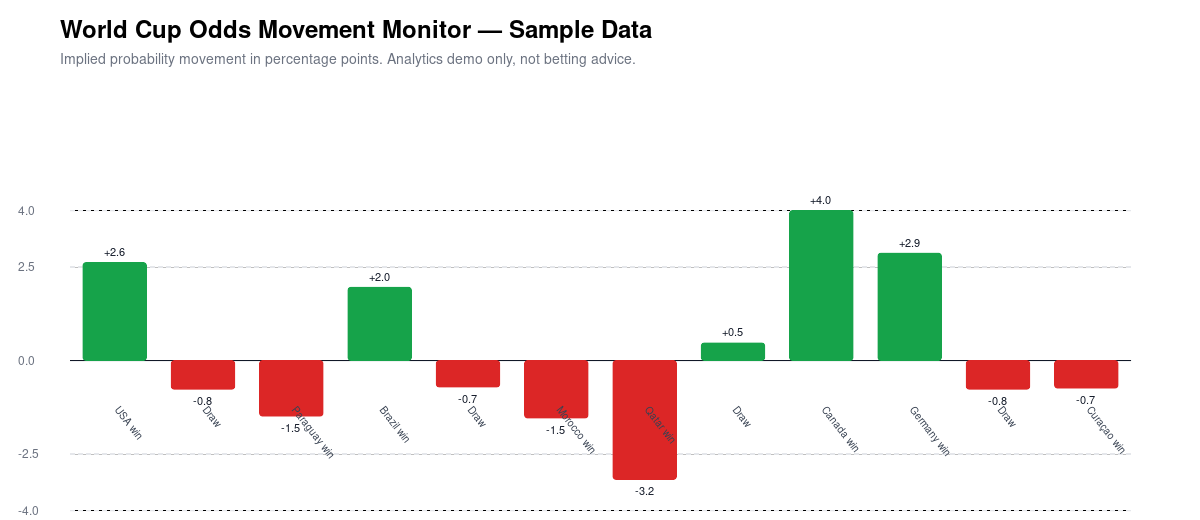
The script generated four significant movement alerts:
[
  {
    "match": "USA vs Paraguay",
    "market": "USA win",
    "direction": "shortened",
    "delta_pp": 2.62
  },
  {
    "match": "Qatar vs Canada",
    "market": "Qatar win",
    "direction": "drifted",
    "delta_pp": -3.18
  },
  {
    "match": "Qatar vs Canada",
    "market": "Canada win",
    "direction": "shortened",
    "delta_pp": 4.01
  },
  {
    "match": "Germany vs Curaçao",
    "market": "Germany win",
    "direction": "shortened",
    "delta_pp": 2.87
  }
]
The biggest movement was Canada win in Qatar vs Canada, where implied probability increased by 4.01 percentage points.
Again: this is not a betting signal. It is a monitoring signal that says, “Something changed enough that a system should record it and maybe ask for more context.”
Calling claude-fable-5 through Crazyrouter#
The next step was to ask claude-fable-5 to summarize the alerts as structured JSON.
The API configuration follows the OpenAI-compatible format:
from openai import OpenAI

client = OpenAI(
    api_key="YOUR_CRAZYROUTER_API_KEY",
    base_url="https://cn.crazyrouter.com/v1",
)
The request used:
{
  "model": "claude-fable-5",
  "messages": [
    {
      "role": "user",
      "content": "Return raw JSON only. Analyze these odds movement alerts for an engineering demo..."
    }
  ],
  "max_tokens": 1200
}
The instruction explicitly said:
No betting advice.
Output raw JSON only.
claude-fable-5 test result#
The final successful test result:
| Model | HTTP | Latency | Prompt tokens | Completion tokens | Total tokens | Valid JSON |
|---|---|---|---|---|---|---|
claude-fable-5 | 200 | 12.14s | 833 | 599 | 1432 | True |
The model returned valid JSON without needing post-cleanup:
{
  "summary": "4 significant odds movements detected across 3 matches. The Qatar vs Canada match shows the largest activity, with Canada win shortening by 4.01pp while Qatar win drifted by -3.18pp, indicating a consistent directional shift within the same market pair. USA win and Germany win both shortened moderately (2.62pp and 2.87pp respectively).",
  "alerts_count": 4,
  "top_movement": {
    "match": "Qatar vs Canada",
    "market": "Canada win",
    "direction": "shortened",
    "delta_pp": 4.01
  },
  "checks": [
    "Verify lineup announcements and injury news for all flagged matches, especially Qatar vs Canada",
    "Confirm market liquidity at the time of movement to rule out thin-market noise",
    "Validate data feed integrity and timestamp consistency across sources",
    "Cross-check movements against multiple bookmakers to confirm market-wide vs single-source shifts",
    "Check whether Qatar/Canada movements are mirrored (overround-consistent) or indicate a data anomaly"
  ],
  "recommendations": [
    "Treat the paired Qatar vs Canada movements as a single correlated event in downstream analytics",
    "Add automated correlation detection for opposing markets in the same match",
    "Log raw odds snapshots around alert timestamps for audit and replay",
    "Set per-market thresholds since a 4pp move may be normal in volatile markets but anomalous in stable ones",
    "Flag movements lacking corresponding news events for manual data-quality review"
  ],
  "disclaimer": "This analysis is for engineering and data-quality demonstration purposes only. It does not constitute betting advice, predictions, or recommendations to wager. Odds movements reflect market activity and data signals, not outcome probabilities endorsed by this system."
}
That output is useful because it does not turn the alert into a betting recommendation. It turns the alert into an engineering checklist.
A real integration lesson: payload shape matters#
There was one important failure during testing.
My first request to claude-fable-5 returned:
HTTP 400
Invalid request
The cause was not the model name. The model was available in /v1/models.
The issue was request compatibility. A slightly different payload shape worked later.
I also tested a longer JSON-output prompt with a lower token cap. That returned HTTP 200, but the content was wrapped in a Markdown code fence and sometimes reached the output limit.
The final working pattern was:
- use
model: claude-fable-5; - keep the input compact;
- use
max_tokensrather than extra unsupported parameters; - explicitly request raw JSON;
- validate the returned JSON anyway.
This is exactly why “model quality” is not only about intelligence.
For production systems, quality includes:
- payload compatibility;
- schema adherence;
- output length behavior;
- latency;
- retry and fallback behavior;
- cost per accepted output.
Why this is a good Crazyrouter use case#
An odds monitor is a good example of why an API gateway helps.
The workflow has several model-dependent tasks:
- summarize large movement alerts;
- identify possible data-quality checks;
- explain correlated market movements;
- generate an analyst-friendly report;
- avoid prohibited or unsafe advice.
Different models may behave differently on these requirements.
With Crazyrouter, the integration stays simple:
one API key
one OpenAI-compatible base URL
multiple model routes
same validation layer
That makes it easier to compare claude-fable-5 with other models later, without rewriting the application.
What Claude Code should build here#
A useful Claude Code workflow should not just produce a script. It should build the operational pieces around the script:
sample_odds_movements.csvfor reproducible input;odds_monitor_output.jsonfor deterministic alert output;odds_movement_chart.svgfor visualization;crazyrouter_raw_claude-fable-5.jsonfor raw API audit;claude_fable_5_final_test_result.jsonfor validation evidence;- a publishable technical article.
That is the pattern I care about in this series.
Claude Code should not be treated as a magic answer machine. It should be treated as a project executor that produces files, tests, logs, and artifacts.
Limitations#
This demo intentionally uses synthetic sample data.
A production odds monitor would need:
- real sportsbook or odds API integrations;
- multiple bookmakers;
- overround normalization;
- liquidity estimates;
- timestamp alignment;
- lineup and injury news;
- alert deduplication;
- historical calibration;
- compliance review.
The article is about building the monitoring workflow, not about making betting predictions.
Next improvements#
A stronger version could add:
- scheduled odds snapshots;
- multiple data providers;
- overround-adjusted implied probabilities;
- correlated movement detection within each match;
- news and lineup correlation;
- model comparison between
claude-fable-5, GPT, Gemini, and Qwen routes; - cost per valid JSON report;
- a small web dashboard.
The most important metric would not be token cost alone.
It would be:
cost per valid alert report
That includes failed requests, retries, malformed JSON, and time spent debugging payload issues.
Final verdict#
Yes, Claude Code can build an odds movement monitor, but the right framing matters.
The best architecture is:
Python calculates implied probability movement.
Claude Code builds the pipeline and artifacts.
claude-fable-5 summarizes alerts through Crazyrouter.
JSON validation decides whether the output is usable.
This project is a good second entry in the Claude Code project series because it moves from match prediction into monitoring: a more realistic pattern for analytics dashboards, financial dashboards, API observability, and operational alerts.
If you want to test claude-fable-5 or other models through one OpenAI-compatible API layer, try Crazyrouter: