 简体中文
简体中文 繁體中文
繁體中文 English
 Français
 Русский
 日本語
日本語 Tiếng Việt
 한국어
한국어 Deutsch
 Español
 Italiano
 Português
 العربية
 ไทย
ไทย Bahasa Indonesia
 Bahasa Melayu
 Türkçe
 Polski
 Nederlands
 Dansk
Dansk Norsk
Norsk Қазақша
How to Fix AI API 500, 502, and 524 Errors
A practical troubleshooting guide for AI API 500, 502, and 524 errors. Learn what each error usually means, how to debug timeouts and upstream failures, and how to build retry, fallback, and logging into production AI apps.
How to Fix AI API 500, 502, and 524 Errors#
AI API errors are frustrating because they often appear at the worst possible time: during a demo, a production workflow, a coding-agent run, or a customer support automation task.
From real support conversations, three error families appear again and again:
500— server-side or upstream failure;502— bad gateway or invalid upstream response;524— timeout, often from a long-running request.
The mistake is treating all three the same.
A retry might fix one request. It will not fix a fragile production design.
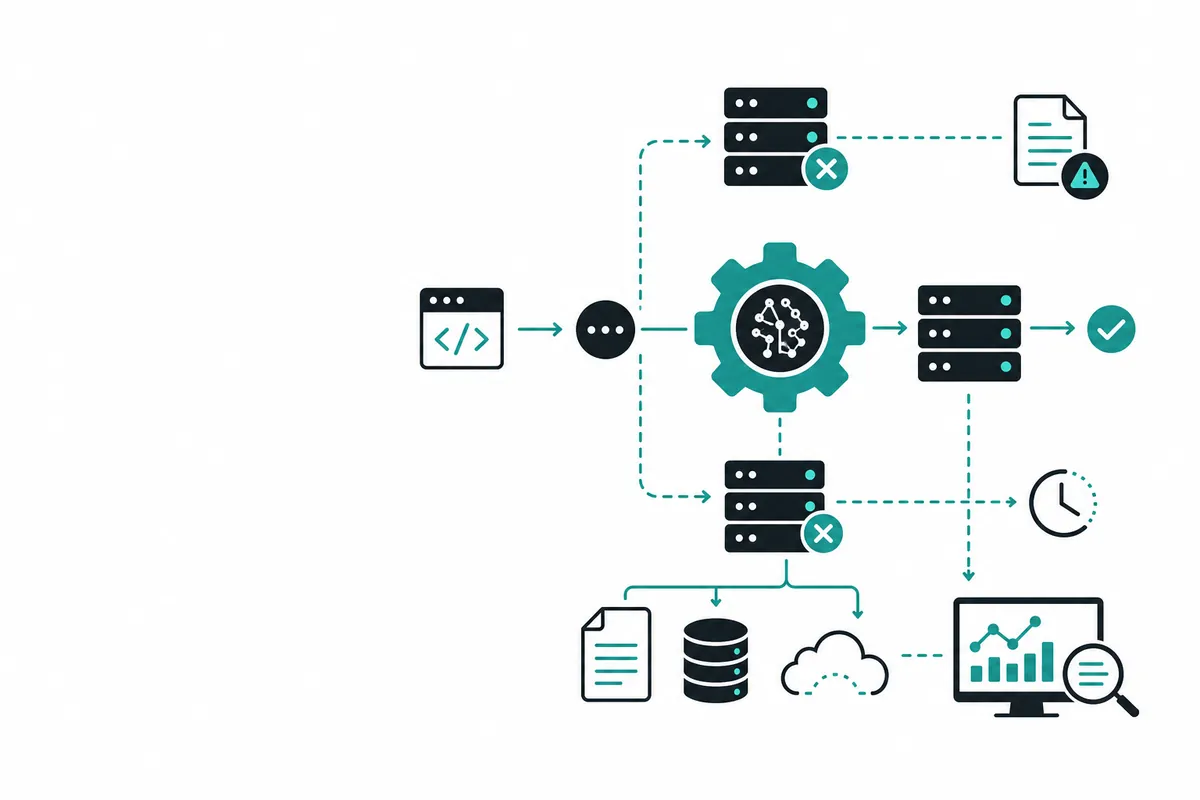
This guide explains what these errors usually mean, what to check first, and how to make AI API calls more resilient with logging, retries, model fallback, and endpoint fallback.
Quick error table#
| Error | Usually means | First action | Production fix |
|---|---|---|---|
| 500 | Internal server or upstream provider failure | Retry once and capture request details | Add retry with backoff and fallback model |
| 502 | Gateway could not get a valid upstream response | Try a nearby model or route | Add model/provider fallback |
| 524 | Request timed out | Reduce context/output or use streaming | Add timeout controls and split long tasks |
| 429 | Rate limit or quota issue | Reduce rate and check limits | Queue, throttle, or request higher limits |
| 401/403 | Auth or permission issue | Check API key and model access | Validate config before deploy |
If you only remember one thing: log the model, endpoint, request time, error code, and whether streaming was enabled. Without that, troubleshooting becomes guesswork.
What a 500 AI API error usually means#
A 500 error usually means something failed server-side.
In an AI API workflow, that could be:
- the gateway encountered an internal error;
- the upstream model provider returned an unexpected failure;
- the model route was temporarily unstable;
- the request payload triggered an edge case;
- a long or complex request failed during processing.
A single 500 is often temporary.
A repeated 500 on the same request usually means you need to inspect the request shape.
Check:
- model name;
- endpoint path;
- message format;
- tool/function calling schema;
- image/video/audio payload format;
- context size;
- whether the same request works on another model.
What a 502 AI API error usually means#
A 502 Bad Gateway means the gateway did not receive a valid response from the upstream service.
For AI APIs, common causes include:
- upstream provider instability;
- overloaded model route;
- bad or incomplete upstream response;
- network interruption;
- route-specific failure;
- gateway-provider mismatch for a special model feature.
If a 502 happens once, retrying may be enough.
If it happens repeatedly on one model, test a similar model.
For example, if one high-end reasoning model is unstable, temporarily route the same prompt to:
- a nearby model version;
- a faster model in the same family;
- a different provider with similar capability;
- a cheaper fallback model for non-critical tasks.
This is where a gateway is useful: you can switch model routes without rewriting the app.
What a 524 timeout usually means#
A 524 usually means the connection timed out while waiting for a response.
This is common with:
- very long prompts;
- large context windows;
- huge expected outputs;
- complex reasoning tasks;
- image or video generation jobs;
- non-streaming requests that run too long;
- coding-agent workflows that ask the model to solve too much in one call.
Immediate fixes:
- reduce input size;
- lower
max_tokensor output length; - use streaming for text responses;
- split the task into smaller steps;
- choose a faster model;
- avoid asking for massive JSON output in one response.
A timeout is not always a platform outage. Sometimes it means the request is too large or too slow for a synchronous API call.
Immediate troubleshooting checklist#
When an AI API request fails, do this before changing your whole setup.
| Step | What to do | Why it helps |
|---|---|---|
| 1 | Retry once | Handles temporary upstream failure |
| 2 | Save the full error body | Error text often shows auth/model/payload clues |
| 3 | Record request time | Support can map it to route/provider logs |
| 4 | Record model name | Many failures are model-route specific |
| 5 | Check Base URL | Wrong endpoint causes confusing failures |
| 6 | Test a smaller prompt | Separates payload-size issues from route issues |
| 7 | Try streaming | Reduces timeout risk for long text responses |
| 8 | Try a nearby model | Confirms whether the issue is model-specific |
| 9 | Try region endpoint if needed | Helps when access to the global endpoint is unstable |
| 10 | Remove optional features | Tool calls, images, long JSON schemas can add failure points |
For OpenAI-compatible clients with Crazyrouter, the common Base URLs are:
https://crazyrouter.com/v1
and:
https://cn.crazyrouter.com/v1
Do not add UTM parameters or tracking strings to API endpoints.
How to write a safe retry strategy#
Retries help, but blind retries can make an outage worse.
Use exponential backoff with jitter:
import random
import time
from openai import OpenAI

client = OpenAI(
    api_key="YOUR_CRAZYROUTER_API_KEY",
    base_url="https://crazyrouter.com/v1"
)

def call_with_retry(messages, model="gpt-5-mini", max_retries=3):
    last_error = None

    for attempt in range(max_retries):
        try:
            return client.chat.completions.create(
                model=model,
                messages=messages,
                timeout=60,
            )
        except Exception as exc:
            last_error = exc
            wait = (2 ** attempt) + random.random()
            time.sleep(wait)

    raise last_error
This is better than retrying immediately in a tight loop.
Model fallback example#
A production app should not depend on one model route for every task.
You can define a fallback list:
from openai import OpenAI

client = OpenAI(
    api_key="YOUR_CRAZYROUTER_API_KEY",
    base_url="https://crazyrouter.com/v1"
)

MODELS = [
    "gpt-5-mini",
    "claude-sonnet-4-6",
    "gemini-2.5-flash",
]

def call_with_model_fallback(messages):
    errors = []

    for model in MODELS:
        try:
            return client.chat.completions.create(
                model=model,
                messages=messages,
                timeout=60,
            )
        except Exception as exc:
            errors.append({"model": model, "error": str(exc)})

    raise RuntimeError(f"All model routes failed: {errors}")
This pattern is especially useful for:
- support bots;
- internal automation;
- coding agents;
- summarization pipelines;
- batch content workflows;
- production apps with user-facing latency requirements.
Endpoint fallback example#
If your users or servers sometimes have unstable access to one region, you can test an endpoint fallback.
from openai import OpenAI

ENDPOINTS = [
    "https://crazyrouter.com/v1",
    "https://cn.crazyrouter.com/v1",
]

API_KEY = "YOUR_CRAZYROUTER_API_KEY"

for base_url in ENDPOINTS:
    client = OpenAI(api_key=API_KEY, base_url=base_url)
    try:
        response = client.chat.completions.create(
            model="gpt-5-mini",
            messages=[{"role": "user", "content": "Health check"}],
            timeout=30,
        )
        print("working endpoint:", base_url)
        break
    except Exception as exc:
        print("failed endpoint:", base_url, exc)
Do not randomly switch endpoints on every request. Use endpoint fallback intentionally and log which route succeeded.
What to send support#
If the issue persists, support can help much faster when you include the right information.
Send:
- account email;
- model name;
- Base URL used;
- endpoint path;
- request time and timezone;
- error code;
- error body or screenshot;
- whether streaming was enabled;
- whether the same request works on another model;
- simplified request body without secrets.
Do not send your full API key in public channels.
How a gateway helps with AI API reliability#
An AI API gateway cannot make every upstream provider perfect.
But it can make your application more flexible.
With a gateway, you can:
- switch models without rewriting SDK code;
- route simple tasks to cheaper models;
- route critical tasks to stronger models;
- add fallback across model families;
- keep one OpenAI-compatible integration surface;
- monitor cost and usage more centrally.
With Crazyrouter, OpenAI-compatible clients can use:
https://crazyrouter.com/v1
or, when needed:
https://cn.crazyrouter.com/v1
Then your app can focus on retry logic, fallback policy, and good observability.
Production checklist#
Before relying on an AI API in production, implement this checklist.
| Area | Recommendation |
|---|---|
| Timeout | Set explicit request timeouts |
| Retry | Use exponential backoff with jitter |
| Fallback | Prepare at least one alternate model |
| Logging | Log endpoint, model, latency, error code, and request ID if available |
| Payload size | Limit context and output size |
| Streaming | Use streaming for long text responses |
| Rate limits | Track RPM and TPM usage |
| Cost | Monitor input/output tokens and cache behavior |
| User experience | Show graceful fallback messages |
| Support | Store enough metadata to debug failures later |
Helpful links#
- Base URL setup guide: https://crazyrouter.com/blog/openai-compatible-api-base-url-explained?utm_source=blog&utm_medium=article&utm_campaign=api_error_guide
- Model list: https://crazyrouter.com/models?utm_source=blog&utm_medium=article&utm_campaign=api_error_guide
- Pricing calculator: https://crazyrouter.com/tools/pricing-calculator/?utm_source=blog&utm_medium=article&utm_campaign=api_error_guide
- Model comparison: https://crazyrouter.com/tools/model-comparison/?utm_source=blog&utm_medium=article&utm_campaign=api_error_guide
- API docs: https://docs.crazyrouter.com
FAQ#
What does an AI API 500 error mean?#
An AI API 500 error usually means an internal server or upstream provider failure. Retry once, then check the model, endpoint, request format, and whether the same prompt works on another model.
What does an AI API 502 error mean?#
A 502 error usually means the gateway could not get a valid response from the upstream model provider. It is often temporary, but repeated 502 errors may require a model or route fallback.
What does a 524 timeout mean?#
A 524 timeout usually means the request took too long. Reduce context size, shorten expected output, use streaming, split the task, or choose a faster model.
Should I retry every failed AI API request?#
No. Retry temporary server, gateway, and timeout errors with backoff. Do not blindly retry authentication errors, invalid model errors, or bad request payloads.
How do I make AI API calls more reliable?#
Use explicit timeouts, retry with backoff, model fallback, endpoint fallback, request logging, payload limits, and monitoring for latency, token usage, and error rates.