 简体中文
简体中文 繁體中文
繁體中文 English
 Français
 Русский
 日本語
日本語 Tiếng Việt
 한국어
한국어 Deutsch
 Español
 Italiano
 Português
 العربية
 ไทย
ไทย Bahasa Indonesia
 Bahasa Melayu
 Türkçe
 Polski
 Nederlands
 Dansk
Dansk Norsk
Norsk Қазақша
GPT-5.6-sol vs GPT-5.6-terra: What Does a 2x Price Gap Buy in Performance?
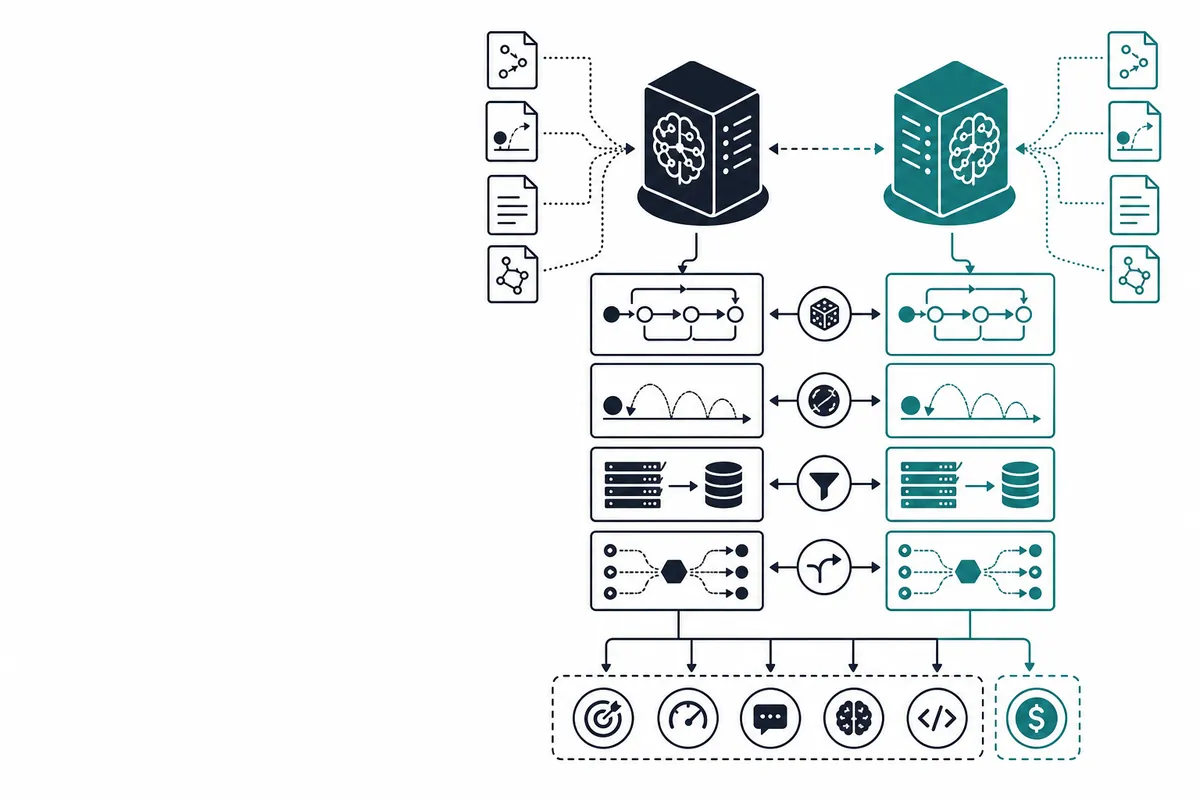
A real-world price-performance test using the Crazyrouter OpenAI-compatible API: gpt-5.6-sol and gpt-5.6-terra are compared across four tasks involving a probabilistic state machine, multi-stage physics, log aggregation, and stable routing. The evaluation covers correctness, response time, completion tokens, reasoning tokens, local code tests, and per-request costs estimated from public list prices.
GPT-5.6-sol vs GPT-5.6-terra Benchmarked: How Much Performance Does a 2x Price Difference Buy?#
gpt-5.6-sol and gpt-5.6-terra are two popular GPT-5.6-series models currently available for direct use through Crazyrouter.
Both have 8 available channels and 7 backup channels, but their input and output prices differ by exactly 2x. For developers already using the GPT-5.6 series, the question worth testing is:
The input and output prices of
gpt-5.6-solare both 2x those ofgpt-5.6-terra. Does spending twice as much produce a comparably large performance gap?
I ran the same set of probability, physics, and Python engineering problems once on each model, for a total of 8 API requests. The conclusion first:
- Core correctness was essentially tied: both models passed 4 tasks.
- Both Python coding tasks passed the same local test suite, while
terrawas faster and more concise. solprovided a more complete exact fraction for the probability task and avoided one clear long tail in the physics task.- Based on the displayed prices and actual token usage in this run, the estimated total cost for the four tasks was
$0.1614versus$0.0718;solwas about 2.25x more expensive in practice.
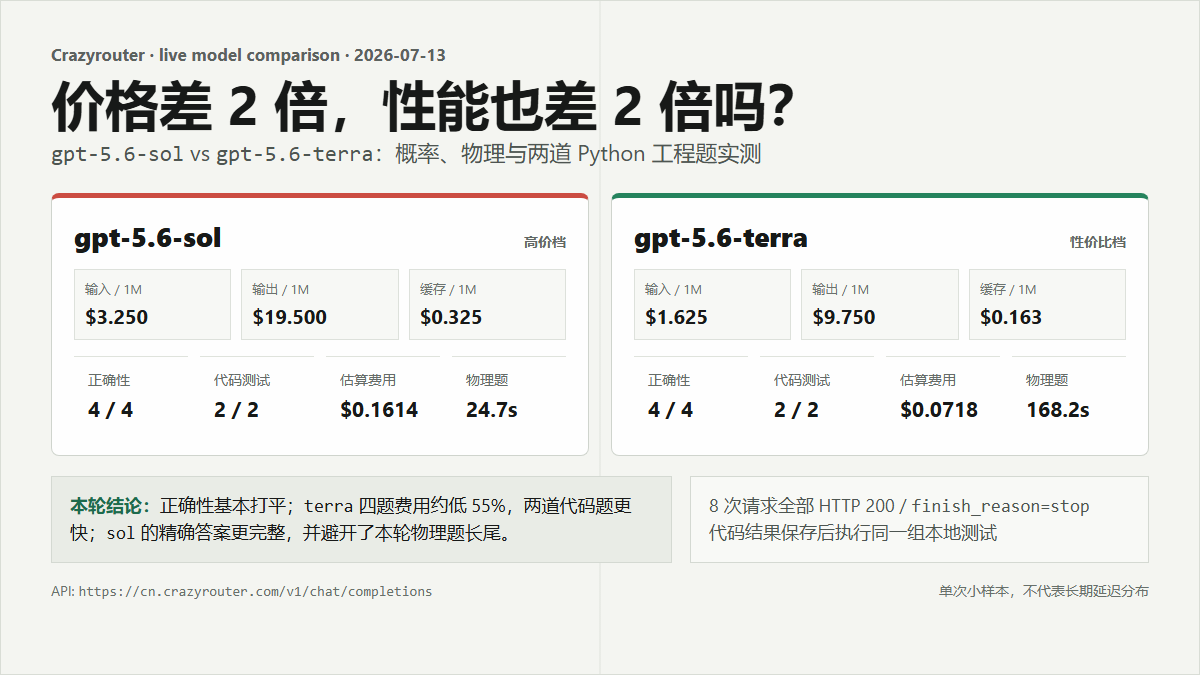
The most interesting part of this round is that the price was indeed 2x higher, but performance did not scale linearly by 2x.
First, the pricing: sol is the premium tier over terra#
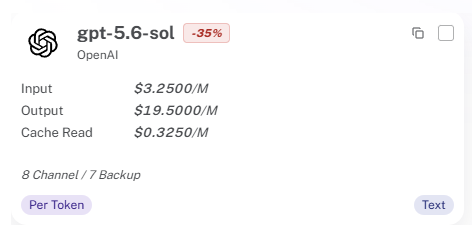
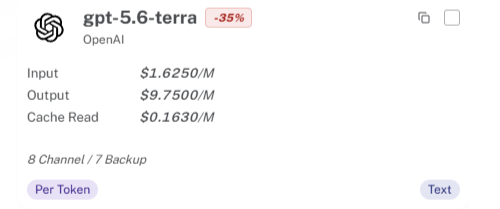
The test was conducted on July 13, 2026. The page showed both models at a -35% price level. The following prices are a snapshot from that day and may change later.
gpt-5.6-sol:
gpt-5.6-terra:
In table form:
| Model | Input / 1M tokens | Output / 1M tokens | Cache Read / 1M tokens | Channels |
|---|---|---|---|---|
gpt-5.6-sol | $3.2500 | $19.5000 | $0.3250 | 8 Channel / 7 Backup |
gpt-5.6-terra | $1.6250 | $9.7500 | $0.1630 | 8 Channel / 7 Backup |
The input and output prices are exactly 2x. Because the page retains four decimal places for cache reads, the displayed values are $0.3250 versus $0.1630, which can also be understood as approximately 2x.
Therefore, this test compares more than answer quality:
Whether the same problem is solved correctly
Whether the response is complete
Whether the code runs
Response latency
completion / reasoning tokens
Estimated request cost based on displayed unit prices
Test setup#
All requests used:
Base URL: https://cn.crazyrouter.com/v1
Endpoint: POST /v1/chat/completions
Model A: gpt-5.6-sol
Model B: gpt-5.6-terra
temperature: 0.2
Each task used exactly the same prompt and max_tokens for both models.
The four tasks were:
| Task | Type | Primary evaluation criteria |
|---|---|---|
Biased coin until HHTH appears | Probability state machine | Pattern overlap, state equations, exact answer |
| Model invocation log aggregation | Python engineering code | Time windows, failed requests, cache rate, stable sorting |
| Compressing a spring after an inelastic collision | Multi-stage physics | Work-energy relation, momentum conservation, work done by friction |
| Stable routing under multiple constraints | Python graph algorithm | cost, latency, reliability, multi-level tie-breaking |
The validation criteria went beyond HTTP 200:
- Probability and physics answers were checked against precomputed reference answers.
- Python output was saved as
.pyfiles. - Code from both models was executed against the same local test suite.
- The requested model, returned model,
finish_reason, token usage, and latency were recorded.
All 8 requests ultimately returned:
HTTP 200
returned_model matches requested_model
finish_reason = stop
Visible content is non-empty
Overall results: correctness tied, cost did not#
First, the most important results:
| Task | gpt-5.6-sol | gpt-5.6-terra |
|---|---|---|
HHTH probability task | Correct; provided an exact fraction and decimal | Correct; provided a formula and decimal, but did not reduce it to an exact fraction |
| Log aggregation code | Passed local tests | Passed local tests |
| Inelastic-collision physics task | Correct | Correct |
| Stable-routing code | Passed local tests | Passed local tests |
If scoring only whether the core task was completed, this round ended 4:4.
However, the cost difference was clear:
| Task | Estimated sol cost | Estimated terra cost | sol / terra |
|---|---|---|---|
HHTH probability task | $0.03537 | $0.01872 | 1.89x |
| Log aggregation code | $0.03463 | $0.01716 | 2.02x |
| Inelastic-collision physics task | $0.02909 | $0.01235 | 2.35x |
| Stable-routing code | $0.06231 | $0.02360 | 2.64x |
| Total | $0.16140 | $0.07183 | 2.25x |
The estimate uses:
cost ≈
(prompt_tokens - cached_tokens) × input_price
+ cached_tokens × cache_read_price
+ completion_tokens × output_price
Then divide by 1,000,000.
This is an approximate calculation based on publicly displayed unit prices, not a billing audit. Actual charges should be determined by platform logs and billing rules.
Why can the final cost ratio reach 2.25x when the listed price is 2x? Output length also differed. Across all four tasks:
gpt-5.6-sol completion tokens:   7,391
gpt-5.6-terra completion tokens: 6,481
sol generated about 14% more output in this run. Combined with its 2x output unit price, that drove the estimated per-request cost of the stable-routing task to 2.64x that of terra.
Task 1: both probability answers were correct, but sol gave a more complete exact expression#
The probability task was:
P(H)=0.62, P(T)=0.38.
Keep tossing until HHTH appears for the first time.
Find the expected number of tosses and derive it using state equations.
Reference answer:
E[N] = 7162950 / 566029 ≈ 12.6547
Both models correctly defined the states:
S0 = empty
S1 = H
S2 = HH
S3 = HHT
S4 = HHTH
Both also explained the key transition: when another H appears after HH, it produces HHH, whose longest valid suffix is still HH, so the state remains at S2.
Both ultimately derived:
E0 = 1 / (p^3 q) + 1 / p ≈ 12.6547
The difference is in how the answer was presented:
solfurther simplified it to7162950 / 566029.terraprovided the correct formula and12.6547, but did not reduce it to the requested exact fraction.
So terra did not calculate incorrectly; it was simply one step short in the exact representation.
The two took almost the same amount of time:
sol:   33.0s
terra: 33.2s
Interestingly, terra used more reasoning tokens, 999 versus 710, while its final visible response was shorter. This shows that a lower price does not necessarily mean less internal reasoning; it still depends on the specific task.
Question 2: Log Aggregation Code, terra Is Cheaper and Slightly Faster#
The second question required implementing:
aggregate_model_usage(events, window_start, window_end)
The specification included:
Only count events within [window_start, window_end)
For failed requests, count requests only; do not accumulate tokens or cost
Use unknown for missing user/model values
Calculate cache_hit_rate
Sort top_users by cost descending, then by username ascending for ties
Do not modify input objects
Both models' code passed the same local test suite.
| Metric | sol | terra |
|---|---|---|
| Duration | 31.7s | 29.5s |
| completion tokens | 1,527 | 1,511 |
| reasoning tokens | 114 | 156 |
| Visible code characters | 5,225 | 5,008 |
| Local tests | Passed | Passed |
| Estimated cost | $0.03463 | $0.01716 |
On this task, terra did not miss critical edge cases because it was cheaper, and it was also about 2.2 seconds faster. For backend functions with clear specifications and test-based acceptance, terra offers standout price-performance.
Question 3: Both Solved the Physics Problem Correctly, but terra Had a 168-Second Long Tail#
The physics problem had three stages:
Sliding down a rough incline
A perfectly inelastic collision
Compressing a spring on a horizontal surface with friction
Reference answer:
v1 ≈ 6.10 m/s
v2 ≈ 2.44 m/s
x  ≈ 0.302 m
Both models got every result right and correctly distinguished between:
- Using the work-energy relation, or equivalent Newton's second-law analysis, for the incline stage.
- Using conservation of momentum at the instant of collision; mechanical energy is not conserved.
- Using an energy relation that includes work done by friction during spring compression.
Correctness was again tied, but the latency gap suddenly widened:
sol:    24.7s
terra: 168.2s
terra actually produced a shorter response: 1,059 completion tokens, compared with sol's 1,284. Therefore, this long tail cannot simply be attributed to excessive output. It is more likely related to reasoning at the time, channel load, or routing state.
This is only a single sample, so it cannot support a conclusion that terra is consistently slow on physics problems. But it does highlight one point: even if a low-cost model has good average speed, P95/P99 long-tail latency should be measured separately rather than looking only at average latency.
Question 4: Stable Routing Code, terra Is Faster, Shorter, and Cheaper#
The final question required implementing:
cheapest_stable_route(
    nodes,
    edges,
    start,
    target,
    banned_nodes=None,
    max_hops=None,
    min_reliability=0.0,
)
The selection rules were not standard shortest path rules:
First choose the lowest total cost
For equal cost, choose the lowest total latency
If still tied, choose higher reliability
If still tied, choose the lexicographically smallest path
Also handle banned_nodes, max_hops, and the minimum reliability threshold
Both models' code passed tests for cost, latency, reliability, lexicographic ordering, banned nodes, maximum hops, and invalid edges.
| Metric | sol | terra |
|---|---|---|
| Duration | 55.7s | 41.0s |
| completion tokens | 2,954 | 2,179 |
| reasoning tokens | 1,034 | 516 |
| Visible code characters | 6,941 | 5,286 |
| Local tests | Passed | Passed |
| Estimated cost | $0.06231 | $0.02360 |
This was terra's strongest task in this round:
- About 14.7 seconds faster.
- About 26% fewer completion tokens.
- About half as many reasoning tokens as
sol. - It passed the same tests, with an estimated cost of only about 38% of
sol's.
If real workloads mainly consist of this kind of verifiable Python engineering code, the higher-priced sol did not demonstrate a corresponding benefit on this task.
How to Interpret These Two Popular Production Models#
This round should not be framed as “terra is a stripped-down version” or “sol delivers exactly what you pay for.” The actual results look more like two different tiers:
Strengths of gpt-5.6-terra#
- Input and output pricing are both half of
sol's. - Core correctness was tied across all four questions.
- Both code tasks passed tests, and both were faster than
sol. - Its engineering-code output was shorter, with about 12% fewer total completion tokens in this round.
- Estimated total cost across the four questions was about 55% lower than
sol.
Strengths of gpt-5.6-sol#
- It delivered the exact answer to the probability problem more completely.
- It responded substantially faster on the physics problem in this round, without
terra's long-tail latency. - Its stable-routing solution was more fully elaborated, which suits cases where more implementation detail is desired.
A More Practical Usage Pattern#
For teams already using the GPT-5.6 family, route by task type:
High-frequency, testable code generation: prioritize terra
Batch log processing and structured tasks: prioritize terra
Mathematical derivations requiring exact expressions: test sol first
Sensitive to long-tail latency in complex derivations: retain a sol path as well
All code output: run through automated tests consistently
This is not a question of whether to deploy them. Once both popular models are available, the question is how to achieve more effective results per dollar.
Limitations of This Test Round#
This must be stated clearly: this is a single, small-sample test set, not a long-term benchmark.
It can demonstrate:
All 8 requests succeeded in this run
Both models completed all 4 tasks
Both code tasks passed the same test suite
The token usage, estimated costs, and durations in this run differed as described above
It cannot demonstrate:
terra will consistently require 168 seconds for physics problems
sol is more precise on every math problem
terra is faster on every coding task
Four tasks can represent all production workloads
A more rigorous next step would repeat each task category 20 to 50 times and observe:
Success rate
P50 / P95 / P99 latency
Time to first token
Average completion tokens
Actual cost per successfully completed task
FAQ#
Is GPT-5.6-terra Worse Than GPT-5.6-sol?#
This round does not support that conclusion. Core correctness across the four questions was 4:4, and both code tasks passed local tests. The main difference was that terra did not further simplify an exact fraction in the probability problem, rather than producing an incorrect answer.
Why Is the List Price Only 2x Higher While Measured Cost Is 2.25x Higher?#
Because the output token counts also differed. Across the four questions, sol generated 7,391 completion tokens, while terra generated 6,481. The higher output price combined with longer output pushed the cost gap for the stable-routing task to approximately 2.64x.
Will terra's Physics Tasks Always Have 168-Second Latency?#
That conclusion cannot be drawn from a single request. This result only shows that this request had a noticeable long-tail delay. A long-term assessment requires repeated sampling and observation of P50, P95, and P99 latency.
Which Model Is Better for Code Generation?#
For the two executable Python tasks in this round, both models passed the tests, while terra was faster, produced shorter output, and cost less. Other code types should still be retested against your own real-world benchmark suite.
Final Conclusion#
In this round, gpt-5.6-sol and gpt-5.6-terra differed in price by 2x, but their correctness did not differ by 2x, or even by a single question.
terra demonstrated strong price-performance for the two executable code tasks: it passed the same tests, responded faster, produced shorter output, and cost only about one-third to one-half as much as sol.
sol's value lies primarily in more complete exact answers and more stable response times for the complex physics task in this round. It is not universally superior, but its additional cost may be worthwhile for tasks sensitive to expression quality and long-tail latency.
So the most accurate conclusion from this comparison is:
gpt-5.6-terrais better suited as a cost-effective primary model, whilegpt-5.6-solis a higher-priced option that complements it for precise expression and complex reasoning. Now that both models are available, routing by task is more valuable than choosing based solely on model name or price.
Reproducing the Tests with Crazyrouter#
This article completed the tests through the Crazyrouter OpenAI-compatible API. To reproduce them, use the same prompt, temperature, max_tokens, and validation scripts for both models.
from openai import OpenAI

client = OpenAI(
    api_key="YOUR_API_KEY",
    base_url="https://cn.crazyrouter.com/v1",
)

response = client.chat.completions.create(
    model="gpt-5.6-terra",
    temperature=0.2,
    max_tokens=3600,
    messages=[{"role": "user", "content": "YOUR_TEST_PROMPT"}],
)

print(response.model)
print(response.choices[0].finish_reason)
print(response.usage)
print(response.choices[0].message.content)
Change model to gpt-5.6-sol and run the request again. Run the same test suite against the code output to obtain comparable data.
- Registration: https://crazyrouter.com/register?utm_source=crazyrouter_blog&utm_medium=article&utm_campaign=gpt56_sol_terra_price_performance&utm_content=gpt-56-sol-vs-gpt-56-terra-price-performance-2026-en__body_cta
- API Base URL:
https://cn.crazyrouter.com/v1 - Recommended fields to record:
requested_model,returned_model,finish_reason,reasoning_tokens, cached tokens, total duration, and code test results.