 简体中文
简体中文 繁體中文
繁體中文 English
 Français
 Русский
 日本語
日本語 Tiếng Việt
 한국어
한국어 Deutsch
 Español
 Italiano
 Português
 العربية
 ไทย
ไทย Bahasa Indonesia
 Bahasa Melayu
 Türkçe
 Polski
 Nederlands
 Dansk
Dansk Norsk
Norsk Қазақша
Designing a Codex-Style World Cup 2026 Predictor Workflow with Crazyrouter
A practical Codex-style workflow demo: deterministic World Cup 2026 predictions, validation tests, JSON schema checks, charts, and real Crazyrouter API model routing.
Designing a Codex-Style World Cup 2026 Predictor Workflow with Crazyrouter#
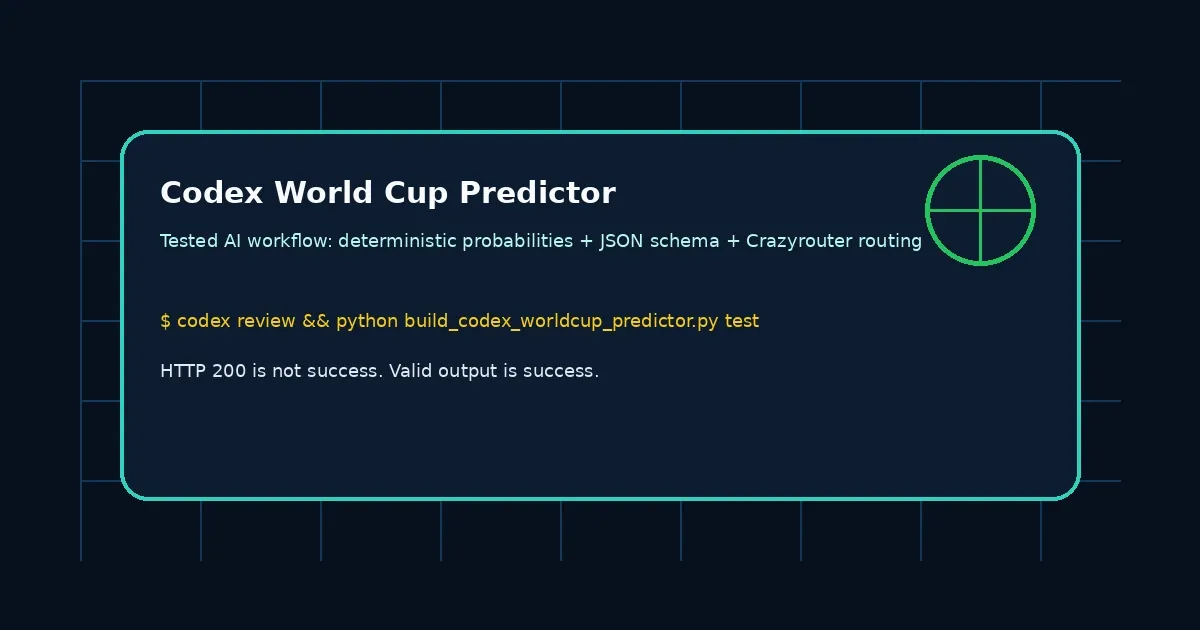
Codex-style coding agents are most useful when they do more than generate code once. For this experiment, I designed a Codex-style workflow that turns a World Cup 2026 prediction prototype into a reproducible engineering demo: deterministic match probabilities, fixture checks, JSON schema validation, charts, raw API audit files, and a real Crazyrouter multi-model test.
Important context: this is a developer workflow demo, not an official World Cup data product and not betting advice. The fixture and rating data used here is a small demo dataset created for reproducible testing. A production sports model would need official live fixtures, lineups, injuries, travel, odds, and continuous result updates.
The live API layer was tested through:
Base URL: https://cn.crazyrouter.com/v1
Date: 2026-06-14 UTC
Endpoints tested:
- GET /v1/models
- POST /v1/chat/completions
Why this should be a Codex-style workflow, not just a prediction prompt#
The weak version of this idea is simple: ask an AI model who will win a match and publish the answer.
The better version is more engineering-heavy:
- keep fixture data in files;
- calculate probabilities with deterministic Python;
- ask models only to explain structured outputs;
- validate JSON;
- preserve raw responses;
- render charts;
- run tests before trusting the result.
That is where a Codex-style workflow becomes interesting. The value is not that an AI can guess sports outcomes. The value is that a coding agent can help turn a rough demo into a workflow with gates.
Claude Code built the prototype. Codex-style workflow hardens it.#
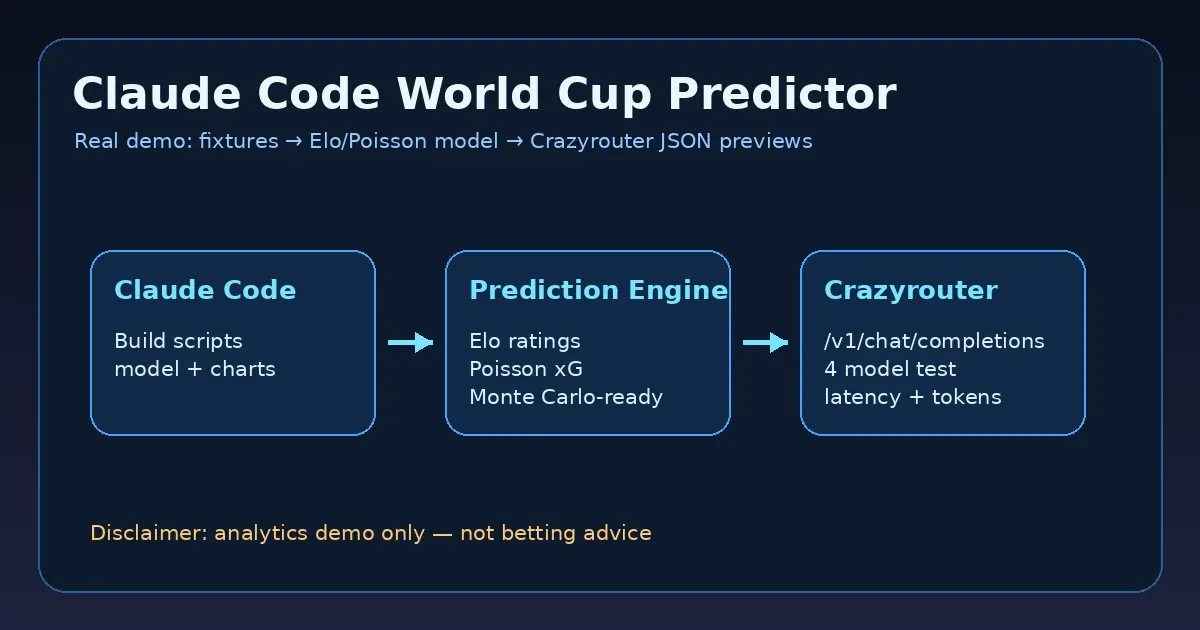
The earlier Claude Code-style version focused on building the first working predictor: fixture data, Elo/Poisson probabilities, charts, and Crazyrouter API calls.
For the Codex-style version, the angle is different:
- add fixture integrity checks;
- add probability normalization checks;
- add JSON schema validation;
- make raw model outputs auditable;
- separate deterministic calculation from model-written explanations;
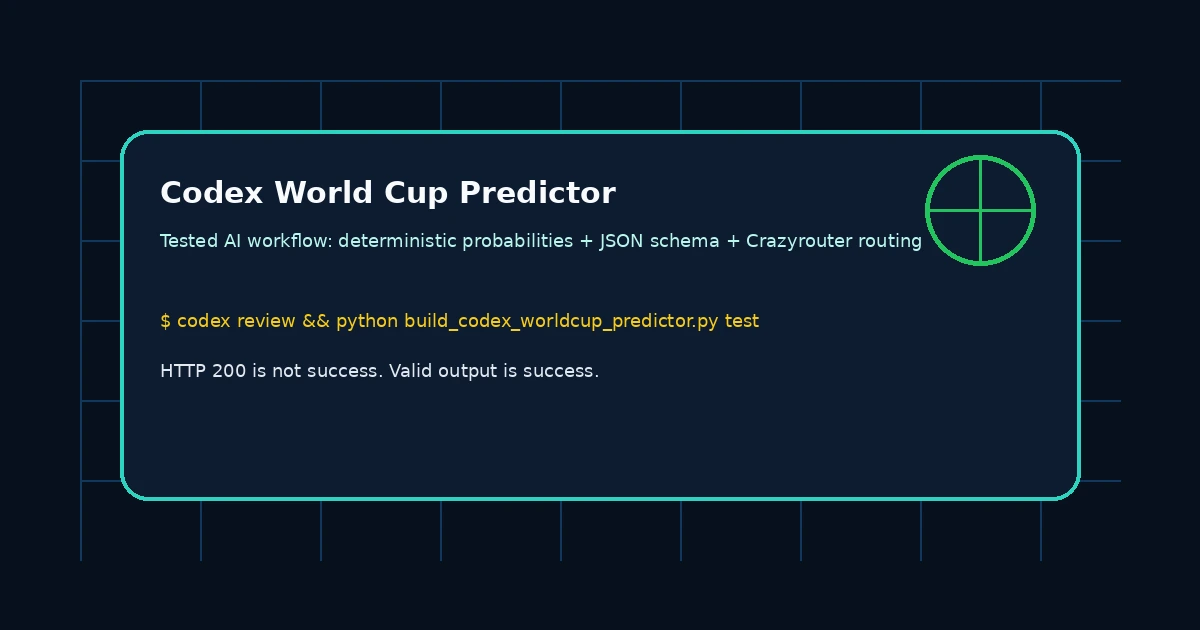
- treat malformed output as a workflow failure even when HTTP status is 200.
In short: Claude Code is a good builder story. Codex is a good reviewer-builder story.
The prediction model: deterministic first#
The predictor uses a deliberately transparent model:
- Elo-style seed ratings for the demo dataset;
- host boost for relevant host-nation fixtures;
- expected-goals transform;
- Poisson scoreline distribution;
- top score probabilities.
The expected-goals function is intentionally simple:
def expected_goals(rating_for, rating_against, host_boost=0):
    diff = (rating_for + host_boost) - rating_against
    return max(0.45, min(2.65, 1.28 + diff / 520))
This is not a production sports model. For this article, transparency is more important than pretending to have secret predictive power.
Sample demo predictions#
| Date | Match | Group | xG | Home / Draw / Away | Pick |
|---|---|---|---|---|---|
| 2026-06-11 | Mexico vs South Africa | A | 1.68-0.98 | 55.8% / 24.2% / 19.9% | Mexico |
| 2026-06-11 | South Korea vs Czechia | A | 1.35-1.21 | 40.1% / 26.6% / 33.3% | South Korea |
| 2026-06-12 | USA vs Paraguay | D | 1.53-1.14 | 48.2% / 25.5% / 26.3% | USA |
| 2026-06-13 | Brazil vs Morocco | C | 1.64-0.92 | 54.9% / 24.7% / 20.4% | Brazil |
| 2026-06-13 | Qatar vs Canada | B | 1.1-1.57 | 24.6% / 25.2% / 50.2% | Canada |
| 2026-06-14 | Germany vs Curaçao | E | 2.08-0.48 | 75.1% / 17.7% / 7.2% | Germany |
| 2026-06-14 | Netherlands vs Japan | F | 1.53-1.03 | 49.5% / 25.7% / 24.8% | Netherlands |
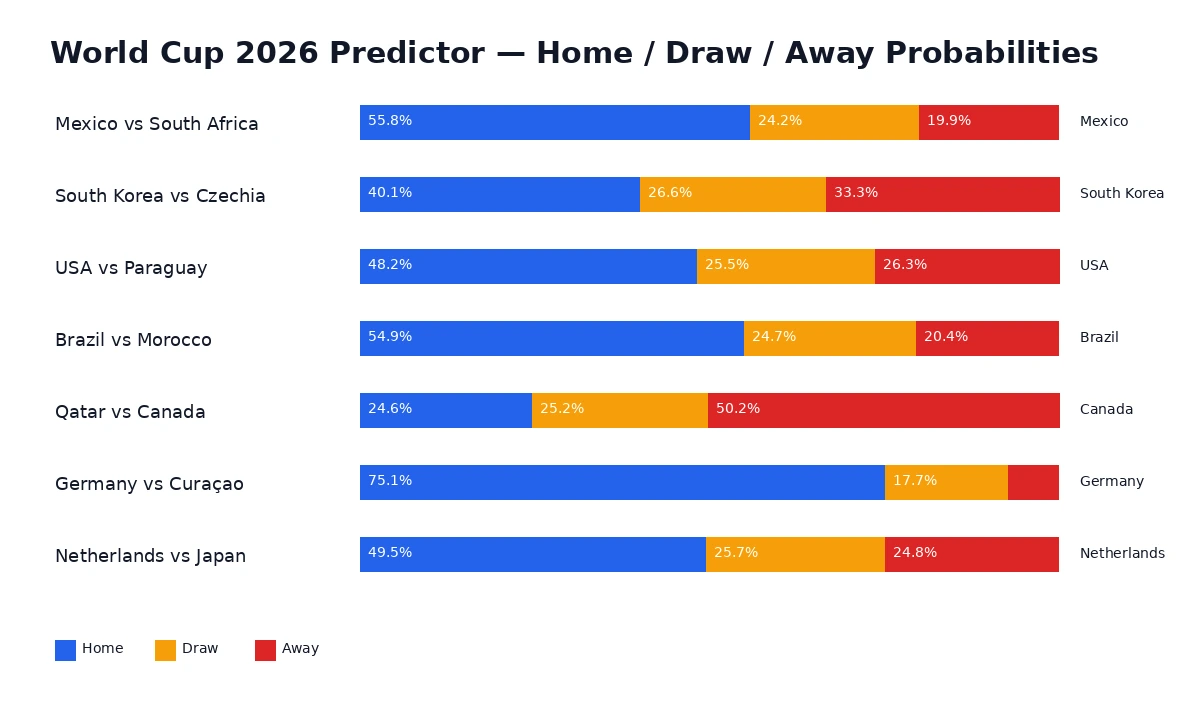
The USA vs Paraguay prediction is a good example. The model gives USA an edge, but not a dominant one: 48.2% home win, 25.5% draw, 26.3% away win. A good workflow should preserve that uncertainty instead of turning it into overconfident prose.
Validation gates#
The demo includes these checks:
Fixture integrity:
- every fixture has id, date, group, home, away, venue
- no duplicate fixture IDs
- every team exists in the rating table

Prediction math:
- home + draw + away probability sums to 1.0 ± 0.002
- expected goals stay within configured bounds
- top score probabilities are sorted descending
- every prediction includes a no-betting-advice disclaimer

LLM output validation:
- response must parse as JSON
- required top-level keys must exist
- match must be an object with date, group, home, away, venue
- probability_summary must include home_win, draw, away_win
This is the main workflow lesson: generated content should pass gates before it becomes product output.
Crazyrouter real API test#
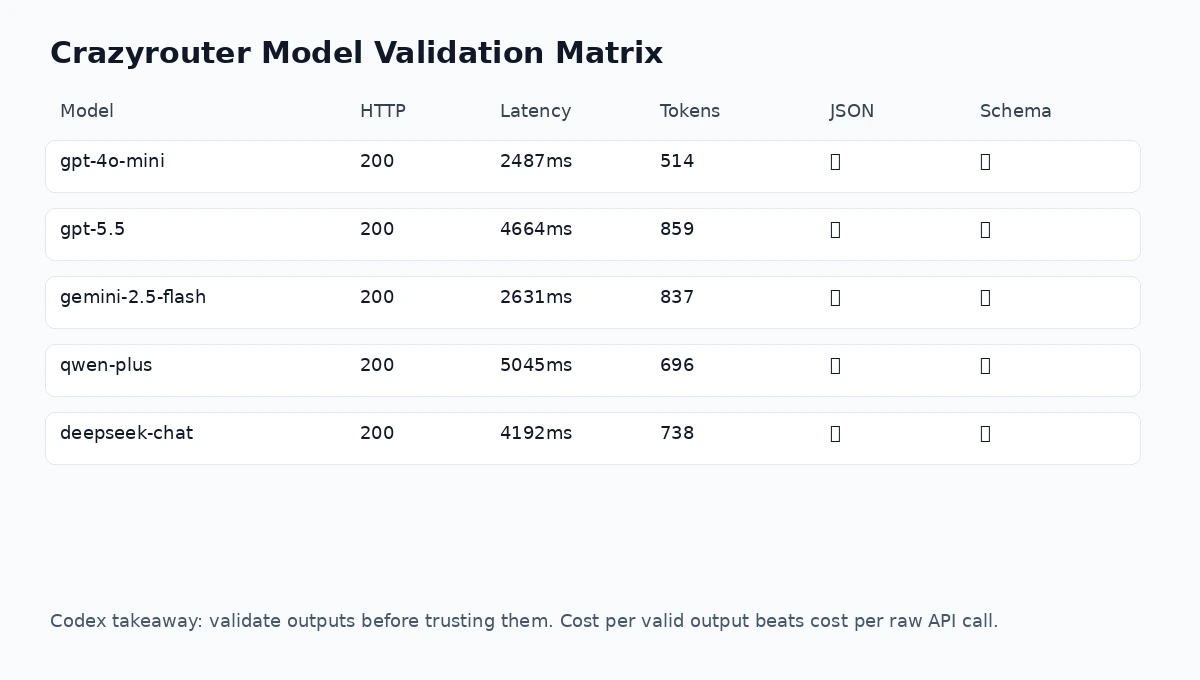
After generating probabilities, the workflow asked several model routes to produce a compact JSON match preview for USA vs Paraguay.
Task:
Return ONLY compact valid JSON. No markdown. No prose.
The top-level object MUST have exactly these keys:
match, predicted_edge, probability_summary, key_factors, uncertainty, disclaimer.
The match value MUST be an object, not a string, with exactly these keys:
date, group, home, away, venue.
The probability_summary value MUST include numeric keys:
home_win, draw, away_win.
The disclaimer MUST include the phrase: not betting advice.
The model-list endpoint worked:
GET /v1/models
HTTP status: 200
Latency: 449 ms
Models returned: 261
API results:
| Model | HTTP | Latency | Total tokens | Valid JSON | Schema valid |
|---|---|---|---|---|---|
gpt-4o-mini | 200 | 2487 ms | 514 | True | True |
gpt-5.5 | 200 | 4664 ms | 859 | True | True |
gemini-2.5-flash | 200 | 2631 ms | 837 | False | False |
qwen-plus | 200 | 5045 ms | 696 | True | True |
deepseek-chat | 200 | 4192 ms | 738 | True | True |
The useful failure: one route still broke the workflow#
With a stricter prompt, 4 out of 5 model routes returned schema-valid JSON. That is exactly what we want from a validation experiment: most routes passed, and one route still exposed a failure case.
In this run:
gpt-4o-mini,gpt-5.5,qwen-plus, anddeepseek-chatreturned schema-valid JSON.gemini-2.5-flashreturned truncated JSON in this specific test.
This is not a reason to reject any model globally. It is a reason to build retries, stricter prompts, schema repair, and fallback routes.
A plain JSON parser asks:
Is this syntactically valid JSON?
A workflow validator asks:
Can the application safely use this object?
Those are different questions.
Why Crazyrouter fits this workflow#
A coding-agent workflow should not be tied to one model route. The same task may need:
- a cheap baseline model;
- a premium model for harder formatting;
- a fast model for drafts;
- a fallback model when JSON breaks;
- a non-US model route for comparison.
Crazyrouter makes that operationally simple because the client shape stays OpenAI-compatible:
from openai import OpenAI

client = OpenAI(
    api_key="YOUR_CRAZYROUTER_API_KEY",
    base_url="https://cn.crazyrouter.com/v1",
)
The useful metric is not raw request price. It is cost per valid output.
If a cheap route often returns malformed or schema-invalid content, the workflow may spend more on retries than expected. If a premium route returns usable structured output more consistently, it may be cheaper per successful task.
Minimal reproduction structure#
generated/worldcup_predictor_codex_20260613/
├── build_codex_worldcup_predictor.py
├── fixtures.json
├── team_ratings_seed.json
├── predictions.json
├── schema_match_preview.json
├── crazyrouter_test_results.json
├── crazyrouter_raw_<model>.json
├── tests/
│   ├── test_fixture_integrity.py
│   ├── test_prediction_math.py
│   └── test_prediction_schema.py
└── charts/
    ├── codex-world-cup-2026-match-predictor-crazyrouter-cover.webp
    ├── codex-world-cup-2026-match-predictor-crazyrouter-01.webp
    └── codex-world-cup-2026-match-predictor-crazyrouter-02.webp
Run commands:
python build_codex_worldcup_predictor.py predict
python build_codex_worldcup_predictor.py test
python build_codex_worldcup_predictor.py api-test
python build_codex_worldcup_predictor.py render-charts
Takeaways#
- Coding agents should not just generate code. They should leave behind tests.
- LLMs should explain deterministic probabilities, not invent them.
- HTTP 200 is not workflow success.
- JSON parsing is not enough; schema validation matters.
- The best production metric is cost per valid output, not cost per raw API call.
- API gateways are useful because model routing becomes an engineering choice, not a rewrite.
That is the real lesson from a World Cup predictor demo: the prediction is the hook, but the workflow is the product.