 中文
中文 English
 Français
 Русский
 日本語
日本語 Tiếng Việt
 한국어
한국어 Deutsch
 Español
 Italiano
 Português
 العربية
 ไทย
ไทย Bahasa Indonesia
 Bahasa Melayu
 Türkçe
 Polski
 Nederlands
 Dansk
Dansk Norsk
Norsk Қазақша
ChatGPT 6 Release Date: Latest Timeline, Predictions, and What to Do Now
Crazyrouter already exposes 300+ AI models through one API, yet OpenAI has not published an official GPT-6 launch schedule. That gap is why teams keep searching for the **ChatGPT 6 Release Date** w...

ChatGPT 6 Release Date: Latest Timeline, Predictions, and What to Do Now#
Crazyrouter already exposes 300+ AI models through one API, yet OpenAI has not published an official GPT-6 launch schedule. That gap is why teams keep searching for the ChatGPT 6 Release Date while still shipping features on GPT-4-class models right now. I keep seeing the same issue in sprint planning: release plans pause, prompt QA slips, and budget forecasts drift because people wait for a date that is still unconfirmed.
A safer move is to prepare for phased rollout now, then switch fast when reliable launch signals appear. You will learn which timeline signals are worth tracking, how to set up a model-agnostic integration path, and how to protect uptime during model changes. You will also get a practical cost angle for the waiting period: multi-provider gateways can run 30-50% lower than official API pricing, based on published Crazyrouter pricing claims, so teams can keep testing instead of freezing delivery. The goal is simple: keep current operations stable while making GPT-6 adoption a controlled upgrade, not a rushed rewrite. Start with the release signals that actually change engineering decisions.
ChatGPT 6 Release Date: The Short Answer#
The ChatGPT 6 Release Date is not confirmed today. No public OpenAI post gives a fixed day or month. If a blog gives an exact launch date, treat it as a guess, not a plan.
ChatGPT 6 release date status: confirmed facts vs speculation#
| Claim type | What you should treat as true now | How to use it |
|---|---|---|
| Confirmed status | No publicly fixed launch date | Keep current roadmap running |
| Speculation | Exact day/month from third-party blogs | Track only as low-confidence noise |
Source: OpenAI public date status (no fixed date announced) and unofficial third-party forecast posts.
ChatGPT 6 launch window planning instead of single-day prediction#
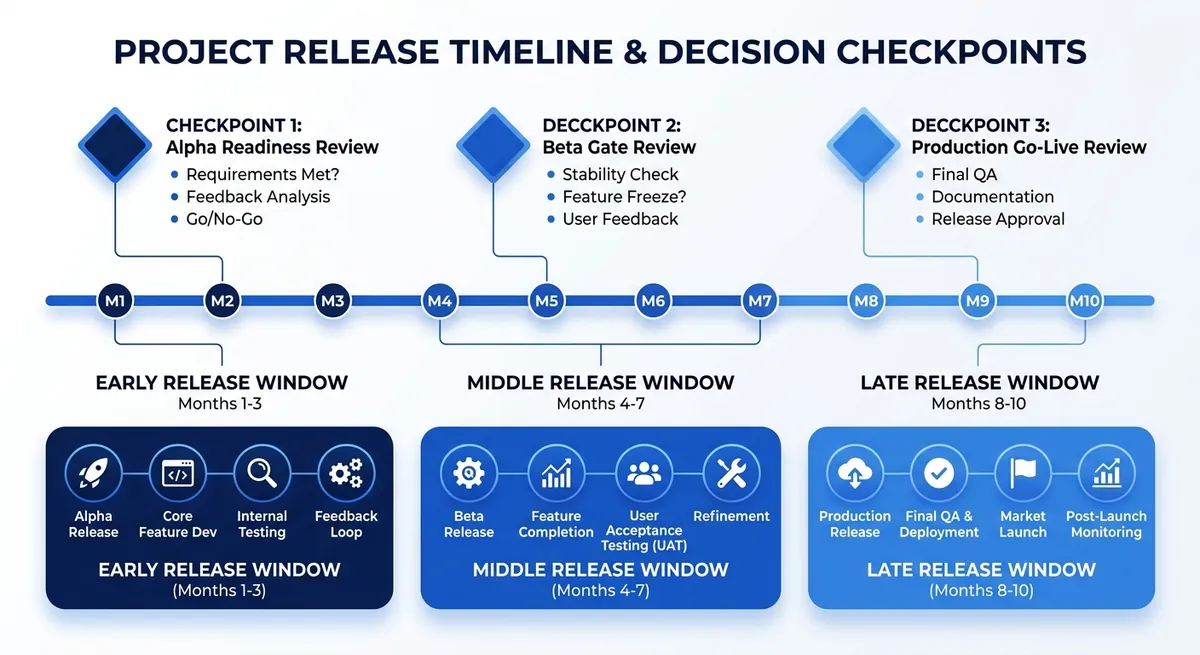
Use scenario ranges: early window, middle window, late window. Set one action for each window, like API smoke tests, load checks, and fallback routing.
Watch official OpenAI channels for real launch signals, then move fast. Ignore rumor spikes on social feeds unless an official post matches them.
If your team needs to keep testing while waiting, you can route across providers and control spend. For example, Crazyrouter states 30-50% lower API pricing than official channels, so teams can keep validation work active during uncertain release timing.
Timeline Context: From GPT-4 to Today#
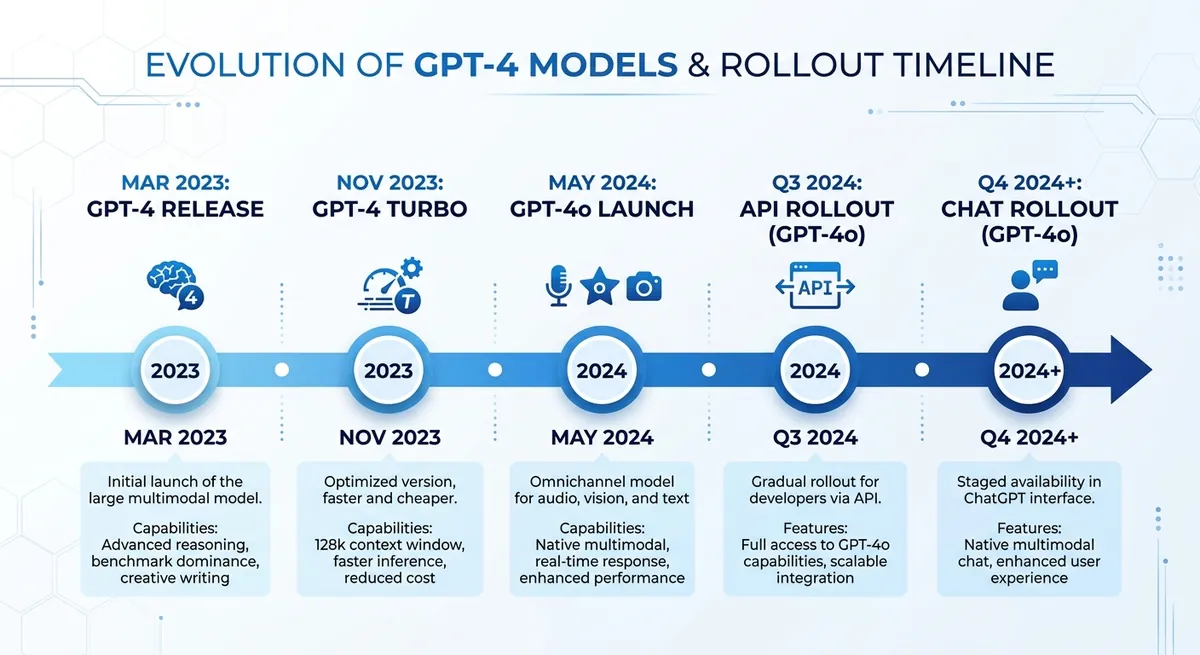
If you are tracking the ChatGPT 6 Release Date, past launch patterns help, but they do not give a fixed calendar. OpenAI has shipped interim model updates that changed output quality before any new flagship label arrived.
Why major version numbers are not the whole story for ChatGPT 6 timing#
Teams often wait for a big version jump, then get surprised by smaller releases that already shift user experience. GPT-4 Turbo and GPT-4o-style updates can affect latency, cost, and quality while product names stay close. Another gap: API access and the ChatGPT app rollout can move on different tracks. A model may appear in one channel while feature flags, rate limits, or plan tiers still block full use elsewhere. Treat staged rollout as the default case, not an edge case.
What historical cadence suggests for ChatGPT 6 Release Date expectations#
Shorter cycles can happen, yet no public rule says each cycle must shrink. Safety checks, compute allocation, and product integration still gate launch speed. That is why hard date claims are weak unless they include proof from official release channels and API docs.
Signals that matter more than hype for ChatGPT 6 launch window#
| Signal | Why it changes planning | What to do right away |
|---|---|---|
| Official release notes and model cards | Confirms real capability and limits | Update QA test cases and fallback rules |
| API availability notice | Confirms you can call the model in production | Run canary traffic, measure error rate |
| Pricing page updates | Changes budget assumptions | Recheck token cost and alert thresholds |
Source basis: Crazyrouter knowledge base states 30-50% lower API pricing claims and support for 300+ models. You can use a multi-provider gateway during the wait so testing continues while the GPT-6 date stays unconfirmed.
Most Likely ChatGPT 6 Release Date Scenarios#
A single date guess breaks planning fast. Treat release timing as probability ranges, not promises. For a usable ChatGPT 6 Release Date plan, track signals you can verify: who gets access, what limits apply, and how stable the API stays.
<.-- IMAGE: Timeline with three paths: early preview, phased rollout, delayed launch; each path shows trigger signals and team actions -->
| Scenario | Planning probability (working estimate) | What launch looks like | Signals to watch | Team move now |
|---|---|---|---|---|
| A. Early limited preview | 30% | Small invite group, API or select paid plans only, tight quotas | Invite-only docs, waitlist updates, low request caps | Build fallback routes and cap-heavy retry logic |
| B. Phased mainstream rollout | 50% | Access expands by tier, features gated behind flags | Tier-by-tier access notes, gradual model availability, changing limits | Stage rollout by user segment and keep model switch config-based |
| C. Delayed launch | 20% | Date shifts due to safety checks or compute pressure | Longer eval cycles, benchmark holdbacks, infra capacity updates | Keep current stack stable and extend test budget window |
Scenario A: ChatGPT 6 early preview release window#
Expect limited API keys and strict rate limits at start. Pricing can stay high during this phase. If your product depends on high volume, preview access helps testing, not full launch traffic. Set a traffic ceiling now. Route overflow to current models so uptime stays stable.
Scenario B: ChatGPT 6 phased rollout timeline#
This is the most likely path for production teams. Access usually expands by subscription tier and region. Feature flags and capability caps may change week by week. Keep your model calls provider-agnostic. Then you can switch models without rewriting core flows.
Scenario C: ChatGPT 6 release delay risk window#
Delays often come from safety review depth and compute scheduling. Plan for a longer waiting period than public chatter suggests. You can use Crazyrouter during that window to keep experiments running at claimed 30–50% lower API cost than official pricing, plus a $0.2 free credit on signup, so teams keep shipping instead of pausing.
Expected ChatGPT 6 Capabilities (And What May Actually Matter)#
The ChatGPT 6 Release Date still has no confirmed public date. That uncertainty can push teams to chase rumors instead of results. The safer move is to rank features by measurable output, then test each claim in your own workflow before any full switch.
ChatGPT 6 release timeline focus: reasoning and factual reliability#
People expect fewer ungrounded answers and steadier reasoning across long tasks. In practice, you should test this with a fixed benchmark set from your real work, like support replies, policy checks, or SQL generation. Track three numbers each week: task success rate, correction rate after review, and human review time per task. If model quality rises but review time stays flat, the gain is weaker than it looks.
| Capability area | Expected gain | What to measure in production | Common failure mode |
|---|---|---|---|
| Reasoning reliability | Fewer wrong steps in complex tasks | Task success rate, correction rate, review minutes | Confident but wrong outputs |
| Longer context behavior | Better handling of long docs and threads | End-to-end completion rate, latency, token cost | Context bloat and hidden prompt errors |
| Agentic execution | More work done per request | Tool-call success, failed handoff count, rollback count | Overreach without permission checks |
| Multimodal quality | Better cross-format understanding | Resolution time, rework rate, output acceptance | Good text, weak image/audio grounding |
| Personalization control | Better fit per user role | Policy violation rate, override count, opt-out rate | Drift from policy baseline |
Table: Capability comparison for GPT-6 readiness. Source: Crazyrouter Core/Product.md (pricing claim context), Domain/Models.md (multi-model operations context), and standard team QA metrics.
ChatGPT 6 Release Date planning: longer context and memory behavior#
Longer context helps with contract review, long ticket threads, and multi-file debugging. You can keep more evidence inside one run, which cuts copy-paste errors. The trade-off is real: bigger prompts raise latency and cost, and prompt design gets harder. Set a hard context budget per workflow. Keep retrieval blocks short and structured, or the model starts to miss key facts buried in noise.
GPT-6 launch expectations: native agentic task execution#
Agentic behavior means the model plans steps, calls tools, and passes work across stages. That can cut manual glue work in support ops and internal automation. Still, governance has to come before rollout. Define tool permissions by role, keep guardrails for risky actions, and log every tool call with timestamp and input hash. Without audit logs, incident review turns into guesswork.
ChatGPT 6 Release Date signals for multimodal quality upgrades#
Text, image, audio, and video in one flow can speed support triage, content ops QA, and analysis pipelines. A support bot could read a screenshot, transcribe a voice note, and draft a response in one pass. <.-- IMAGE: Matrix chart mapping expected GPT-6 feature areas to business use cases. --> Run acceptance tests by modality pair, not text-only tests. Mixed inputs fail in new ways, so your test set must mirror real tickets.
ChatGPT 6 release readiness: personalization and controllability#
User-level adaptation can improve output fit for sales, legal, and support roles. Keep policy controls visible and strict. Add clear opt-out and reset controls for memory-like behavior, and expose why a response used a profile rule. During the wait, you can use a multi-provider gateway like Crazyrouter to keep testing across models with one API key and OpenAI-compatible calls, while tracking cost pressure from its published 30-50% lower pricing claim versus official APIs.
Access, Pricing, and Rollout: What to Expect#
If you are tracking the ChatGPT 6 Release Date, plan for staggered access, not a single launch moment. Track both app and API timelines, not just headlines.
ChatGPT 6 Release Date: app access vs API access#
Consumer app features and API access often move on different clocks. App users may see a model option early, while API teams still wait for docs, rate limits, and billing support. For business teams, this gap changes test plans and launch dates.
<.-- IMAGE: Timeline showing app launch signal, API launch signal, and production readiness checkpoint -->
| Channel | What you may see early | What can lag |
|---|---|---|
| ChatGPT app | New model toggle or limited preview | Stable behavior for production tasks |
| API | Model name in docs or model list | Broad quota, region reach, and predictable latency |
Source: OpenAI timeline for GPT-6 is unconfirmed; channel and model access notes based on Crazyrouter model/API compatibility docs.
ChatGPT 6 Release Date pricing scenarios for early rollout#
Early access may start in paid tiers, then widen later. API cost can also start high, then shift after traffic scales. Keep two budgets: launch-month budget and steady-state budget.
You can use Crazyrouter during this gap if you need multi-model testing; published claims state 30-50% lower pricing than official APIs, with a free trial credit.
ChatGPT 6 availability rollout: who gets access first#
Likely early groups are enterprise accounts, active API developers, and paid plan users. Waitlists, quotas, and region limits can delay teams even after public announcements. So your real go-live date may trail the public ChatGPT 6 Release Date by days or weeks.
How to Prepare Before the ChatGPT 6 Release Date#
Waiting for an official date can freeze delivery. A better move is to get your stack ready now, so the ChatGPT 6 Release Date becomes a switch event, not a rewrite event.
Build a model-agnostic path before ChatGPT 6 launch#
Use an adapter layer between your product logic and model APIs. Keep one internal interface for chat, tools, and retrieval calls. Then map each provider to that interface. Your app code stays stable while model routing changes under it.
Keep prompts in version control like normal code. Store tool schemas and retrieval settings with clear versions too. Run regression checks on each prompt version, so you can see if output quality drops after a model change. The real risk is not missing launch day; it is shipping blind model changes without tests.
If you need multi-provider access during this phase, you can use Crazyrouter with an OpenAI-compatible endpoint and one API key across providers.
Create fallback and cost rules for GPT-6 release readiness#
Route by task type, latency target, and budget ceiling. Use strict failover rules before launch day.
| Task profile | Primary tier | Fallback tier | Control rule |
|---|---|---|---|
| High-stakes reasoning | premium model | balanced model | switch after timeout or error burst |
| Daily support chat | balanced model | low-cost model | cap cost per request window |
| Bulk background jobs | low-cost model | queue and retry | pause when budget ceiling is hit |
Source: routing pattern based on Crazyrouter multi-model support and pricing claim of 30-50% lower than official API pricing; free trial credit listed as $0.2.
Set up a ChatGPT 6 launch-readiness evaluation suite#
Benchmark your key flows now and re-run the same suite after model switch. Track:
- task success rate
- safety violations
- p95 latency
- cost per successful outcome
<.-- IMAGE: Checklist-style readiness framework for GPT-6 migration. -->
Use fixed test prompts plus real production samples. This catches prompt drift early.
Operational access control before ChatGPT 6 goes live#
Use isolated browser profiles for parallel account testing. Keep staging and production sessions separate. Add role-based permissions so QA, prompt editors, and release owners have only the access they need. Rotate keys and expire test sessions fast to reduce leakage risk during launch-week testing.
How to Spot Bad GPT-6 Release Date Claims#
Bad ChatGPT 6 Release Date rumors can freeze hiring, delay launches, and push teams into rushed rewrites. <.-- IMAGE: quick flowchart for checking launch claim credibility -->
ChatGPT 6 Release Date credibility checklist#
Check who published the claim, then open the direct source link. If a post cites “insider news” but gives no URL to an OpenAI page, treat it as noise. Confirm timing only on official release artifacts: OpenAI product pages, API docs, changelog notes, and model availability endpoints.
ChatGPT 6 release date rumor red flags#
Screenshots alone are weak evidence. A real launch trail has a live URL, timestamp, and matching docs update. Watch for claims like “instant access for all users” or extreme price drops with no policy page.
| Claim type | Reliable signal | Red flag |
|---|---|---|
| Release timing | Official OpenAI doc/update | Viral post with no source link |
| Access scope | Staged rollout notes | “Everyone gets it today” |
| Pricing talk | Published pricing page | Unreal numbers, no terms |
ChatGPT 6 release date decision rule for teams#
Do not re-architect from rumors. Set internal triggers: official docs update, API model listing, and production access confirmation.
You can use tools like DICloak during this waiting phase to run parallel tests safely. Isolated browser profiles keep multiple ChatGPT account sessions separate, so teams avoid account mix-ups.
Tools like DICloak let you assign role-based permissions and managed sessions. That keeps pre-release experiments controlled while your rollout plan stays audit-friendly and calm.
Bottom Line: What to Do Next#
Your 30-day plan for the ChatGPT 6 release date#
- Track OpenAI blog posts, model list API updates, and status page changes. Set alerts.
- Lock your benchmark set now: output quality, latency, and cost. Define rollout gates.
- Assign owners for migration, compliance checks, and stakeholder updates.
<.-- IMAGE: 30-day rollout board with alert feeds, benchmark gates, and owner lanes -->
ChatGPT 6 Release Date: switch or wait#
| Trigger | Action |
|---|---|
| Benchmarks beat your current stack and migration risk stays low | Switch in phases |
| Price, uptime, or compliance is not ready | Wait and retest weekly |
Source: Crazyrouter knowledge base claims (30-50% lower API pricing than official APIs).
Do not pause delivery while waiting for a ChatGPT 6 Release Date. Keep shipping now, and use model-agnostic APIs; you can use Crazyrouter to keep testing at claimed 30-50% lower cost.
Frequently Asked Questions#
What is the official ChatGPT 6 Release Date right now?#
Right now, there is no officially confirmed public ChatGPT 6 Release Date. If you see a specific day on social media, treat it as rumor unless OpenAI posts it. The safest sources are OpenAI’s official blog, release notes, and product update pages. Also watch the status page and in-app announcements. These are the first places where OpenAI confirms launch timing, access tiers, and any rollout limits.
Is the ChatGPT 6 Release Date likely to be a single-day global launch?#
A single-day global launch is unlikely. OpenAI often rolls out new models in phases: early preview access, then paid tiers, then wider access. You may see Plus, Team, or Enterprise users get access before free users. API access can also expand in stages based on capacity and safety checks. Some regions may wait longer due to local rules, language support, or infrastructure limits.
Will ChatGPT 6 be available in both ChatGPT and API at the same time?#
Not always. OpenAI can launch a model first in the ChatGPT app, then open API access later, or do the reverse for selected developers. Consumer and developer channels have different needs: UI testing, rate limits, pricing controls, and safety policies. So when tracking the ChatGPT 6 Release Date, monitor both ChatGPT release notes and API model pages. They may show different dates and feature sets.
How should businesses plan if the ChatGPT 6 Release Date gets delayed?#
Plan for delay from day one. Build a model-agnostic stack so you can switch models without rewriting your app. Use fallback routing: if your primary model is unavailable, send traffic to a tested backup. Keep prompts, evals, and guardrails versioned. Run benchmark-driven adoption: compare quality, latency, and cost before full rollout. This way, a delayed ChatGPT 6 Release Date will not block product launches or customer commitments.
Will pricing be higher immediately after the ChatGPT 6 Release Date?#
Early pricing is often premium for new, high-demand models. At launch, providers may set stricter limits and higher per-token costs while they manage capacity. Over time, pricing and limits often improve as systems scale and improved variants appear. Expect tier differences too: consumer plans, business plans, and API pricing can move separately. Read official pricing pages at launch instead of relying on screenshots or old forum posts.
Should I wait for ChatGPT 6 or use current models now?#
Use current models now. Ship features that solve real user problems today, then upgrade later. Build your system to be upgrade-ready: keep prompts modular, isolate model calls behind one service layer, and track performance metrics. This lets you swap in ChatGPT 6 fast when it arrives. Waiting for the ChatGPT 6 Release Date can slow growth, delay feedback, and increase product risk for no clear gain.
How can I verify real news about the ChatGPT 6 Release Date?#
Verify news with primary sources only. Check OpenAI’s official blog, docs, changelogs, and model cards. Look for reproducible proof: a live model name in docs, an official dashboard update, or access links that work in your account. Be careful with leaked screenshots and reposted tweets. If a claim has no official URL, no release note, and no product page update, do not treat it as confirmed launch news.
While there is no confirmed ChatGPT 6 release date yet, the most reliable approach is to watch official announcements, separate rumors from documented updates, and plan your roadmap around capabilities rather than speculation. Teams that stay flexible on integration, testing, and rollout timing will be best positioned to adopt new models quickly and safely. Track official model updates and prepare your stack for fast adoption by following OpenAI release channels and model docs.
Implementation Guides
Available in other languages: