 简体中文
简体中文 繁體中文
繁體中文 English
 Français
 Русский
 日本語
日本語 Tiếng Việt
 한국어
한국어 Deutsch
 Español
 Italiano
 Português
 العربية
 ไทย
ไทย Bahasa Indonesia
 Bahasa Melayu
 Türkçe
 Polski
 Nederlands
 Dansk
Dansk Norsk
Norsk Қазақша
Claude Jupiter v1-p vs GPT-5.5 Benchmark: Real API Test on Reasoning and Coding
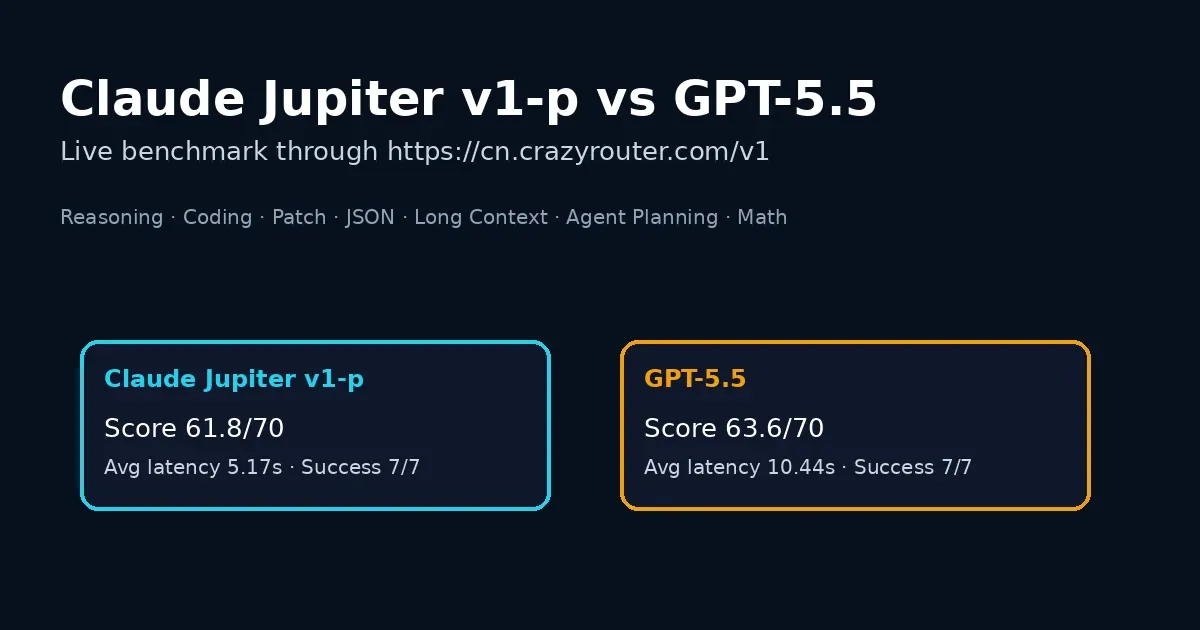
We tested claude-jupiter-v1-p and gpt-5.5 through https://cn.crazyrouter.com/v1 across reasoning, coding, patching, JSON, long-context recall, agent planning, and math tasks. GPT-5.5 scored slightly higher, while Jupiter was much faster but required a payload compatibility fix.
Claude Jupiter v1-p vs GPT-5.5: Real API Benchmark for Reasoning and Coding#
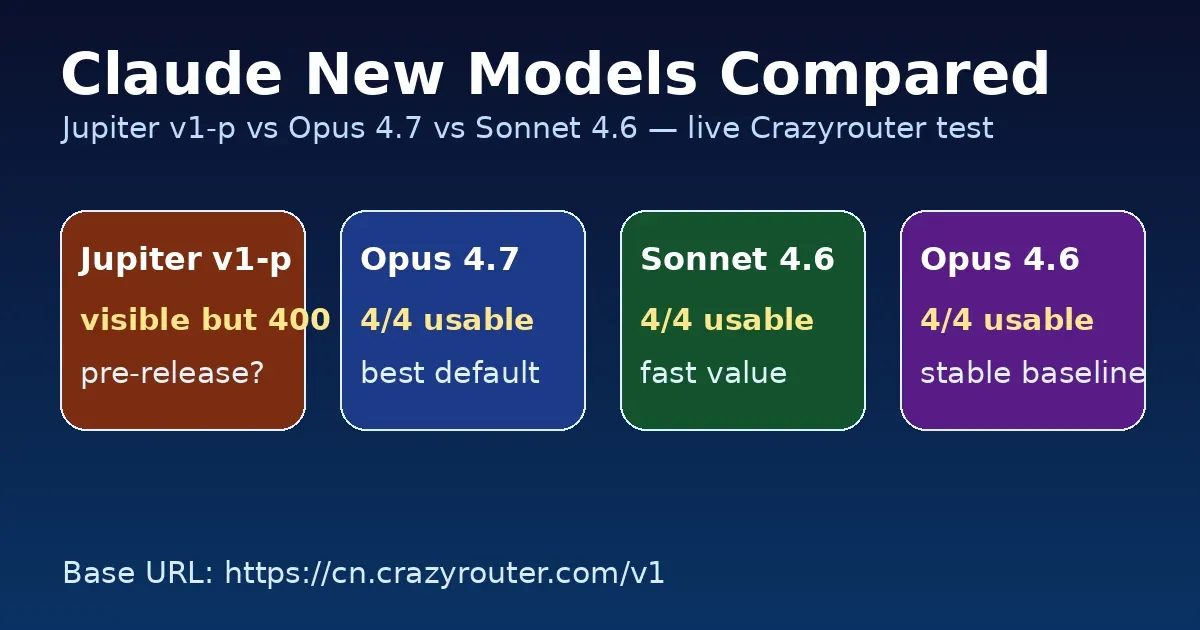
claude-jupiter-v1-p is an interesting model ID because it looks like a test or pre-release Claude route, while gpt-5.5 is the current high-end GPT route available through Crazyrouter.
Instead of guessing from the names, I ran both models through the same benchmark using the China endpoint:
Base URL: https://cn.crazyrouter.com/v1
Models tested:
- claude-jupiter-v1-p
- gpt-5.5
Date: 2026-05-27
The goal was not to create a massive academic benchmark. The goal was more practical:
If I were routing real developer tasks, which model looks smarter, which model codes better, which one is faster, and what hidden API compatibility issues would matter in production?
Short conclusion#
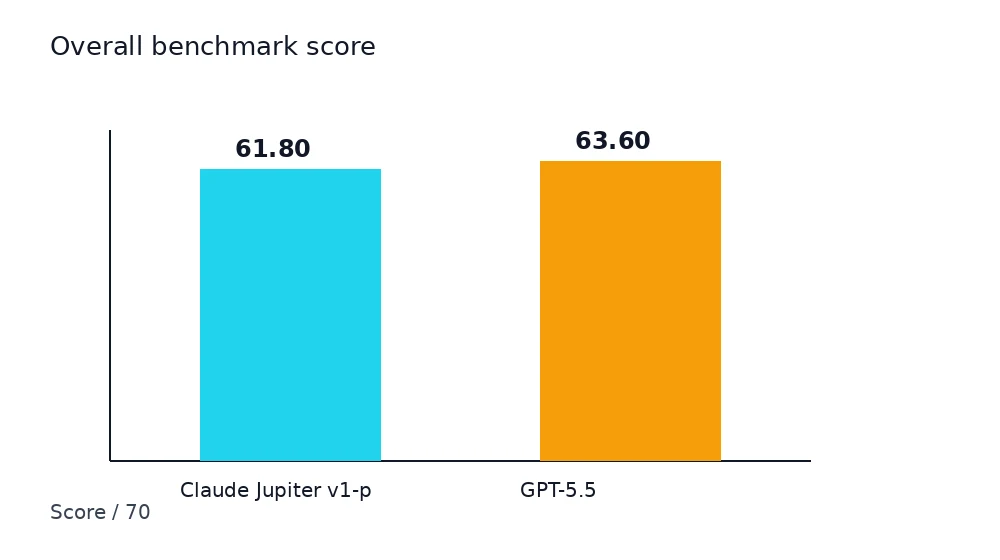
Here is the result from the final runnable test:
| Model | Success rate | Total score | Average score | Average latency | Median latency | Total tokens |
|---|---|---|---|---|---|---|
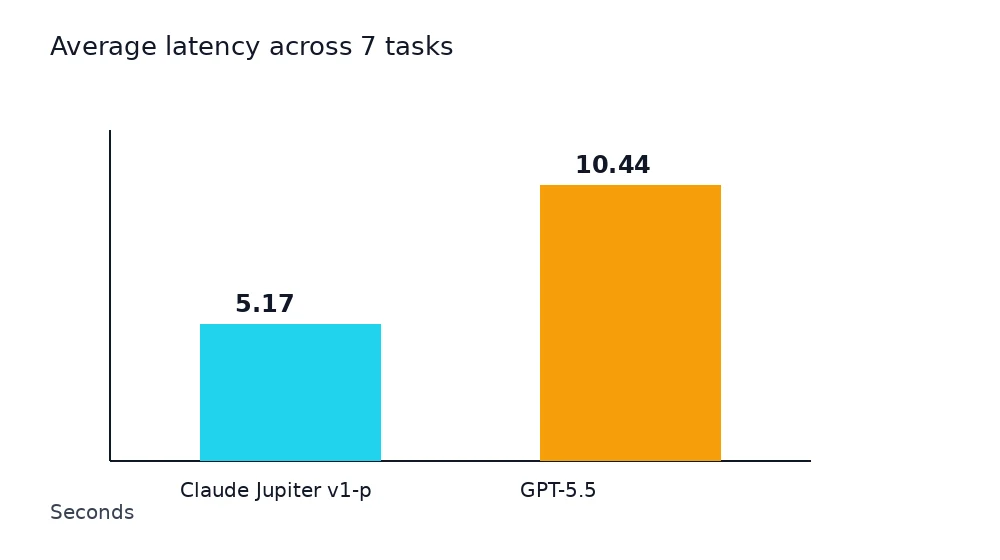
| claude-jupiter-v1-p | 7/7 | 61.8/70 | 8.83/10 | 5.17s | 3.35s | 6096 |
| gpt-5.5 | 7/7 | 63.6/70 | 9.09/10 | 10.44s | 9.63s | 3802 |
My reading:
- GPT-5.5 won narrowly on quality: 63.6/70 vs 61.8/70.
- Claude Jupiter v1-p was much faster: 5.17s average latency vs 10.44s.
- Both models completed all seven tasks in the fair run.
- Jupiter has an important compatibility caveat: with
temperature: 0included in the OpenAI-compatible payload, it returned400 invalid_requeston every task. Removingtemperaturemade it pass 7/7.
So the practical conclusion is:
GPT-5.5 is the safer quality winner.
Claude Jupiter v1-p is surprisingly competitive and faster, but needs payload compatibility checks before production use.
The most important finding: payload compatibility matters#
The first run used the same OpenAI-compatible payload for both models:
{
  "model": "claude-jupiter-v1-p",
  "messages": [...],
  "temperature": 0,
  "max_tokens": 900
}
Result:
| Model | Tasks | Success | Result |
|---|---|---|---|
| claude-jupiter-v1-p | 7 | 0/7 | all returned 400 invalid_request |
| gpt-5.5 | 7 | 7/7 | all completed |
At first glance, that looks like Jupiter failed the benchmark.
But a compatibility probe showed the real issue: Jupiter currently rejects this payload shape when temperature: 0 is included.
I tested several payload variants:
| Jupiter payload variant | Result |
|---|---|
| system + max_tokens + temperature=0 | 0/7 |
| system + max_tokens, no temperature | 7/7 |
| no system, max_tokens, no temperature | 7/7 |
| messages only | 7/7 |
| short minimal prompt | 1/1 |
This matters because production systems often assume OpenAI-compatible parameters are universally accepted. They are not.
For real routing, the correct health check is not just:
Is the model visible in /v1/models?
It should be:
Can the model handle my exact production payload?
Benchmark design#
I used seven tasks designed to reflect practical intelligence and developer usefulness:
| Task | What it tests |
|---|---|
| logic_grid | constraint reasoning and contradiction handling |
| algorithm_design | coding ability, sorting, edge cases |
| bug_fix_patch | patch generation and exception correctness |
| json_schema_extraction | structured output reliability |
| long_context_recall | recall from a long prompt with distractors |
| agent_tool_plan | agent safety policy and workflow design |
| math_word_problem | arithmetic, cost modeling, retry reasoning |
Scoring was heuristic but answer-key based. The raw outputs and scoring JSON are saved with the benchmark so the result can be inspected.
Per-task results#
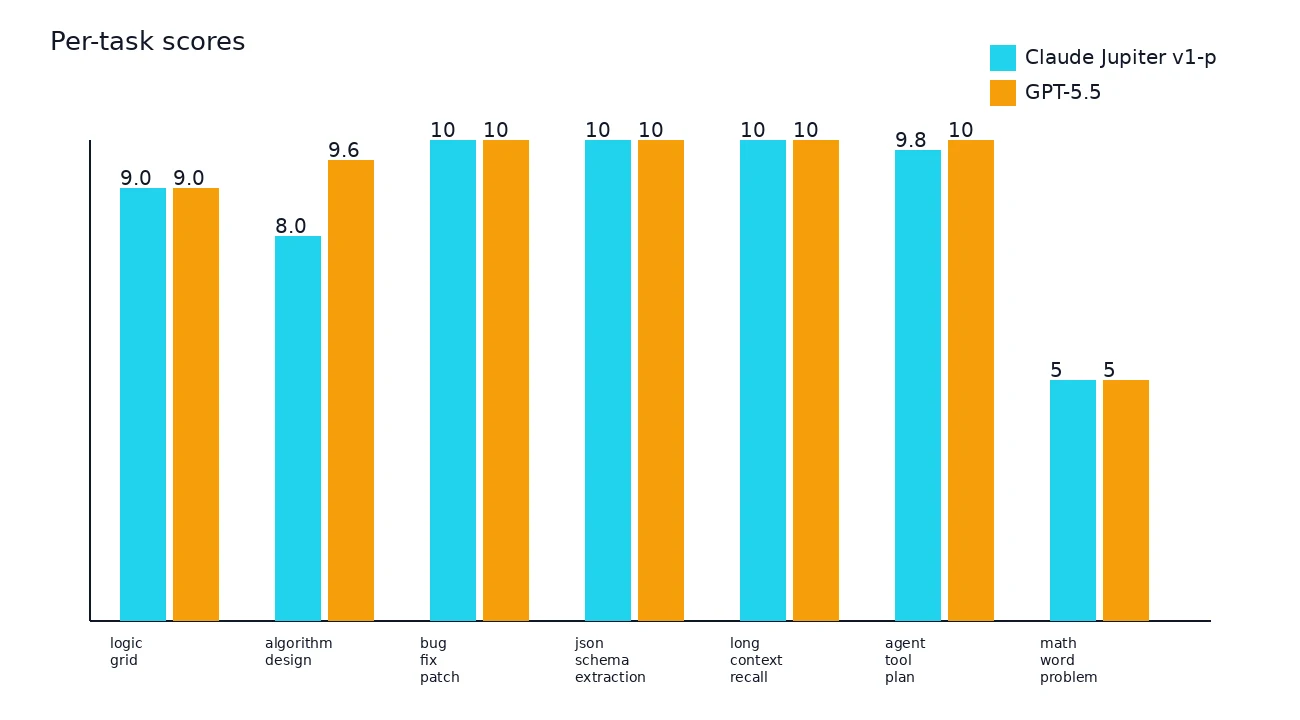
| Task | Jupiter score | GPT-5.5 score | Jupiter latency | GPT-5.5 latency |
|---|---|---|---|---|
| logic_grid | 9.0/10 | 9.0/10 | 5.691s | 11.287s |
| algorithm_design | 8.0/10 | 9.6/10 | 2.411s | 7.045s |
| bug_fix_patch | 10/10 | 10/10 | 3.349s | 9.628s |
| json_schema_extraction | 10/10 | 10/10 | 2.118s | 6.193s |
| long_context_recall | 10/10 | 10/10 | 2.53s | 2.335s |
| agent_tool_plan | 9.8/10 | 10/10 | 13.838s | 14.071s |
| math_word_problem | 5/10 | 5/10 | 6.266s | 22.511s |
A few observations stand out.
1. Reasoning: both solved the logic puzzle#
Both models correctly solved the region/datastore puzzle:
A = Tokyo / Postgres
B = Singapore / S3
C = Frankfurt / Redis
Both scored 9/10. GPT-5.5 gave a more compact answer. Jupiter gave a longer explanation but reached the same result faster.
2. Coding: GPT-5.5 was slightly cleaner on the algorithm task#
The topKFrequent(words, k) task required:
- frequency descending;
- lexicographic tie-break;
- handling
k <= 0and empty input; - better than O(n²).
GPT-5.5 explicitly used localeCompare for tie-breaking and got 9.6/10.
Jupiter also produced a correct implementation, using a direct comparison expression:
entries.sort((a, b) => b[1] - a[1] || (a[0] < b[0] ? -1 : a[0] > b[0] ? 1 : 0));
That is valid, but GPT-5.5's answer was slightly cleaner and easier to read.
3. Patch generation: both were excellent#
Both models fixed the Python retry function correctly:
- initial attempt plus
retriesretries; - preserve and raise the final exception;
- no sleep after the final failed attempt;
- return a unified diff.
Both scored 10/10.
4. JSON extraction: both were perfect#
Both returned valid strict JSON with:
- service;
- severity;
- 27-minute duration;
- connection pool exhaustion root cause;
customer_visible: true;- mitigation actions.
Both scored 10/10.
5. Long-context recall: both passed#
The long-context test buried two important facts among repeated filler:
Jupiter can leave evaluation only after payload stability reaches 99%.
Optimize cost per successful task, not token price.
Both models recalled the key facts correctly.
6. Agent planning: both were strong#
Both models produced an 8-point safe execution policy for an AI coding agent, covering:
- permission boundaries;
- test gates;
- rollback;
- logging;
- model fallback;
- human escalation.
GPT-5.5 was marginally more concise. Jupiter was more detailed.
7. Math/cost reasoning: both got the important answer#
The math problem:
1,200,000 monthly requests
900 input tokens/request
250 output tokens/request
Model X: $0.80/M input, $2.40/M output
Model Y: 35% cheaper but 8% retries
Correct calculation:
Model X = $864 input + $720 output = $1,584.00
Model Y = ($1,584 × 0.65 × 1.08) = $1,111.97
Savings = $472.03/month
Both models produced the correct final conclusion: Model Y is cheaper by about $472.03/month.
What this means for developers#
If you are choosing a default model for coding and agent workflows, I would not make the decision based only on raw score.
I would separate three layers:
Layer 1: Quality#
GPT-5.5 is slightly ahead in this test. It was cleaner on algorithm implementation and more concise in several tasks.
Layer 2: Speed#
Jupiter was much faster in this sample:
Jupiter average latency: 5.17s
GPT-5.5 average latency: 10.44s
That is a big difference if you are building interactive coding tools or agent loops.
Layer 3: Payload stability#
This is where Jupiter needs caution.
The model worked well after removing temperature, but failed completely with temperature: 0 in the payload.
For production, that means you should not simply add it to your model list and route traffic blindly. You should run route-specific health checks:
1. Test /v1/models visibility.
2. Test your exact chat payload.
3. Test streaming if you use streaming.
4. Test tools/function calling if your agent uses tools.
5. Test structured JSON output.
6. Record 400/empty-output/timeout separately.
Recommended routing policy#
Based on this benchmark, I would route like this:
| Use case | Recommended model |
|---|---|
| highest-quality reasoning/coding default | GPT-5.5 |
| latency-sensitive coding helper after compatibility validation | Claude Jupiter v1-p |
| JSON extraction / simple structured tasks | either model |
| agent planning and safety policy | either model, GPT-5.5 slightly safer |
| production routing without custom health checks | GPT-5.5 |
| experimental model lane | Claude Jupiter v1-p |
Reproducibility#
This benchmark used:
Base URL: https://cn.crazyrouter.com/v1
Endpoint: /chat/completions
Models: claude-jupiter-v1-p, gpt-5.5
Tasks: 7
Scoring: answer-key heuristic scoring plus manual inspection of key outputs
Important payload note:
GPT-5.5 used temperature=0.
Claude Jupiter v1-p omitted temperature because compatibility testing showed temperature=0 caused 400 invalid_request.
That is not a minor detail. It is one of the main findings.
Final verdict#
My conclusion:
GPT-5.5 is still the better default if you optimize for quality and production confidence.
Claude Jupiter v1-p is much more capable than a simple test placeholder and was faster in this run, but it must stay behind payload compatibility checks.
If Jupiter's parameter compatibility improves, it could become a very interesting low-latency coding and agent workflow candidate.
But today, I would not replace GPT-5.5 with Jupiter as a default production model.
I would add Jupiter to an evaluation lane, run it against real payloads, and promote it only when route-level stability is proven.