 简体中文
 繁體中文
 English
 Français
 Русский
 日本語
 Tiếng Việt
 한국어
 Deutsch
 Español
 Italiano
 Português
 العربية
 ไทย
 Bahasa Indonesia
 Bahasa Melayu
 Türkçe
 Polski
 Nederlands
 Dansk
 Norsk
 Қазақша
Claude Jupiter v1-p vs Claude Opus 4.7 vs Sonnet 4.6: Live API Test
A live Crazyrouter API test comparing claude-jupiter-v1-p, claude-opus-4-7, claude-sonnet-4-6, and claude-opus-4-6 for coding and structured output workflows.
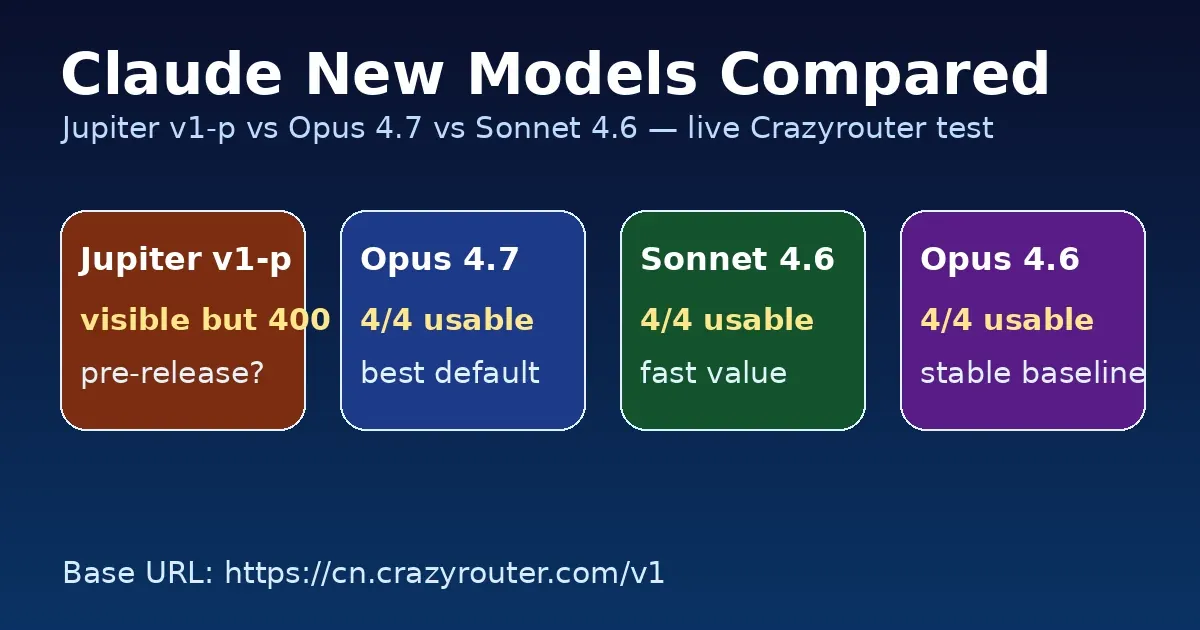
Claude Jupiter v1-p vs Claude Opus 4.7 vs Sonnet 4.6: Live API Test of Anthropic's New Claude Models#
Based on live API calls through
https://cn.crazyrouter.com/v1on 2026-05-26. We testedclaude-jupiter-v1-p,claude-opus-4-7,claude-sonnet-4-6, andclaude-opus-4-6with the same coding and structured-output tasks.
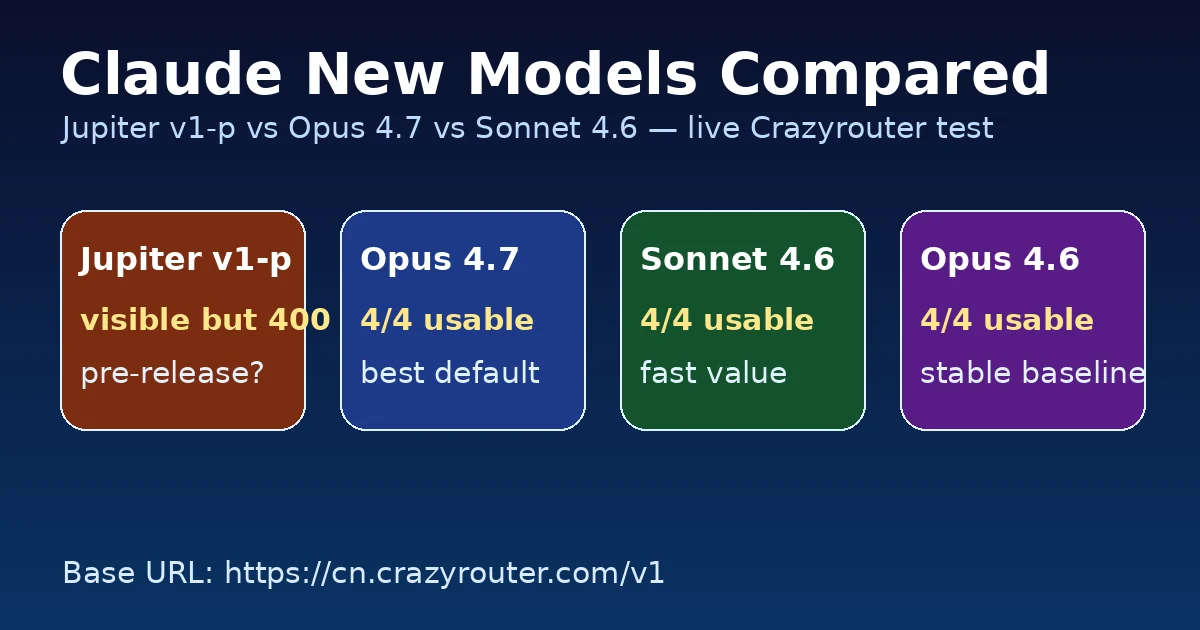
Quick answer#
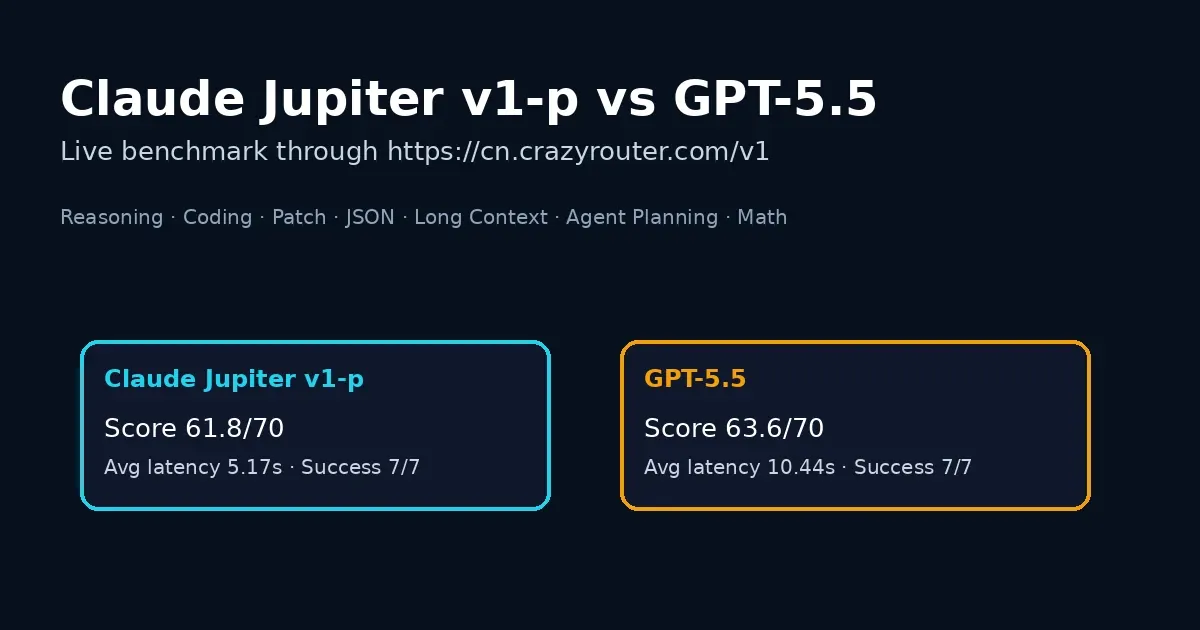
claude-jupiter-v1-p is visible in the Crazyrouter /v1/models list, but in our live Chat Completions test it returned 400 invalid_request for every task. That makes it interesting to watch, but not production-ready in this API path yet.
Among the working Claude models:
- Claude Opus 4.7 is the safest premium default for complex coding and agentic workflows.
- Claude Sonnet 4.6 is the best daily-driver option when you want strong coding output with lower latency and better cost discipline.
- Claude Opus 4.6 remains a stable baseline, but in this run it was slower on structured JSON than Opus 4.7 and Sonnet 4.6.
- Claude Jupiter v1-p should be treated as a watchlist / pre-release model ID until it returns successful content through
/chat/completions.
The practical production rule is simple:
Health-check every model before routing traffic.
Use Sonnet 4.6 for daily coding.
Use Opus 4.7 for hard coding and high-risk agent tasks.
Keep Opus 4.6 as a baseline fallback.
Do not use Jupiter v1-p in production until it returns 200 + usable content.
SERP research: what people are searching for#
Before writing this article, we checked current search results for Claude Jupiter, Claude Opus 4.7, Claude Sonnet 4.6, and Claude model benchmarks.
The current pattern is clear:
- There are rumor-style pages about
claude-jupiter-v1-pappearing in testing or red-team contexts. - Official and semi-official pages emphasize Opus 4.7 as a stronger coding and agentic model compared with Opus 4.6.
- Many benchmark pages repeat headline benchmark claims, but fewer pages show real API behavior through an OpenAI-compatible gateway.
That gap matters. A model can appear in a model list and still fail on a production endpoint. For developers, the first question is not “is the model exciting?” It is:
Can I call it successfully, get usable content, and route production traffic to it?
That is what this article tests.
Test setup#
All tests used Crazyrouter's OpenAI-compatible API:
Base URL: https://cn.crazyrouter.com/v1
Endpoint: /chat/completions
Date: 2026-05-26
Models:
- claude-jupiter-v1-p
- claude-opus-4-7
- claude-sonnet-4-6
- claude-opus-4-6
We first called /v1/models. All four model IDs appeared in the model list:
claude-jupiter-v1-p
claude-opus-4-7
claude-sonnet-4-6
claude-opus-4-6
Then we ran the same four tasks against each model:
- Retry patch — fix a Python retry helper with correct retry semantics.
- JSON schema — return a valid structured JSON object describing routing role, strengths, risks, and recommended use cases.
- Unified diff patch — generate a JS patch for
topK(words, k)with empty-array handling and tie-breaking. - Cost reasoning — explain when to route coding tasks to premium Claude versus cheaper fallback models.
Live test results#
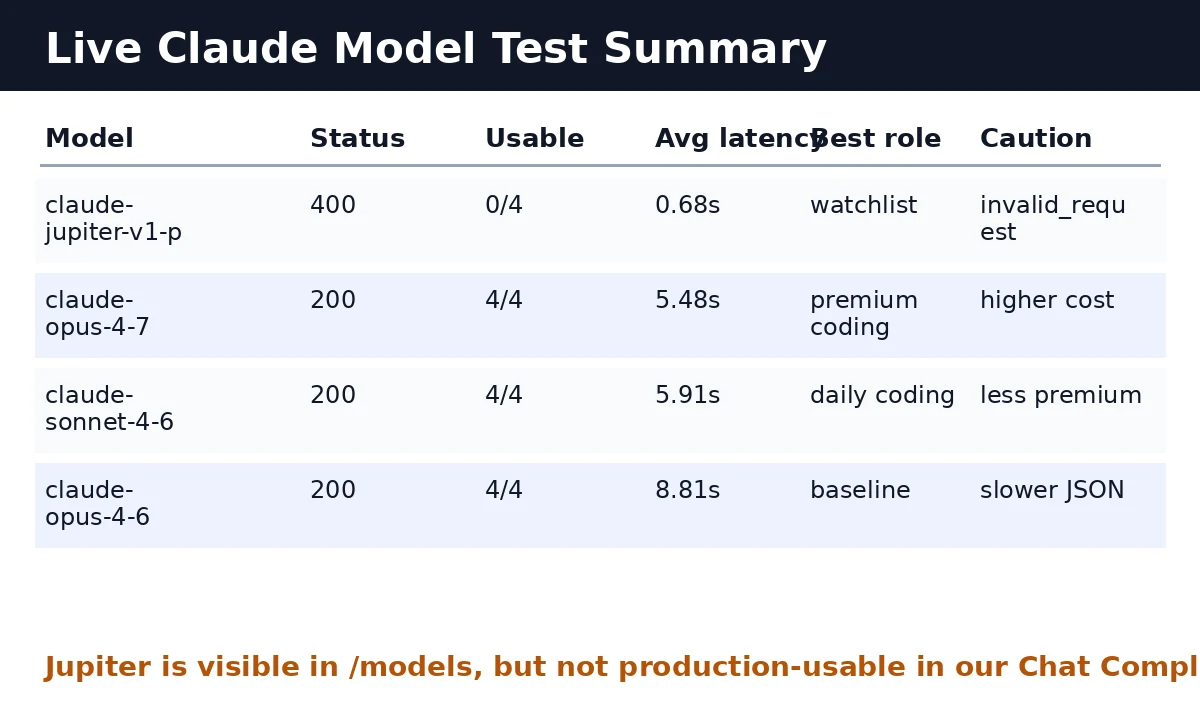
| Model | Endpoint status | Usable outputs | Average latency | Result |
|---|---|---|---|---|
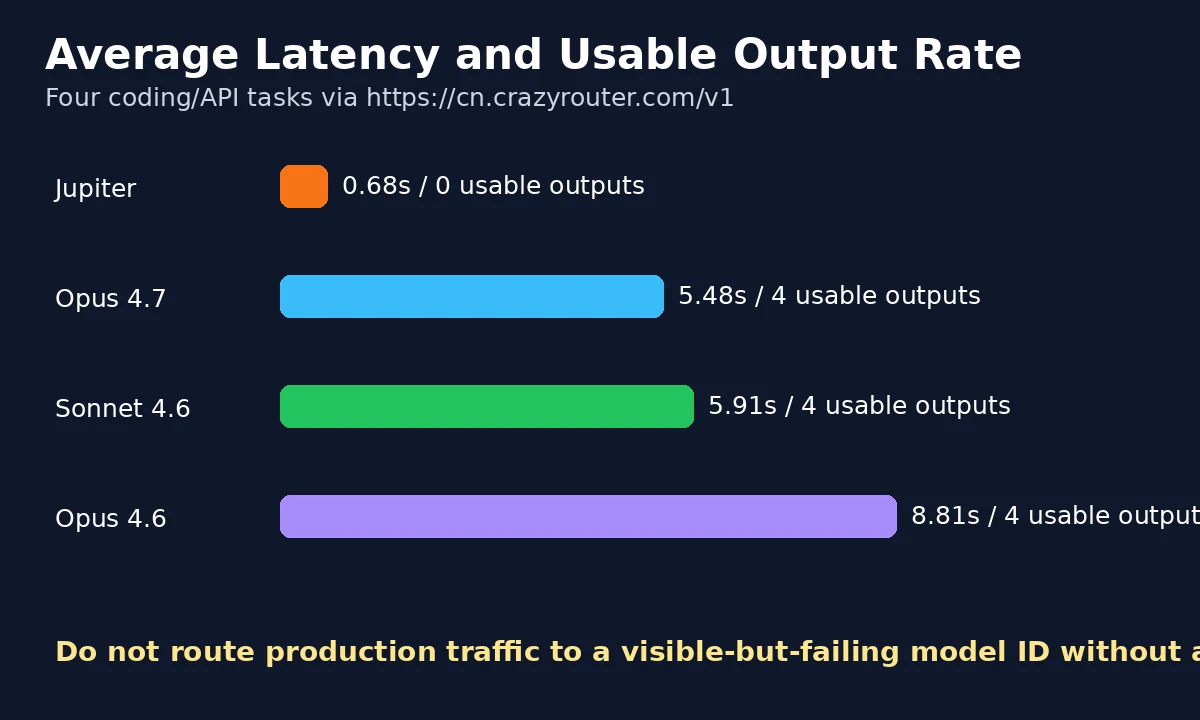
claude-jupiter-v1-p | 400 | 0 / 4 | 0.68s | Visible in model list, but failed all Chat Completions calls |
claude-opus-4-7 | 200 | 4 / 4 | 5.48s | Best premium default for hard coding |
claude-sonnet-4-6 | 200 | 4 / 4 | 5.91s | Strong daily coding model |
claude-opus-4-6 | 200 | 4 / 4 | 8.81s | Stable baseline, slower in this run |
The raw result file is saved internally as:
/root/.openclaw/workspace/generated/claude_new_models_comparison_2026/benchmark.json
What happened with Claude Jupiter v1-p?#
claude-jupiter-v1-p was the most interesting result because it was visible but not callable in our test.
Every request returned HTTP 400 with the same error shape:
{
  "error": {
    "message": "Invalid request.",
    "type": "new_api_error",
    "param": "",
    "code": "invalid_request"
  }
}
That means we should not describe Jupiter as a working production model yet, at least not through this Chat Completions path at the time of testing.
The correct interpretation is cautious:
- The model ID exists in the model list.
- The endpoint rejects normal chat completion requests.
- It may be gated, pre-release, misconfigured, or require different parameters.
- It should not be used in production routing until a health check returns 200 and non-empty content.
For model routers and coding agents, this is an important lesson: model discovery is not enough. You need live request health checks.
Claude Opus 4.7: best premium default#
Claude Opus 4.7 completed all four tasks successfully.
In this run:
- retry patch: 3.24s
- JSON schema: 6.91s
- unified diff patch: 4.09s
- cost reasoning: 7.69s
- usable outputs: 4 / 4
- average latency: 5.48s
The outputs were concise and production-friendly. It fixed the retry helper correctly, generated a usable diff, and produced structured planning output without empty-content failure.
This matches the role we would expect from a premium Claude model:
- complex coding
- production patch generation
- high-risk agent steps
- structured output
- tasks where failure is expensive
The downside is cost. Premium models should not be used for every trivial task. They should be reserved for tasks where success rate matters more than raw token price.
Claude Sonnet 4.6: best daily coding model#
Claude Sonnet 4.6 also completed all four tasks successfully.
In this run:
- retry patch: 2.20s
- JSON schema: 8.23s
- unified diff patch: 3.73s
- cost reasoning: 9.49s
- usable outputs: 4 / 4
- average latency: 5.91s
Sonnet 4.6 was especially fast on the retry patch and unified diff tasks. It is the model I would use as the default for daily coding workflows where you still want Claude-level reliability but do not want to send everything to the most premium Opus model.
Recommended use cases:
- routine bug fixing
- unit test generation
- code explanation
- medium-risk refactors
- CI helper tasks after validation
- IDE assistant workflows
For many teams, Sonnet 4.6 is the practical default, with Opus 4.7 reserved for harder tasks.
Claude Opus 4.6: stable baseline, but slower here#
Claude Opus 4.6 also completed every task successfully.
In this run:
- retry patch: 2.66s
- JSON schema: 17.81s
- unified diff patch: 4.20s
- cost reasoning: 10.58s
- usable outputs: 4 / 4
- average latency: 8.81s
The main issue was the structured JSON task, where it took much longer than Opus 4.7 and Sonnet 4.6. That does not make Opus 4.6 bad. It remains a useful baseline and fallback model. But if Opus 4.7 is available at the same integration layer, Opus 4.7 looks like the better premium routing target.
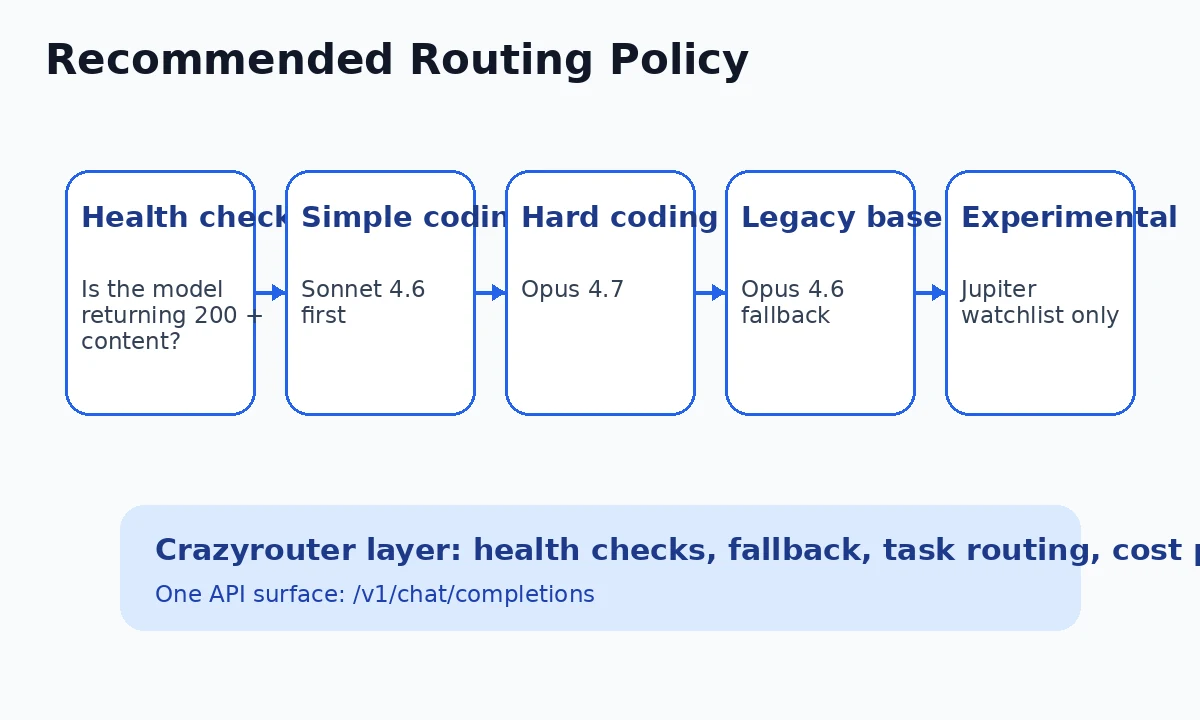
Recommended routing policy#
For a production AI coding stack, I would not hard-code one Claude model everywhere.
A better policy is:
| Task type | Recommended model | Why |
|---|---|---|
| Model health check | all candidates | catch visible-but-failing IDs like Jupiter |
| Daily coding | Claude Sonnet 4.6 | strong quality and practical latency |
| Complex bug fix | Claude Opus 4.7 | better premium default |
| High-risk agent step | Claude Opus 4.7 | success matters more than token cost |
| Baseline fallback | Claude Opus 4.6 | stable backup path |
| Experimental testing | Claude Jupiter v1-p | watchlist only until 200 + content |
Why this matters for Crazyrouter users#
Crazyrouter makes this kind of test useful because all calls go through the same OpenAI-compatible API surface:
from openai import OpenAI

client = OpenAI(
    api_key="YOUR_CRAZYROUTER_KEY",
    base_url="https://cn.crazyrouter.com/v1"
)

response = client.chat.completions.create(
    model="claude-opus-4-7",
    messages=[
        {"role": "user", "content": "Generate a unified diff patch for this bug."}
    ],
    max_tokens=1200,
)

print(response.choices[0].message.content)
The same code can test:
claude-jupiter-v1-p
claude-opus-4-7
claude-sonnet-4-6
claude-opus-4-6
That lets you build a real routing layer:
- discover available models
- run health checks
- measure latency
- validate output quality
- fallback when a model fails
- avoid sending production traffic to a model that only appears available
Final verdict#
Here is the practical conclusion from this live test:
Claude Jupiter v1-p: visible but not usable in this Chat Completions test
Claude Opus 4.7: best premium default for hard coding and agents
Claude Sonnet 4.6: best daily-driver Claude model
Claude Opus 4.6: stable baseline fallback
Crazyrouter: the API layer that makes live comparison and routing practical
The headline is not “Jupiter beats Opus” or “Opus beats Sonnet.”
The real lesson is:
For production AI coding, always combine model discovery with live health checks, output validation, and fallback routing.
That is how you safely adopt new Claude models without breaking your coding agent or CI workflow.
FAQ#
Is claude-jupiter-v1-p available?#
It appeared in the /v1/models list during our test, but every Chat Completions request returned 400 invalid_request. Treat it as visible but not production-usable until live requests succeed.
Is Claude Opus 4.7 better than Opus 4.6?#
In our test, Opus 4.7 completed all tasks and had lower average latency than Opus 4.6. It is the better premium default based on this run.
Is Claude Sonnet 4.6 still worth using?#
Yes. Sonnet 4.6 completed all tasks and was especially fast on patch and diff tasks. It is a strong default for daily coding.
Which Claude model should coding agents use?#
Use Sonnet 4.6 for routine tasks, Opus 4.7 for difficult or high-risk steps, and keep Opus 4.6 as a fallback. Do not route to Jupiter until it passes health checks.
Why use Crazyrouter for Claude model testing?#
Crazyrouter lets you compare and route multiple models through one OpenAI-compatible API endpoint. That makes it easier to test availability, latency, output quality, and fallback behavior before production deployment.
Implementation Guides
Podcast
AI Dev Tools: The Crazyrouter Podcast
Short episodes for developers on AI APIs, gateways, cost control and coding tools.
Latest episodes
EP196 · Oct 29, 2026 · 6:53
AI API Security Posture — Turn Controls Into Continuous Evidence
A practical guide to AI API security posture: inventory exposure, verify controls continuously, protect keys and data, constrain tools, and turn security assumptions into evidence that operators can act on.
EP195 · Oct 28, 2026 · 7:21
AI API Policy Drift — Detect When Production Rules Stop Matching Intent
A practical guide to policy drift in AI APIs: version routing and safety rules, detect stale enforcement, compare intended and observed behavior, and restore control before small gaps become incidents.