 简体中文
 繁體中文
 English
 Français
 Русский
 日本語
 Tiếng Việt
 한국어
 Deutsch
 Español
 Italiano
 Português
 العربية
 ไทย
 Bahasa Indonesia
 Bahasa Melayu
 Türkçe
 Polski
 Nederlands
 Dansk
 Norsk
 Қазақша
Designing an AI API Provider Abstraction Layer Without Losing Features
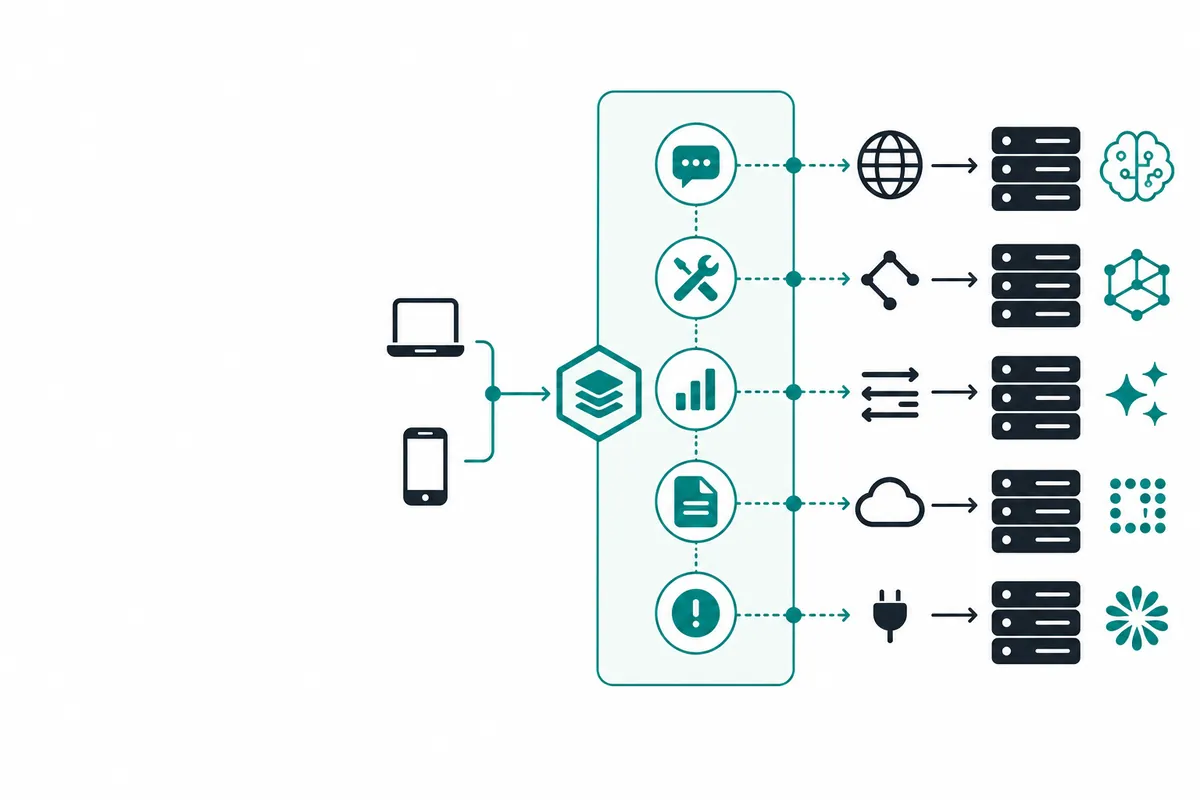
A provider abstraction should hide transport and lifecycle differences, not erase useful capabilities. Define a stable core for messages, tools, usage, errors, and tracing. Keep provider ext

Designing an AI API Provider Abstraction Layer Without Losing Features#
A provider abstraction should hide transport and lifecycle differences, not erase useful capabilities. Define a stable core for messages, tools, usage, errors, and tracing. Keep provider extensions for vision, reasoning controls, audio, and structured outputs. This prevents the lowest common denominator from becoming your product design. This guide is for developers who need an implementation path, not a product slogan. It covers the concept, alternatives, a tested API pattern, pricing, production controls, and FAQ answers.
What is Designing an AI API Provider Abstraction Layer Without Losing Features?#
A provider abstraction should hide transport and lifecycle differences, not erase useful capabilities. Define a stable core for messages, tools, usage, errors, and tracing. Keep provider extensions for vision, reasoning controls, audio, and structured outputs. This prevents the lowest common denominator from becoming your product design. In a real application, the model is only one component. You also need authentication, input limits, output validation, telemetry, retries, and a clear policy for data retention. Keep these controls in application code rather than asking the model to enforce them.
Designing an AI API Provider Abstraction Layer Without Losing Features vs alternatives#
Direct SDKs expose every feature but spread provider logic through your codebase. A gateway or internal adapter reduces coupling. Start with one normalized interface, but preserve the raw response and provider metadata for debugging. The goal is reversible routing, not pretending all models behave identically.
| Decision area | Direct provider | Self-hosted model | Crazyrouter |
|---|---|---|---|
| Setup | Fast for one provider | Highest operations burden | Fast multi-model setup |
| Model choice | One ecosystem | Your deployed weights | 627+ model catalog |
| Failover | Usually application-built | Application-built | Centralized route options plus application policy |
| Billing | Separate provider accounts | GPU and operations | One pay-as-you-go account |
How to use it with code#
The following smoke-test pattern was verified against https://cn.crazyrouter.com/v1 on 2026-09-28. The gateway returned HTTP 200 for /v1/models and for a chat completion request. Use an environment variable in production and replace the model with one shown in the live model list.
from openai import OpenAI
client=OpenAI(base_url="https://cn.crazyrouter.com/v1",api_key="YOUR_KEY")
response=client.chat.completions.create(model="gpt-5-mini",messages=[{"role":"user","content":"Return a short production checklist."}],max_tokens=200)
print(response.choices[0].message.content)
curl https://cn.crazyrouter.com/v1/chat/completions \
  -H "Authorization: Bearer $CRAZYROUTER_API_KEY" \
  -H "Content-Type: application/json" \
  -d '{"model":"gpt-5-mini","messages":[{"role":"user","content":"Reply with a health check"}],"max_tokens":40}'
For Node.js, the same OpenAI-compatible route can be configured with baseURL: "https://cn.crazyrouter.com/v1". Do not expose the key in browser JavaScript. Put requests behind your server, attach a tenant ID, and enforce a budget before sending long prompts or launching asynchronous media jobs.
Pricing breakdown#
| Route | Pricing model | Best fit |
|---|---|---|
| Official provider | Provider input/output rates | One-provider production |
| Self-hosted open model | GPU, storage, and operations | Predictable high volume or strict data control |
| Crazyrouter | Pay as you go; verify live rates | One key, many models, fast comparison |
Prices and availability change, so check the live Crazyrouter pricing page before forecasting a launch. Do not promise a fixed model price in application code.
The practical calculation is cost per successful task. Include retries, failed generations, moderation checks, retrieval calls, and storage. A cheaper model that needs two retries or produces invalid JSON may be more expensive than a stronger model that succeeds once. Crazyrouter is useful for comparing models through one key; always confirm the current model name and rate on the live pricing page.
Production checklist#
- Keep API keys in a secret manager or runtime environment.
- Set timeouts and bounded exponential backoff for transient failures.
- Validate JSON, tool arguments, and generated URLs outside the model.
- Record request ID, model, latency, token usage, status, and estimated cost.
- Apply per-user and per-tenant quotas before the provider call.
- Redact personal data from logs and minimize what leaves your system.
- Maintain a fallback or human-review path for high-impact actions.
FAQ#
Is this suitable for production?#
Yes, when the integration has authentication, quotas, observability, validation, and a rollback path. A successful demo alone is not a production readiness test.
Is the official API cheaper than a gateway?#
It depends on the model, volume, region, and gateway pricing. Compare effective cost per successful task, not a general assumption. Check current rates before committing.
Can I switch models later?#
Yes, if application logic is separated from model selection and you test output quality, schema behavior, latency, and safety after every route change.
How do I reduce AI API costs?#
Use smaller models for routine tasks, cap output tokens, summarize repeated context, cache deterministic work, batch non-urgent jobs, and stop unbounded retries.
Summary#
A provider abstraction should hide transport and lifecycle differences, not erase useful capabilities. Define a stable core for messages, tools, usage, errors, and tracing. Keep provider extensions for vision, reasoning controls, audio, and structured outputs. This prevents the lowest common denominator from becoming your product design. Start with a narrow workflow, a versioned evaluation set, and a measured fallback. Crazyrouter provides one API surface for comparing many models while you keep product policy and security in your own application.
Implementation Guides
Podcast
AI Dev Tools: The Crazyrouter Podcast
Short episodes for developers on AI APIs, gateways, cost control and coding tools.
Latest episodes
EP196 · Oct 29, 2026 · 6:53
AI API Security Posture — Turn Controls Into Continuous Evidence
A practical guide to AI API security posture: inventory exposure, verify controls continuously, protect keys and data, constrain tools, and turn security assumptions into evidence that operators can act on.
EP195 · Oct 28, 2026 · 7:21
AI API Policy Drift — Detect When Production Rules Stop Matching Intent
A practical guide to policy drift in AI APIs: version routing and safety rules, detect stale enforcement, compare intended and observed behavior, and restore control before small gaps become incidents.
Available in other languages: