 简体中文
 繁體中文
 English
 Français
 Русский
 日本語
 Tiếng Việt
 한국어
 Deutsch
 Español
 Italiano
 Português
 العربية
 ไทย
 Bahasa Indonesia
 Bahasa Melayu
 Türkçe
 Polski
 Nederlands
 Dansk
 Norsk
 Қазақша
Claude Opus 5.5 vs GPT-6.1 Sol: Benchmarks, Pricing, and Selection
Compare official benchmarks and API prices for Claude Opus 5.5 and GPT-6.1 Sol, with a 16-request Crazyrouter sample. Vendor claims and local results stay separate; the sample contains no Opus comparison.

As of October 30, 2026, the public evidence is insufficient to give Claude Opus 5.5 and GPT-6.1 Sol an overall ranking that applies to every task. Across 16 task requests to GPT-6.1 Sol through a fixed channel, Crazyrouter recorded 14 complete deliveries, with 13/14 delivered answers fully correct; without same-task Opus 5.5 samples, these local data cannot determine a winner. Separately, official release materials state that GPT-6.1 Sol scored 2.2 percentage points higher than Opus 5.5 on AutomationBench at medium reasoning effort, at approximately one-third the cost per task; Opus 5.5 demonstrated a strong capability ceiling in another set of coding and science benchmarks at high reasoning effort. These vendor evaluations should not be treated as an independent comparison conducted in the same laboratory with the same configuration.
If you prioritize long-running, multistep coding-agent work, consider putting Opus 5.5 on your shortlist first; if you handle large volumes of everyday tasks and want to control API costs, GPT-6.1 Sol is a useful starting point for testing. Your final choice should depend on your own task pass rate, rework, and total bill, rather than a single leaderboard.
Claude Opus 5.5 vs GPT-6.1 Sol: Which Is Better for Everyday Work?#
The two models target overlapping use cases, but the public data highlight different strengths: Opus 5.5 performs strongly in the difficult coding, desktop operation, and knowledge-work tests published by Anthropic, while OpenAI emphasizes GPT-6.1 Sol's cost efficiency in professional documents, business workflows, and scientific research tasks. The public evidence supports choosing by workload, not extrapolating one vendor's lead on a single benchmark into an overall victory.
Quick Comparison#
| Dimension | Claude Opus 5.5 | GPT-6.1 Sol | Interpretation caveats |
|---|---|---|---|
| Official API model name | claude-opus-5-5 | gpt-6.1-sol | When using a third-party gateway, refer to its current /v1/models response and documentation |
| Standard official API price / million tokens | Input 20; cache reads $0.20 | Input 10; cached input $0.10 | GPT-6.1 Sol's standard input, output, and cached-input list prices are approximately half those of Opus 5.5; actual bills also depend on caching, tools, and output length |
| API context window | 1,000,000 tokens | 1,050,000 tokens | The actual usable window also depends on the product, interface, and request configuration |
| Default reasoning effort | medium; adaptive thinking is always enabled | medium | Identically named effort levels do not guarantee the same reasoning budget or compute |
| Anthropic SWE-bench Pro subset | medium: 92.8% solved, $0.22 / solved task | No public comparison on the same subset | The original compatible subset contained 482 tasks; the two Opus 5.5 runs were scored on 478 tasks, and are not equivalent to public leaderboard results |
| AutomationBench | Anthropic reports 40.0%, without fallback in this run | OpenAI reports a lead of 2.2 percentage points at medium reasoning effort, at approximately one-third the cost per task | Anthropic's page also notes that its Opus 5.5 result came from early Zapier testing; fallback and execution conditions in different reports must be considered separately |
| GDP.pdf professional documents | OpenAI's comparison states that GPT-6.1 Sol outperformed Opus 5.5 with fallback at every tested reasoning effort level, at less than half the cost per task | Self-reported results in OpenAI's release materials | The published text does not provide the full scores for this comparison; it does not establish that GPT-6.1 Sol wins on all PDF or knowledge-work tasks |
| Terminal-Bench 4.0 | Anthropic reports 66.4%, using xhigh effort | GPT-6.1 Sol is not listed in Anthropic's table | The GPT comparison in that table is GPT-6 Astra, not GPT-6.1 Sol |
| Terminal-Bench Science 0.1 | Anthropic reports 58.7%; standard error is ±3.5–5 percentage points | OpenAI reports an average cost per task of 23.21 for Opus 5.5; the release text does not provide an exact GPT-6.1 Sol score | Task pass rate and cost per task are separate metrics; lower cost cannot be described as higher accuracy |
| Crazyrouter local small sample | No same-task Opus 5.5 results | 14 complete deliveries from 16 requests; 13/14 delivered answers correct, plus 2 timeouts | An independent workload record through a fixed channel on 2026-09-30, not an Opus comparison or a measure of long-term availability |
Official Benchmarks Highlight Different Strengths#
Business Workflows: GPT-6.1 Sol's Cost Claim Is More Explicit#
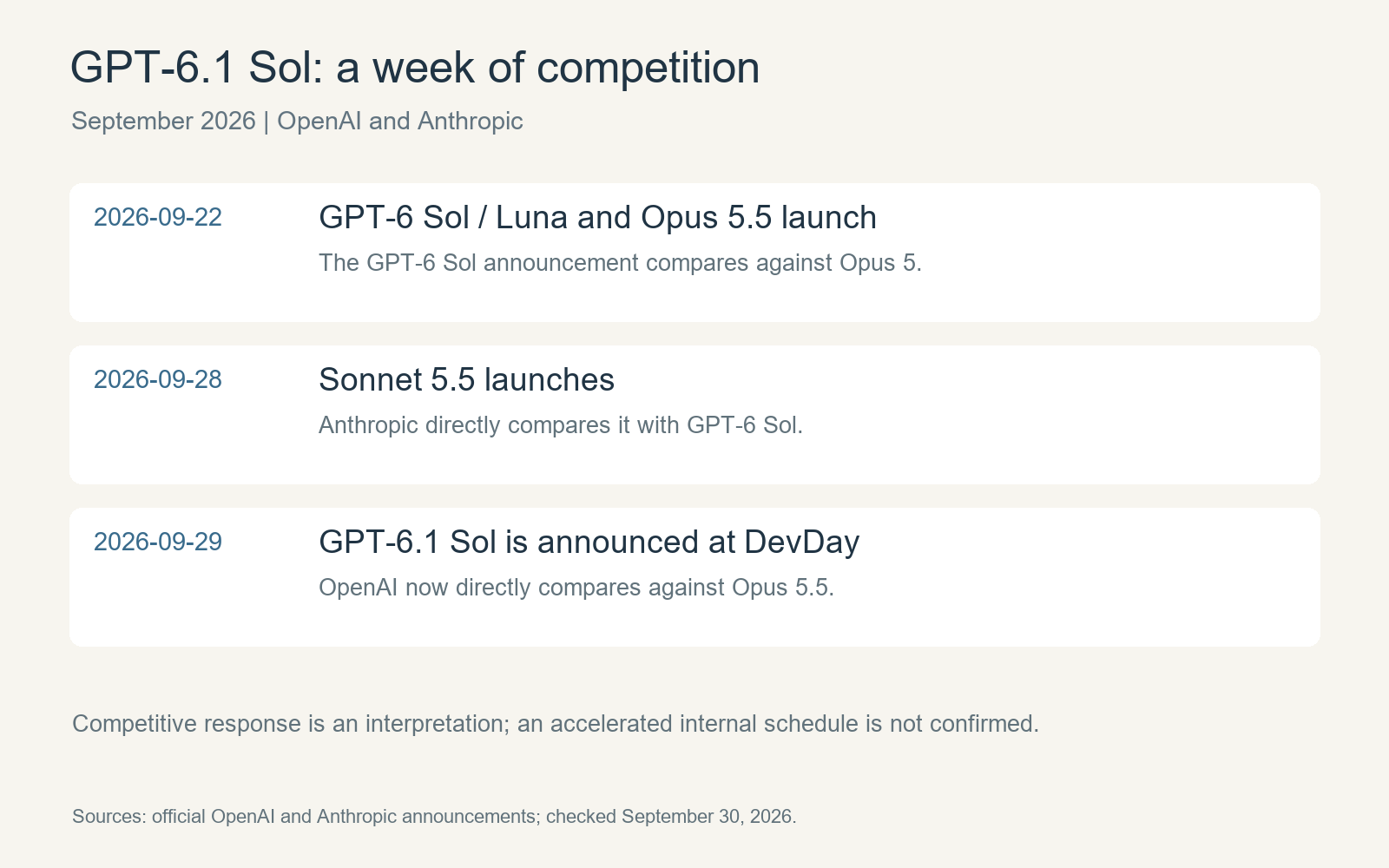
In its September 29, 2026 release materials, OpenAI states that GPT-6.1 Sol scored 2.2 percentage points higher than Opus 5.5 on AutomationBench at medium reasoning effort, at approximately one-third the cost per task. AutomationBench tests agents using 47 tools to complete end-to-end workflows in sales, marketing, operations, customer service, finance, and human resources.
Anthropic's Opus 5.5 page lists an AutomationBench score of 40.0% and explicitly states that this run did not use fallback; GPT-6 Astra scores 41.4% in the same table. Therefore, when citing OpenAI's direct comparison, retain the attribution to OpenAI's release materials; figures from the two vendors' pages cannot be stitched together into an independent experiment with fully identical controlled conditions. Fallback affects completion rates and costs, as well as the actual results delivered to users.
Coding: Opus 5.5 Has Strong Published High-Effort Results, While Direct GPT-6.1 Sol Scores Are Scarcer#
Anthropic reports that Opus 5.5 scored 66.4% on Terminal-Bench 4.0 using xhigh reasoning effort; the same page lists GPT-6 Astra at 57.9%, but provides no GPT-6.1 Sol result for that benchmark. Anthropic also reports that Opus 5.5 scored 54.4% on the FrontierCode v1.1 main set, above the table's GPT-6 Astra score of 53.3%. These figures show that Opus 5.5 is competitive in the listed coding-agent tests, but do not directly establish that it necessarily outperforms GPT-6.1 Sol, because the comparison models, reasoning effort levels, or evaluation conditions are not fully aligned.
Anthropic's model cost guide also publishes another, more recent set of coding results: its SWE-bench Pro compatible subset originally contained 482 tasks; because of scoring-container issues, the two Opus 5.5 medium runs were scored on the remaining 478 tasks, achieving a solve rate of 92.8% at approximately $0.22 per solved task. Anthropic explicitly notes that this subset and its execution conditions differ from the public SWE-bench Pro leaderboard and the results in the Opus 5.5 system card. OpenAI has not published a GPT-6.1 Sol comparison score on the same subset, so these figures only provide an additional quality and cost baseline for Opus 5.5 itself.
OpenAI's claims for GPT-6.1 Sol focus on DeepSWE v1.1: it states that GPT-6.1 Sol exceeds GPT-6 Sol's highest score by 6.4 percentage points even at a lower reasoning effort, while matching GPT-6 Astra's results at approximately one-fifth the task cost. This result is evidence of GPT-6.1 Sol's improvement over the previous Sol generation, not a comparison score against Opus 5.5.
Professional Documents and Science Tasks: Consider Delivery Cost and Whether Scores Are Provided#
OpenAI states that GPT-6.1 Sol outperformed "Opus 5.5 with fallback" at every tested reasoning effort level on GDP.pdf, at less than half the cost per task. GDP.pdf requires models to answer professional questions from complex PDFs containing tables, charts, diagrams, and detailed provisions. Because the release text does not also provide complete scores for each effort level, fallback execution details, and a shared evaluation record, this conclusion is useful as a selection lead, but should not be rewritten as an unconditional verdict.
On Terminal-Bench Science 0.1, OpenAI reports an average cost per task of 23.21 for Opus 5.5. Anthropic reports an Opus 5.5 score of 58.7%, noting a standard error of ±3.5–5 percentage points; however, OpenAI's release text does not list an exact GPT-6.1 Sol score. The published cost information can therefore be compared, but these two statements alone cannot establish which model has the higher science-task success rate.
How Large Is the API Price Gap?#
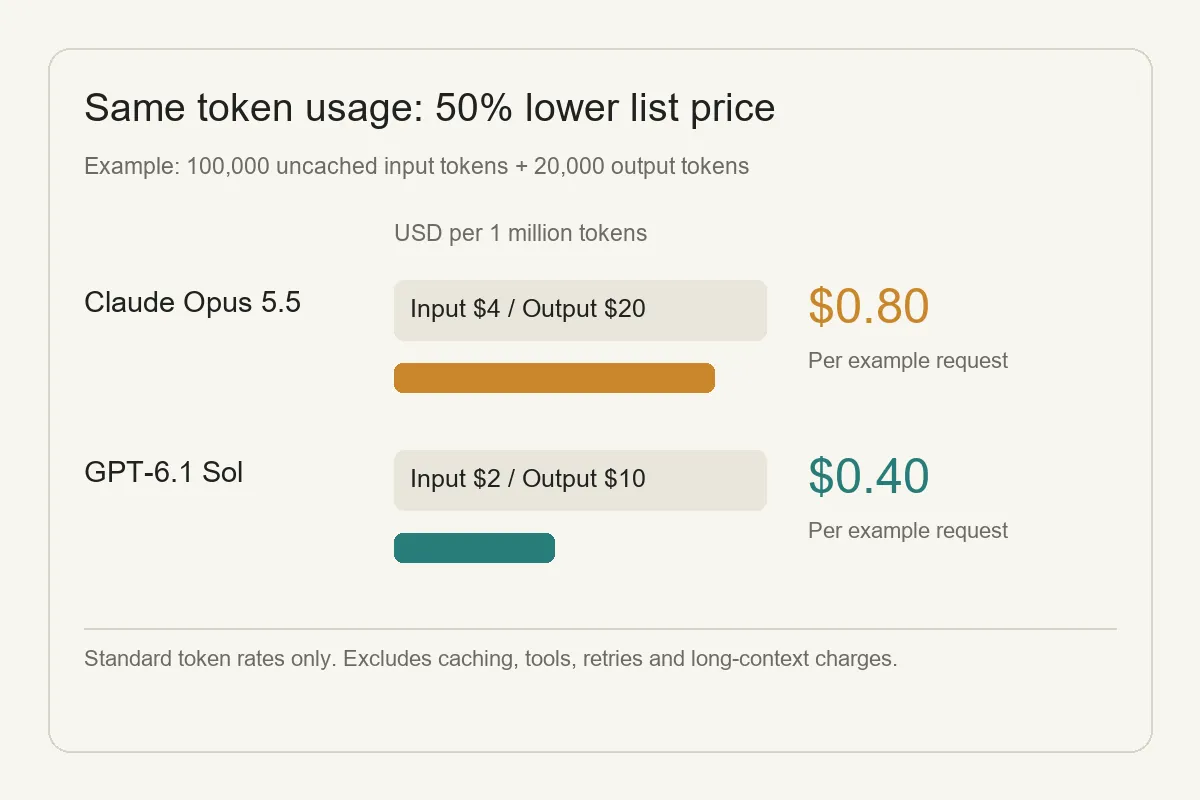
At the standard API list prices on the two vendors' official pages, Opus 5.5 costs 20 per million output tokens; GPT-6.1 Sol costs 10. For a request using 100,000 uncached input tokens and 20,000 output tokens, the estimate at standard list prices is:
input_tokens = 100_000
output_tokens = 20_000

opus55 = input_tokens / 1_000_000 * 4 + output_tokens / 1_000_000 * 20
gpt61 = input_tokens / 1_000_000 * 2 + output_tokens / 1_000_000 * 10

print(f"Opus 5.5: ${opus55:.2f}")
print(f"GPT-6.1 Sol: ${gpt61:.2f}")
This example yields 0.40 for GPT-6.1 Sol. It compares only the list prices for uncached text tokens, excluding retries, tool calls, long-context surcharges, caching strategies, or discounts from other hosting platforms. For GPT-6.1 Sol API requests with more than 272,000 input tokens, the official pricing documentation states that the request is billed at higher long-context rates; Opus 5.5's official documentation states that its 1M context window is billed at standard rates. Anthropic and OpenAI may also differ in token accounting, reasoning overhead, and product configuration, so "half the list price" does not mean "necessarily half the total bill for the same workflow."
Before using either model, you can consult Browse models and integration options by vendor and the Model pricing comparison. To check vendor listings, you can also consult the Anthropic model catalog and OpenAI model catalog. Discounts and billing configurations on different platforms may differ from vendors' standard list prices.
What Can Crazyrouter's GPT-6.1 Sol Records Tell Us?#
In a round of local development-workload testing on September 30, 2026, GPT-6.1 Sol used a fixed channel, reasoning_effort=high, and max_completion_tokens=8192. Each of 8 task types was requested independently twice, for 16 requests in total: 14/16 produced complete deliveries, of which 13 delivered answers were fully correct; the other two requests did not return a complete response within 240 seconds. The main batch included hidden checks for two coding tasks; a separate simulated tool workflow was not included in those 16 main tasks. Small-sample results of this kind cannot replace long-running repository development tests.
This test round did not include Claude Opus 5.5 on the same task set. It therefore shows GPT-6.1 Sol's delivery performance on this batch, but cannot support claims that GPT-6.1 Sol is more accurate, faster, or more stable than Opus 5.5. Compared with official benchmarks, its value is to add a small-sample record through a real gateway path, while reminding readers to count timeouts as part of the delivery experience.
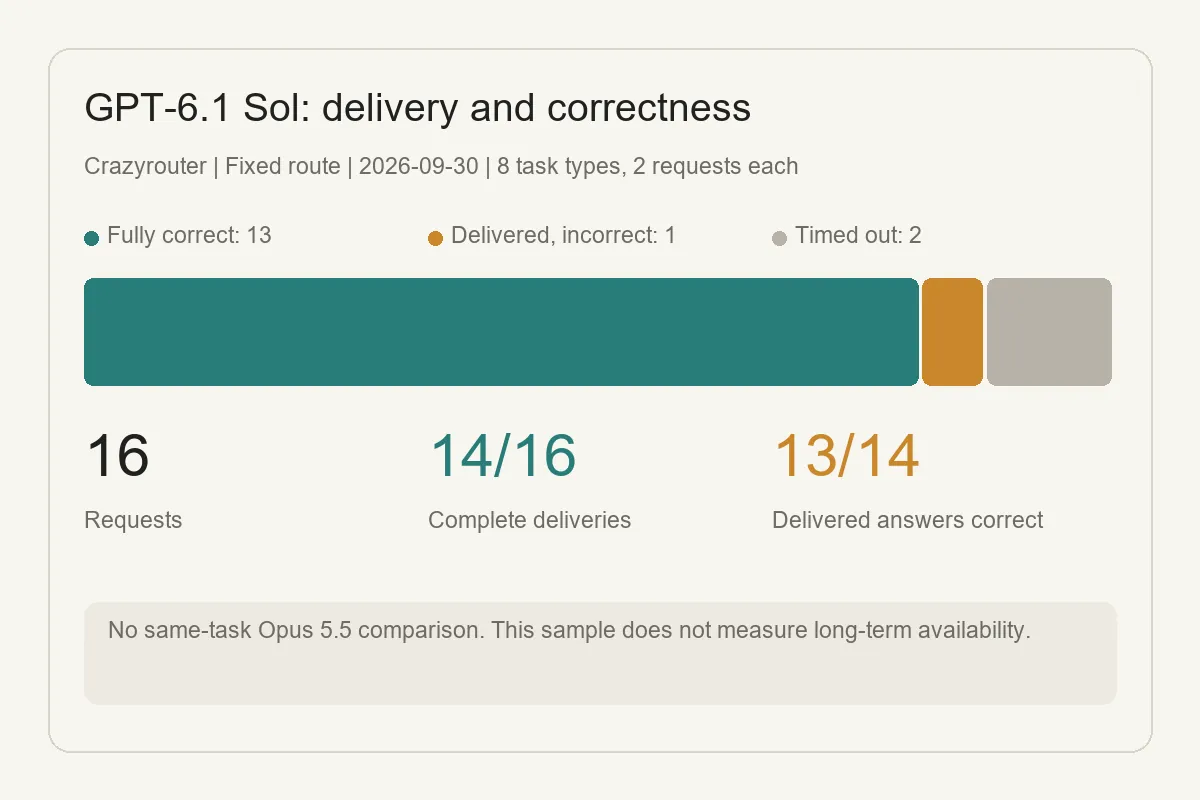
These records are not the same type of evidence as any vendor-published model card. If you plan to integrate a model into a coding agent, you can first consult the Claude Code integration guide and Codex integration guide, then build an acceptance set using your own repository tasks.
Requests and Failures in the Local Records#
The Base URL for this round was https://api.crazyrouter.com/v1, the endpoint was POST /chat/completions, and the model was gpt-6.1-sol. Requests used messages (a fixed system prompt and the same user prompt for each task), reasoning_effort="high", and max_completion_tokens=8192, without sending temperature. This is a historical record from 2026-09-30, not an availability test rerun on this article's publication date.
| Item | Results available for checking |
|---|---|
| Delivery | 14/16 requests received complete results; 13/14 of those answers were fully correct |
| Delivered but incorrect | One rule-counting answer reported 71 rules when there were actually 72 |
| Not delivered | One long-rule retrieval request and one constrained optimal-subset selection request each timed out after 240 seconds; failures were not overwritten by successful retries |
| Example task | Billing-event deduplication: deduplicate globally by event ID, retain 10 <= ts < 20, exclude internal users, and calculate the net amount |
| Final status of the example request | HTTP 200, finish_reason=stop; the answer passed comparison against the local reference answer |
Example response ID: resp_0a6633bd82c5ee75016abd0e0e8b9887d29ef32e920c8843ba; request ID: 202609301326374284700288BdKuu3w. This example used synthetic test data and returned the following final answer:
{"net_cents_by_user":{"alice":-173,"bob":88},"included_unique_events":12}
A timeout only indicates that the client did not receive a complete delivery within the waiting limit; it does not prove that the model cannot solve the task or that the upstream request has been canceled. The sample did not measure long-term availability or time to first token for the two models.
How to Choose: Build Your Own Task-Based Acceptance Set#
- Evaluate Opus 5.5 first: Large-scale code migrations, multi-repository reviews, long-running coding agents, and work for which you are willing to pay higher standard token prices for high-effort reasoning capabilities.
- Evaluate GPT-6.1 Sol first: High volumes of repetitive everyday API requests, business-process automation, complex PDF extraction, and agent tasks requiring control over per-task costs.
- Run parallel trials: When tasks are high-value, errors are costly, or results will be used directly in production. Fix the model versions, reasoning effort, tools, context, and acceptance criteria, and retain records of timeouts, fallback, and retries.
Start by building a small acceptance set of 20–50 real tasks, recording complete delivery, the proportion passing automated checks, human rework, end-to-end duration, and total token cost for each task. Categorize tasks into coding, documents, and tool workflows before calculating results; a single overall score can conceal a model's substantial weaknesses on particular subtasks.
FAQ#
Is Claude Opus 5.5 Necessarily Stronger Than GPT-6.1 Sol?#
That generalization is not justified. Opus 5.5 has strong results in tests such as Terminal-Bench 4.0 published by Anthropic, while OpenAI states that GPT-6.1 Sol outperforms Opus 5.5 under specific GDP.pdf and AutomationBench conditions. Evaluation organizations, reasoning effort levels, fallback, and task sets differ, so validation against your own tasks is advisable.
How Much Cheaper Is GPT-6.1 Sol Than Opus 5.5?#
At official standard API list prices, GPT-6.1 Sol costs 10 per million output tokens, versus 20 for Opus 5.5; the list price for the same number of uncached tokens is approximately 50% lower. Actual task bills also depend on output length, caching, retries, and platform pricing.
Which Is Better for Coding?#
Opus 5.5 has strong officially published Terminal-Bench 4.0 and FrontierCode results; GPT-6.1 Sol's public release materials emphasize DeepSWE long-running software engineering tests. Without a complete public comparison of the two models using the same coding harness and reasoning budget, trials on actual repository tasks are more reliable.
Did This Article Conduct a Local Same-Task Test of Opus 5.5 and GPT-6.1 Sol?#
No. This article cites both vendors' official evaluation materials and supplements them with Crazyrouter's record of 16 GPT-6.1 Sol requests on September 30, 2026; that batch had no Opus 5.5 comparison and cannot be called a local two-model benchmark.
Which Metrics Should You Consider When Choosing a Model?#
At minimum, consider task pass rate, complete delivery rate, timeouts and fallback, human rework, end-to-end duration, and total token cost together. For agent workflows, also check whether tool calls were completed, whether the model handled failures correctly, and whether the final artifacts passed automated acceptance checks.
Conclusion#
The public data for Opus 5.5 and GPT-6.1 Sol show trade-offs across different tasks: Opus 5.5's high-effort coding and science results are appealing, while GPT-6.1 Sol has lower standard token prices and OpenAI reports better task-cost performance on some business benchmarks. If cost is the main constraint, try GPT-6.1 Sol first; if the quality ceiling on complex, long-horizon tasks matters more, include Opus 5.5 in same-task acceptance testing. Until both have been tested under identical conditions, do not combine vendor benchmarks into a single overall champion.
Sources and Test Conditions#
- Anthropic, Introducing Claude Opus 5.5, 2026-09-22. Includes official list prices, Terminal-Bench, FrontierCode, AutomationBench, and Terminal-Bench Science data and descriptions of conditions.
- OpenAI, Introducing GPT-6.1 Sol, 2026-09-29. Includes the publisher's comparisons of GPT-6.1 Sol and Opus 5.5 on GDP.pdf, AutomationBench, and Terminal-Bench Science, and API list prices.
- Anthropic, Claude Opus 5.5 model and pricing documentation and Cost and capability optimization guide. Includes model limits, pricing, and methods and results for the original 482-task SWE-bench Pro compatible subset.
- OpenAI, GPT-6.1 Sol API model documentation. Includes the API context window, output limit, standard and cached-input prices, and the long-context pricing threshold.
- Crazyrouter, internal archive dated 2026-09-30, "GPT-6 Sol and GPT-6.1 Sol vs GPT-5.6 Sol and GPT-6 Astra: Hands-On Testing and Choosing a Primary Model." This article publishes a summary of the results and one response identifier; complete requests, scoring scripts, and responses are retained locally by the editorial team, with no online download of the full evidence package provided. This batch does not include same-task Opus 5.5 results.
This article does not describe vendor self-reported evaluations as independent replications, nor does it compare the two models' time to first token, long-term reliability, or overall ranking in production environments. Official list prices from the two vendors may differ from actual local gateway prices; check the current price lists again before deploying to production.