 中文
中文 English
 Français
 Русский
 日本語
日本語 Tiếng Việt
 한국어
한국어 Deutsch
 Español
 Italiano
 Português
 العربية
 ไทย
ไทย Bahasa Indonesia
 Bahasa Melayu
 Türkçe
 Polski
 Nederlands
 Dansk
Dansk Norsk
Norsk Қазақша
AI API Security Best Practices: Keys, Data, Tools, and Budget Controls
AI API security is broader than hiding an API key. A production integration must protect credentials, control what data leaves your system, constrain model-initiated tools, and prevent one f
AI API Security Best Practices: Keys, Data, Tools, and Budget Controls#
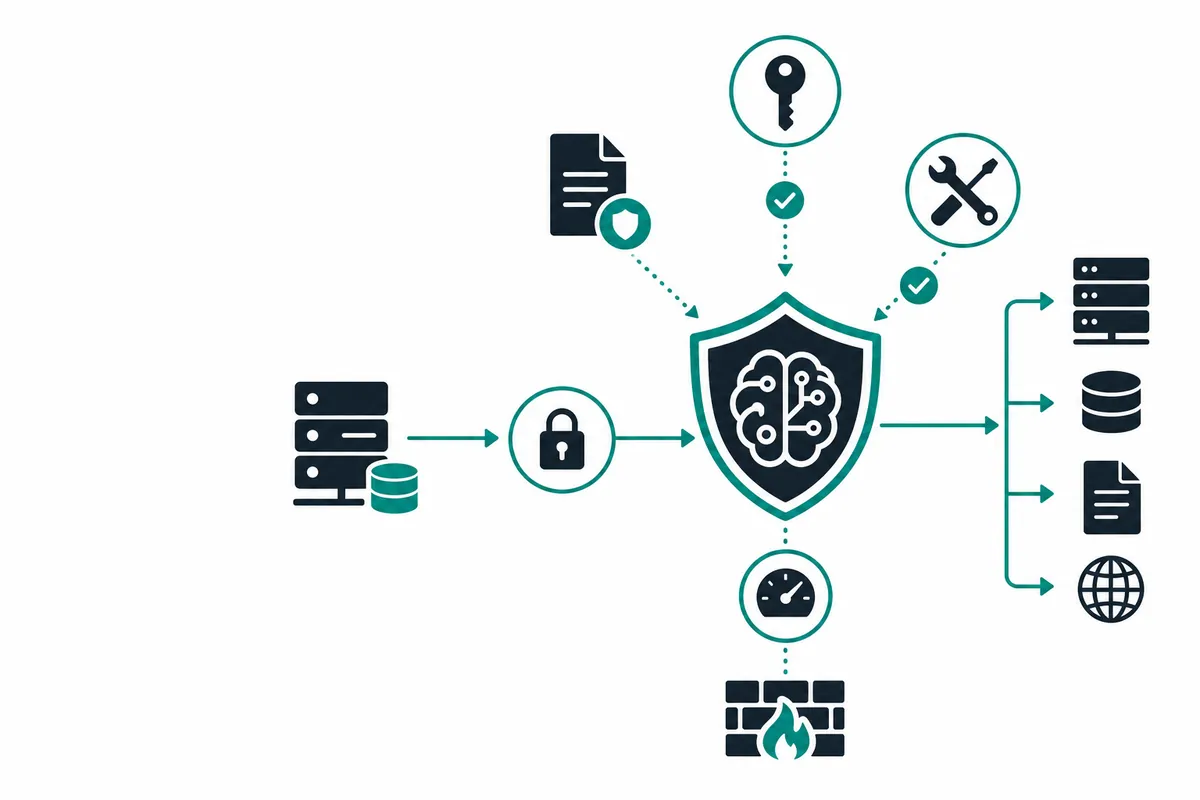
AI API security is broader than hiding an API key. A production integration must protect credentials, control what data leaves your system, constrain model-initiated tools, and prevent one faulty loop from consuming your budget. Treat the model as an untrusted component inside a narrowly permissioned service boundary. This guide is for developers who need an implementation path, not a product slogan. It covers the concept, alternatives, a tested API pattern, pricing, production controls, and FAQ answers.
What is AI API Security Best Practices?#
AI API security is broader than hiding an API key. A production integration must protect credentials, control what data leaves your system, constrain model-initiated tools, and prevent one faulty loop from consuming your budget. Treat the model as an untrusted component inside a narrowly permissioned service boundary. In a real application, the model is only one component. You also need authentication, input limits, output validation, telemetry, retries, and a clear policy for data retention. Keep these controls in application code rather than asking the model to enforce them.
AI API Security Best Practices vs alternatives#
Direct provider access gives you fewer moving parts but creates separate credentials and billing integrations. A gateway can centralize access and routing; a self-hosted proxy gives maximum network control at the cost of operations. Choose based on threat model, compliance, and team capacity, not only token price.
| Decision area | Direct provider | Self-hosted model | Crazyrouter |
|---|---|---|---|
| Setup | Fast for one provider | Highest operations burden | Fast multi-model setup |
| Model choice | One ecosystem | Your deployed weights | 627+ model catalog |
| Failover | Usually application-built | Application-built | Centralized route options plus application policy |
| Billing | Separate provider accounts | GPU and operations | One pay-as-you-go account |
How to use it with code#
The following smoke-test pattern was verified against https://cn.crazyrouter.com/v1 on 2026-09-28. The gateway returned HTTP 200 for /v1/models and for a chat completion request. Use an environment variable in production and replace the model with one shown in the live model list.
import os
from openai import OpenAI
client=OpenAI(base_url="https://cn.crazyrouter.com/v1",api_key=os.environ["AI_API_KEY"])
# Redact and authorize before sending or executing anything.
response=client.chat.completions.create(model="gpt-5-mini",messages=[{"role":"user","content":"[REDACTED]"}],max_tokens=400)
print(response.choices[0].message.content)
curl https://cn.crazyrouter.com/v1/chat/completions \
  -H "Authorization: Bearer $CRAZYROUTER_API_KEY" \
  -H "Content-Type: application/json" \
  -d '{"model":"gpt-5-mini","messages":[{"role":"user","content":"Reply with a health check"}],"max_tokens":40}'
For Node.js, the same OpenAI-compatible route can be configured with baseURL: "https://cn.crazyrouter.com/v1". Do not expose the key in browser JavaScript. Put requests behind your server, attach a tenant ID, and enforce a budget before sending long prompts or launching asynchronous media jobs.
Pricing breakdown#
| Route | Pricing model | Best fit |
|---|---|---|
| Official provider | Provider input/output rates | One-provider production |
| Self-hosted open model | GPU, storage, and operations | Predictable high volume or strict data control |
| Crazyrouter | Pay as you go; verify live rates | One key, many models, fast comparison |
Prices and availability change, so check the live Crazyrouter pricing page before forecasting a launch. Do not promise a fixed model price in application code.
The practical calculation is cost per successful task. Include retries, failed generations, moderation checks, retrieval calls, and storage. A cheaper model that needs two retries or produces invalid JSON may be more expensive than a stronger model that succeeds once. Crazyrouter is useful for comparing models through one key; always confirm the current model name and rate on the live pricing page.
Production checklist#
- Keep API keys in a secret manager or runtime environment.
- Set timeouts and bounded exponential backoff for transient failures.
- Validate JSON, tool arguments, and generated URLs outside the model.
- Record request ID, model, latency, token usage, status, and estimated cost.
- Apply per-user and per-tenant quotas before the provider call.
- Redact personal data from logs and minimize what leaves your system.
- Maintain a fallback or human-review path for high-impact actions.
FAQ#
Is this suitable for production?#
Yes, when the integration has authentication, quotas, observability, validation, and a rollback path. A successful demo alone is not a production readiness test.
Is the official API cheaper than a gateway?#
It depends on the model, volume, region, and gateway pricing. Compare effective cost per successful task, not a general assumption. Check current rates before committing.
Can I switch models later?#
Yes, if application logic is separated from model selection and you test output quality, schema behavior, latency, and safety after every route change.
How do I reduce AI API costs?#
Use smaller models for routine tasks, cap output tokens, summarize repeated context, cache deterministic work, batch non-urgent jobs, and stop unbounded retries.
Summary#
AI API security is broader than hiding an API key. A production integration must protect credentials, control what data leaves your system, constrain model-initiated tools, and prevent one faulty loop from consuming your budget. Treat the model as an untrusted component inside a narrowly permissioned service boundary. Start with a narrow workflow, a versioned evaluation set, and a measured fallback. Crazyrouter provides one API surface for comparing many models while you keep product policy and security in your own application.