 简体中文
简体中文 繁體中文
繁體中文 English
 Français
 Русский
 日本語
日本語 Tiếng Việt
 한국어
한국어 Deutsch
 Español
 Italiano
 Português
 العربية
 ไทย
ไทย Bahasa Indonesia
 Bahasa Melayu
 Türkçe
 Polski
 Nederlands
 Dansk
Dansk Norsk
Norsk Қазақша
Building an AI SaaS on a Budget in 2026: Architecture and Cost Guide
A practical blueprint for launching an AI SaaS with usage limits, model routing, caching, tenant isolation, and predictable margins.

Building an AI SaaS on a Budget in 2026: Architecture and Cost Guide#
The first version of an AI SaaS does not need a large model, a complicated agent framework, or a dozen provider integrations. It needs a narrow job, a measurable outcome, and a cost model that survives real usage. This guide explains how to build an AI SaaS on a budget without turning the prototype into an unreliable demo.
What does an affordable AI SaaS architecture look like?#
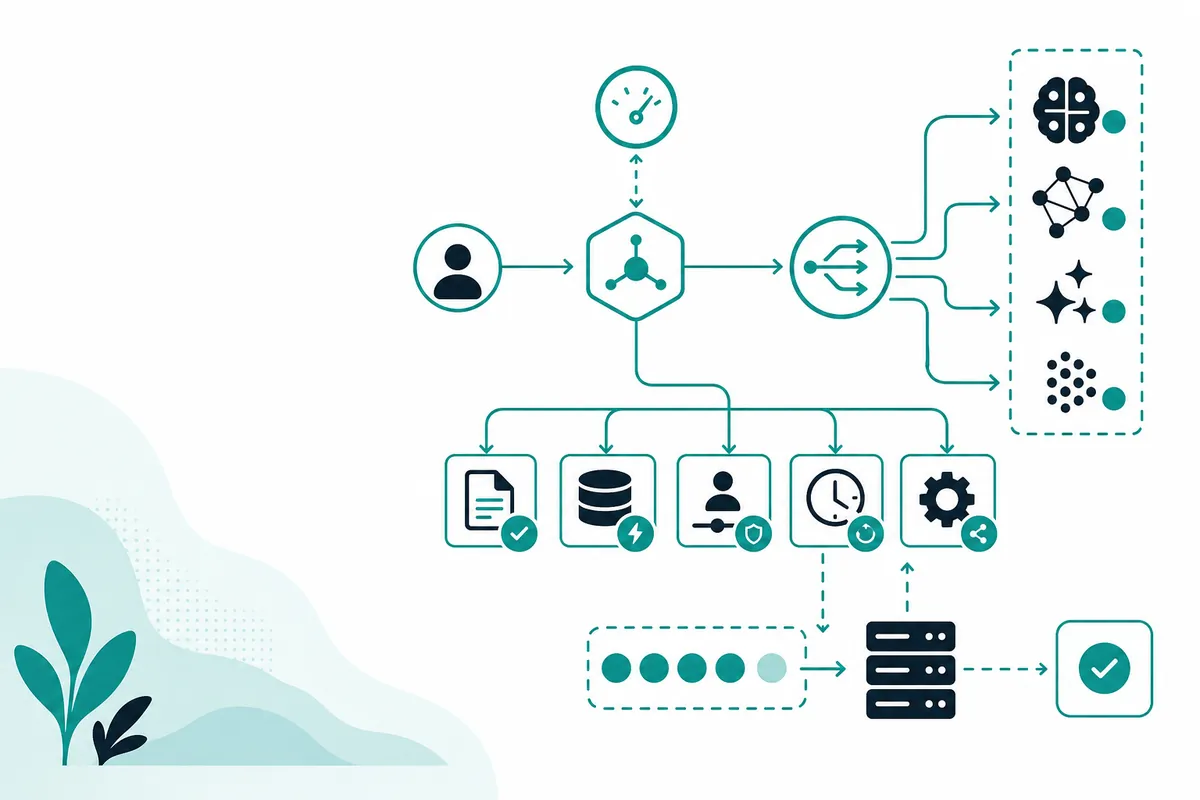
Use a thin application boundary: frontend, authenticated backend, job or request layer, model gateway, and usage ledger. Keep provider keys on the backend. Store tenant, request, model, token, latency, and cost metadata so you can see margin per customer.
| Layer | Budget-friendly choice | Why it matters |
|---|---|---|
| API | OpenAI-compatible client | Fast integration |
| Model access | One gateway, several models | Avoid key and adapter sprawl |
| Storage | Postgres plus object storage | Usage and files in one system |
| Async work | Queue for long jobs | Protect web request latency |
| Controls | Per-tenant quota and token cap | Prevent surprise bills |
Choose models by unit economics#
Estimate cost per successful user outcome, not just cost per token. A cheap model that requires three retries or extensive post-processing may be more expensive than a stronger first pass. Start with a fast model for classification and drafting, then escalate only when a quality check fails.
from openai import OpenAI
import os

client = OpenAI(api_key=os.environ["CRAZYROUTER_API_KEY"],
                base_url="https://crazyrouter.com/v1")
response = client.chat.completions.create(
    model="gemini-2.5-flash",
    messages=[{"role": "user", "content": user_input}],
    max_tokens=600,
)
Set max_tokens deliberately. Reject oversized inputs before inference. Cache deterministic requests such as repeated document classification. For long documents, retrieve only relevant passages instead of sending the entire corpus.
Pricing: official API versus Crazyrouter#
| Cost | Direct official accounts | Crazyrouter |
|---|---|---|
| Model usage | Official input/output prices | Usage-based rates vary by model |
| Monthly platform fee | Provider-dependent | No monthly fee or minimum consumption in documented plan |
| Multi-provider setup | Several keys and integrations | One key and compatible endpoint |
| Observability | Build or buy | Usage tracking and records available |
Check Crazyrouter pricing. Never publish a fixed margin based on old rates; recompute from actual usage.
Build billing and abuse controls early#
Give every tenant a monthly quota, a request rate limit, and a maximum output size. Distinguish free trials from paid usage in your ledger. Reject requests when the account is over quota instead of allowing a negative balance. Add a per-request idempotency key for queued jobs so client retries do not duplicate work.
Protect prompts and generated files as customer data. Redact secrets from logs, expire temporary files, and make retention visible. Use a queue for image, audio, and video tasks because they are asynchronous and can create expensive bursts.
A simple margin model#
For each plan, calculate: revenue minus model cost, storage, queue and database cost, payment fees, and an allowance for retries and support. Track p50 and worst-case cost per request. If a user can submit a 100,000-token document, your free plan needs a hard input limit or a separate paid workflow. Add a dry-run estimator when the request can be measured before inference. This makes upgrades easier to explain and protects the business from a single accidental batch.
A lean launch sequence#
In week one, ship one workflow with server-side credentials, a request ledger, and a hard daily budget. In week two, add authentication, tenant isolation, error states, and a small evaluation set. Before charging, add usage visibility, export or deletion controls, abuse limits, and a support path for failed jobs. Delay model marketplaces, complex agents, and broad integrations until users prove which outcome they value. Narrow scope is a cost-control feature: it reduces prompt complexity, QA surface, and support load at the same time.
FAQ#
What is the cheapest way to launch an AI SaaS?#
Start with one narrow workflow, one compatible API, strict quotas, and a measured model. Add providers only when quality, availability, or cost data justifies them.
Should an AI SaaS use the strongest model by default?#
Usually no. Use a smaller model for simple tasks and escalate based on a tested quality rule.
How much should a free trial include?#
Enough requests to demonstrate value, but with hard token, rate, and daily spend limits. Design the trial from your worst-case input size.
Does caching help every AI product?#
It helps repeated or deterministic workloads. Do not cache private responses across tenants, and include prompt and policy versions in the cache key.
Why use Crazyrouter for an AI SaaS?#
It provides an OpenAI-compatible base URL and access to many model families, which can reduce early integration work while you validate product-market fit.
Summary#
An affordable AI SaaS is built around unit economics, quotas, and a narrow user outcome. Keep the provider boundary replaceable, measure every request, and use Crazyrouter to test models without multiplying credentials and adapters.