 简体中文
简体中文 繁體中文
繁體中文 English
 Français
 Русский
 日本語
日本語 Tiếng Việt
 한국어
한국어 Deutsch
 Español
 Italiano
 Português
 العربية
 ไทย
ไทย Bahasa Indonesia
 Bahasa Melayu
 Türkçe
 Polski
 Nederlands
 Dansk
Dansk Norsk
Norsk Қазақша
GPT-6.1 Sol vs GPT-6 Sol: An Update After Just One Week—How Much Did Claude 5.5 Have to Do with It?
GPT-6.1 Sol arrived just a week after GPT-6 Sol. I examine the competitive pressure from Claude 5.5, OpenAI’s reported gains, and what my API tests reveal about accuracy, timeouts, and readiness for everyday work.
GPT-6.1 Sol vs GPT-6 Sol: An Update After Just One Week—How Much Did Claude 5.5 Have to Do with It?#
GPT-6.1 Sol arrived just a week after GPT-6 Sol launched. To understand that timing, I think we should start with the Opus 5.5 and Sonnet 5.5 releases happening alongside it.
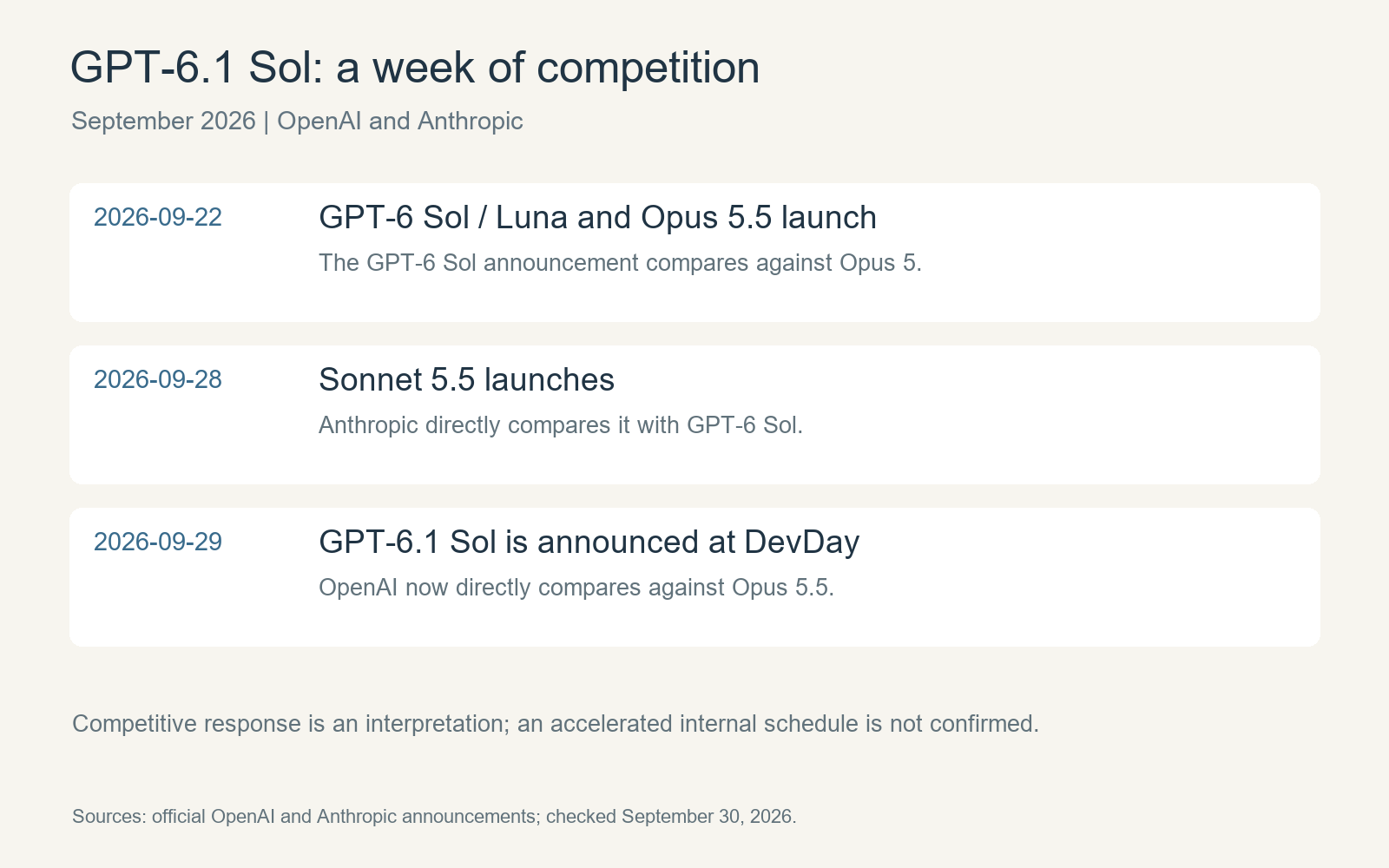
Put both companies’ releases on the same timeline, and the competitive context becomes clear:
| Date | Release event |
|---|---|
| September 22 | OpenAI releases GPT-6 Sol and Luna; Anthropic releases Opus 5.5 |
| September 28 | Anthropic releases Sonnet 5.5 |
| September 29 | OpenAI introduces GPT-6.1 Sol at DevDay |
These dates come from the companies’ official announcements.[1][2][4][5] The public releases of Sonnet 5.5 and 6.1 Sol were just one day apart.
My view is that competitive pressure should be the starting point for understanding this release cadence: Opus 5.5 raised the bar for complex work, while Sonnet 5.5 moved directly into the everyday workhorse role that Sol is competing for. DevDay provided an opportunity for a coordinated response.
The timing is not the only evidence behind that interpretation. There was also a clear shift in the comparisons featured in the two companies’ announcements.
Almost as soon as 6 Sol launched, it faced a new generation of competitors.
The September 22 announcement for 6 Sol compared it with Opus 5 on evaluations including AutomationBench. By the 6.1 Sol announcement, OpenAI explicitly stated that 6.1 Sol, at medium reasoning effort, scored 2.2 percentage points above Opus 5.5 on AutomationBench. On GDP.pdf, it scored above Opus 5.5 with a fallback mechanism at every reasoning setting tested.[1][3]
That means the 6.1 release materials were already addressing a newer question: against the newly released Claude models, where could Sol still hold an advantage in practical work?
The pressure from Opus 5.5 was specific. Anthropic put large code migrations, tasks spanning multiple repositories, professional analysis, and extended autonomous execution at the center of its announcement, with direct comparisons against GPT-6 Astra across several evaluations.[4]
That creates a positioning question for Sol: if users believe a stronger Claude is already available for complex tasks, what case does Sol need to make to remain the model handling most of their everyday work? Astra’s performance cannot automatically answer that question for Sol.
Sonnet 5.5 added another layer of pressure. Anthropic explicitly positioned it for clearly scoped everyday tasks, bug fixes, and the creation of documents, slides, and spreadsheets, while reserving Opus 5.5 for complex, open-ended tasks that require sustained judgment.[5]
More directly, the Sonnet announcement named GPT-6 Sol: according to its release page, Sonnet 5.5 at the high setting on FrontierCode already matched 6 Sol’s highest score. It also compared the two on long-horizon knowledge work.
One release challenged the upper limits of complex work; the other competed to become the model people choose by default when they open their tools each day. Together, they put Sol under sustained pressure. These are evaluation claims from the companies’ release pages. They cannot be combined into an overall ranking of models from different vendors under uniform conditions.
The default-model position also has staying power. Once users have adapted their prompts, acceptance criteria, and tool workflows around a model, they are more likely to keep assigning it subsequent tasks. Competition therefore matters during the window when users are reconsidering their main model: whichever model can take on more work this time has a better chance of becoming the default next time.
That also explains why “6 Sol only just launched” is not necessarily a reason to wait. How new a version is depends on your own calendar; its competitive position depends on what others deliver at the same time. When users are actively comparing tools again, there is an external incentive to release a version promptly if it already offers improvements ready for use.
I see 6.1 Sol as a quick response within that competition. What we can confirm is the release sequence, the explicitly updated comparison targets, and the overlapping areas of capability. There is no public evidence that OpenAI brought its internal schedule forward because of them.
DevDay mattered because it gave that response a fuller practical setting.
Reusable development environments in Codex Cloud and computer-use capabilities in the Agents API, both launched that day, expanded the range of tasks models could execute directly.[2] Access to 6.1 Sol was through work in ChatGPT, Codex, and the API; it was not available in ordinary chat at the time.[3]
Upgrading model capabilities and execution environments together lets users bring the improvements described in announcements into actual work. The more complete the environment, the more the final deliverable depends on whether the model can locate problems itself, understand feedback, and revise its approach.
The capability changes worth watching in this update therefore overlap closely with the areas its competitors emphasized: the quality of complex work, the ability to sustain execution, and whether that execution remains controllable when things go wrong. So how much ground did 6.1 gain over 6 Sol?
The strongest piece of evidence is that the new version, at a lower reasoning setting, surpassed the old version even at its maximum setting.
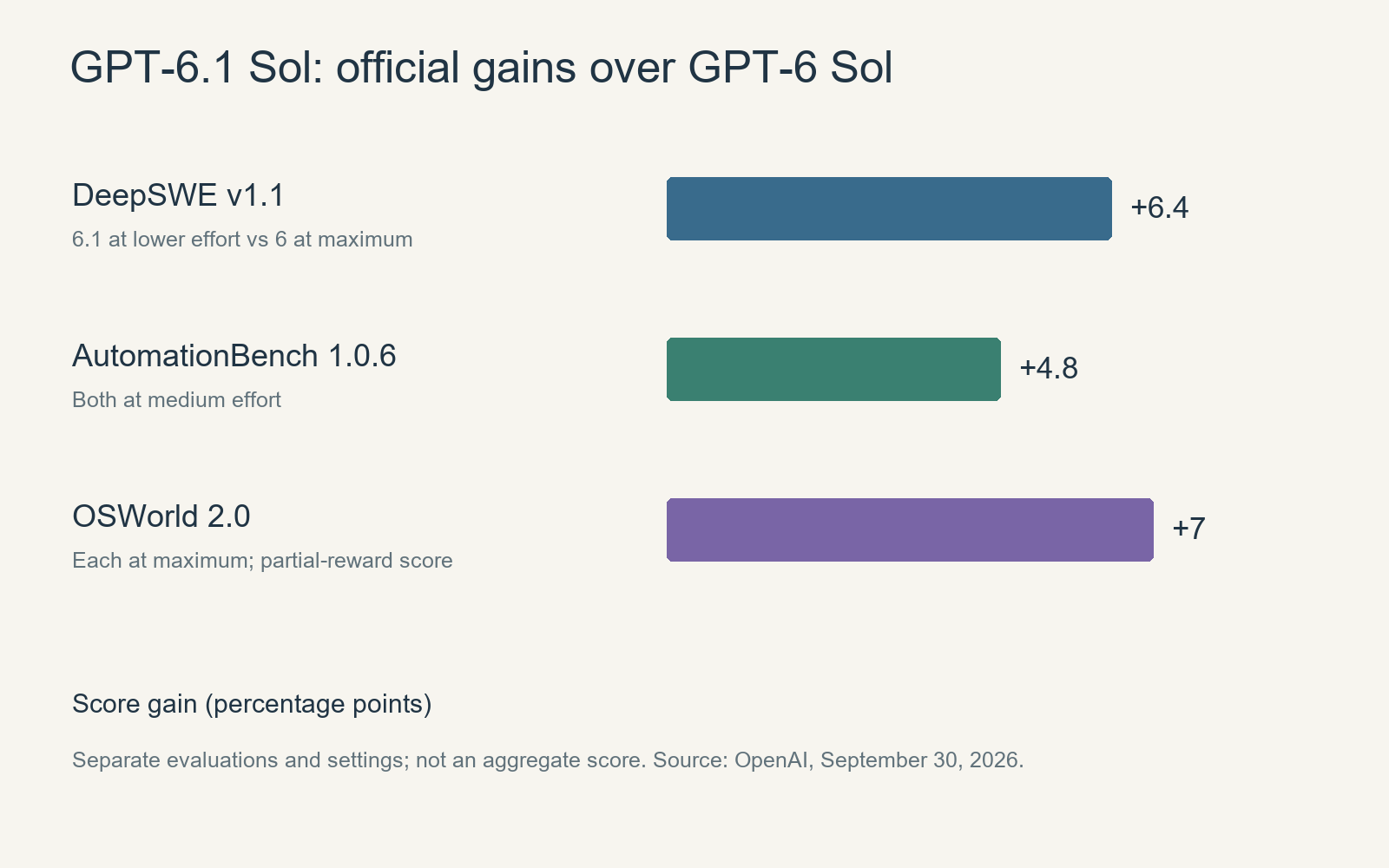
On DeepSWE v1.1, 6.1 Sol at a lower reasoning effort scored 6.4 percentage points above 6 Sol’s highest score. The tasks come from real code repositories and require long-horizon planning and execution.[3]
This comparison gets at a practical question: when a task is difficult, how much can you gain by continuing to increase the old model’s reasoning effort?
In real repositories, some failures begin with choosing the wrong approach. A model might misidentify the module responsible for a bug, then write a set of tests built around that mistaken diagnosis. Or it might fix a local problem while overlooking the project’s existing compatibility constraints. Thinking more carefully along that path can still produce a change that heads in the wrong direction.
The DeepSWE result shows that, at least in this evaluation, 6.1’s gains exceeded what could be achieved by further increasing 6 Sol’s reasoning effort. That gives us more reason to examine the quality of its action choices and its use of feedback. The evaluation did not isolate each capability’s contribution, and the specific training methods were not disclosed.
Another piece of evidence is AutomationBench: at the same medium reasoning effort, 6.1 Sol improved by 4.8 percentage points. That makes it harder to explain all the gains simply as giving the model more time to think.
Putting the main results together makes their shared direction easier to see:
| Official evaluation | Change in 6.1 Sol relative to 6 Sol | Tasks evaluated |
|---|---|---|
| DeepSWE v1.1 | At lower reasoning effort, exceeds the old version’s highest score by 6.4 percentage points | Long-horizon software engineering in real repositories |
| AutomationBench 1.0.6 | Gains 4.8 percentage points at the same medium setting | Business workflows involving 47 tools |
| OSWorld 2.0 | Gains 7 percentage points with each model at maximum reasoning effort | Long-horizon computer use; offline set v2026.08.08, measured by partial-reward score |
| Terminal-Bench Science 0.1 | At maximum reasoning effort, scores more than twice as high as the old version | Scientific research workflows using code and a terminal |
These tasks span programming, business, desktop use, and scientific research, but all require the model to repeat the same cycle: understand the current state, take action, read the feedback, and adjust what it does next.
Within that cycle, errors also change subsequent inputs. Misreading one tool result can leave the next several steps grounded in an incorrect understanding of the state. Editing the wrong file can create new errors and send the investigation further off course. Part of the difficulty of long tasks is therefore recognizing when execution has drifted and correcting it in time.
That is central to how I understand the 6.1 upgrade: improvements across multiple benchmarks suggest an expansion of what it can handle during sustained execution. These results are not enough to separate the contributions of planning, feedback interpretation, and error correction. But they support that interpretation more strongly than success on a single isolated hard problem would.
The announcement’s emphasis on complex PDFs fits the same logic. GDP.pdf involves tables, charts, diagrams, and fine-print details. In actual work, overlooking a qualifying condition in a table footnote can leave the subsequent analysis based on the wrong evidence from the very first step, however well organized it may be.
Document understanding is the entry point to the entire workflow. It determines what problem the model is actually working on downstream. The official announcement emphasized this area, but its main text did not provide a directly quotable figure for 6.1’s PDF improvement over 6.
Another easily underestimated upgrade is whether the system can see that a failure has occurred.
OpenAI disclosed two separate sets of reliability results: in difficult conversations at xhigh, the share of responses containing factual errors fell from 4.5% to 4.1%; in search-tool failure tests at maximum reasoning effort, the rate of undisclosed failures fell from 4.9% to 2.1%. Both used deliberately selected difficult samples.[3]
This is another area both companies are competing over. The Opus 5.5 announcement likewise emphasized reducing behavior that oversteps boundaries, and included longer tasks, tasks the model could not complete, and real incident scenarios in its alignment testing.[4] The companies used different testing methods, but both were addressing the same concern users have when delegating work: what will the model do when it encounters an obstacle?
Imagine a business workflow in which the model must find the latest policy before deciding what to do next. If a search fails and the model clearly reports that it did not obtain the information, the system has an opportunity to retry, switch data sources, or hand the task to a person.
If it instead supplies an answer that appears to have been verified, the subsequent steps may well proceed as usual. A search failure has been repackaged as usable evidence, potentially making its way into the final deliverable.
An explicitly reported failure leaves an opening for recovery; a concealed failure prevents the correction mechanism from being triggered.
For models that can call tools, then, “honesty” has a concrete engineering role. It affects whether the system can decide when to continue, when to stop, and when to escalate.
This result for 6.1 does not establish that an entire business workflow is now more reliable, nor does it mean the model is better at retrying. It does, however, show an improvement in one prerequisite for reliable execution: whether the model acknowledges that it lacks the evidence needed to proceed.
Related to this are the announcement’s points about adherence to constraints and reducing unauthorized outcomes. The longer a model runs, the more it needs to maintain those boundaries throughout. Its ability to complete work and its ability to recognize when it cannot continue jointly determine how much autonomy it can be given.
My own comparison, however, did not show the new version winning across the board.
I used GPT-5.6 Sol as my main model for a long time and recently switched to GPT-6 Astra. For me, this comparison also bears on a practical decision: has Sol improved enough for me to redistribute my work?
On September 30, I sent the same tasks and system prompts to both models through the same gateway route using Crazyrouter’s OpenAI model access, with reasoning_effort=high and an 8192-token output limit throughout. I ran each of eight task types twice for each model, for 32 main requests in total, retaining the first result from each attempt.
| Results from this test | GPT-6 Sol | GPT-6.1 Sol |
|---|---|---|
| Requests initiated | 16 | 16 |
| Complete answers received | 16 | 14 |
| Fully correct answers | 16 | 13 |
| Answers received with errors | 0 | 1 |
| Timeouts after approximately 240 seconds | 0 | 2 |
| Median completion time across all attempts | 21.52 seconds | 18.13 seconds |
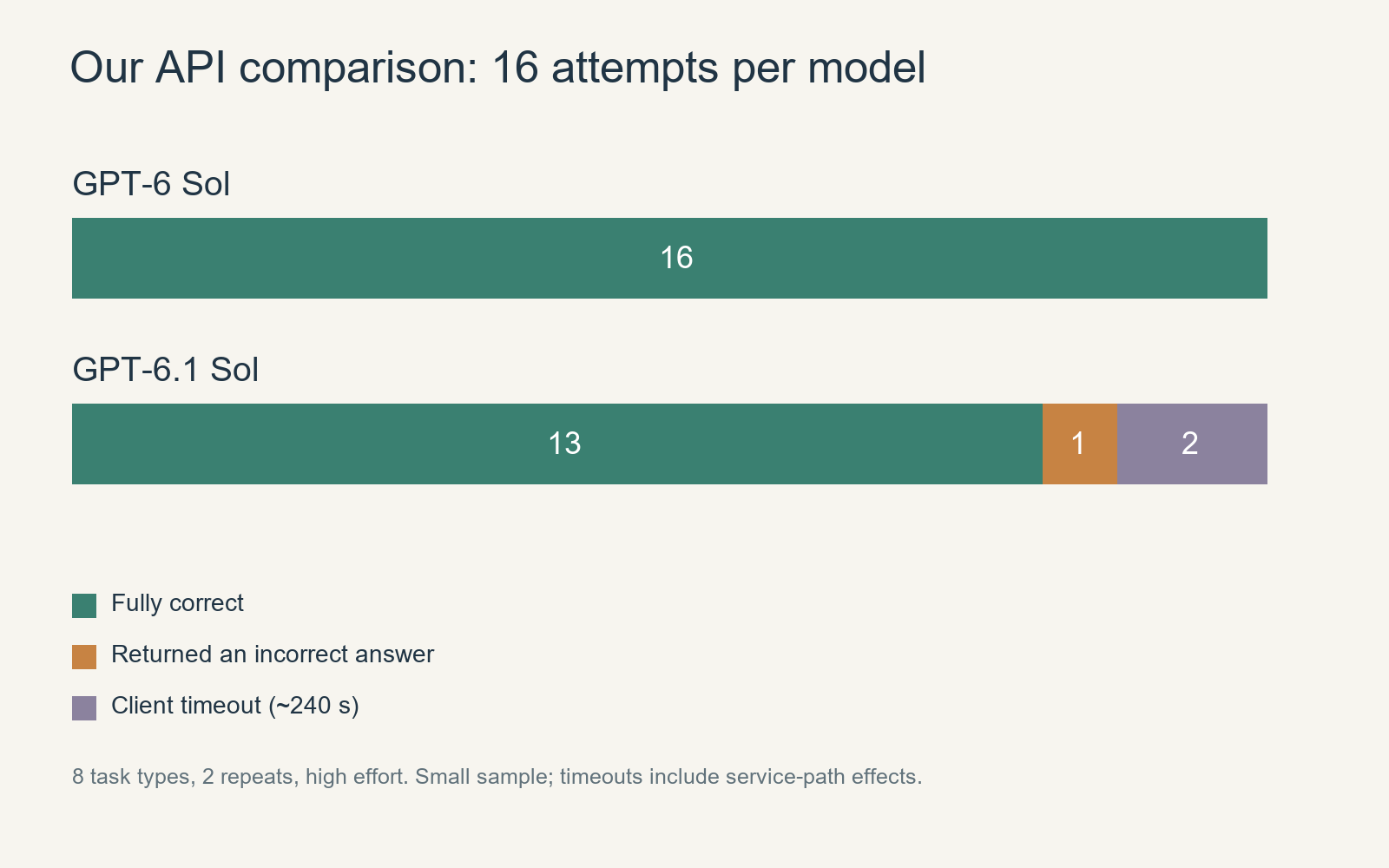
The error from 6.1 was specific: the material contained 72 entries that met the conditions, but it counted 71. It had already identified the false premise in the question, yet still missed one entry. The two timeouts occurred on long-table retrieval and constraint solving; each task passed on its other attempt.
Both models passed all hidden checks on the two small function-writing tasks. They also both passed one additional two-turn workflow using read-only tools.
The lesson for me from these results is this: to decide whether a model can become your main tool, the evaluation must cover the stages where you previously had to take over yourself.
Adding a few hundred assertions for edge cases to two function tasks can check code correctness more rigorously. It does not give the model more opportunities to locate a problem independently, understand repository constraints, or change its approach based on execution results. A short tool workflow is also unlikely to expose failures caused by losing track of state after a dozen or more steps.
This round of testing is therefore enough to document that the new version can still miscount and that timeouts occurred along this service path. It did not reach the long-horizon capabilities that OpenAI primarily emphasized. Nor did it give me enough evidence to replace Astra, my current main model, with 6.1 Sol outright.
Speed also needs to be considered alongside delivery. The median wait for 6.1 was shorter, but this round also included two requests that produced no deliverable. If the goal is a change that passes acceptance checks, the time to the first response is only part of the process. Rework and human intervention also affect the total time required.
The requests ran concurrently, caching was not standardized, and the timings included the effects of the gateway and upstream services. Timeouts also occurred on another route shared by both models. These are observations along a service path; they do not establish that 6.1 itself is more prone to timing out.
For me, the most worthwhile comparison in the next round is how many times I need to steer each model back on track while it works on the same real task.
For example, take a repository bug with clear acceptance criteria. Give the model only the problem description, then let it locate the cause, implement a fix, run tests, and deliver the change. Under the same environment and permissions, compare whether it can pass acceptance checks independently, how many human corrections it needs, whether it can keep making progress after a failure, and whether it declares completion without verification.
That would turn “the model is more capable” into an observable change: can it now make a judgment that I previously had to supply?
6 Sol already emphasized agentic programming and professional work. 6.1 Sol further improves performance on difficult execution tasks and reduces one type of behavior that conceals execution failures. For heavy users, it is the combination of those two changes that could lead to a switch in their main model.
Returning to the question of an update after just one week: I would treat competitive pressure from Opus 5.5 and Sonnet 5.5 as the leading external explanation, and DevDay as the opportunity to deliver a coordinated response. The key evidence for that interpretation is that both companies were already comparing their models directly in their release materials, and that 6.1’s improvements were concentrated in the work capabilities its competitors were targeting.
Ultimately, this competition is about becoming the default choice the next time a user opens a coding tool or hands over a professional task. For me, whether 6.1 earns that position depends on whether it can take on work that has always required repeated corrections from me. One fewer wrong turn or false claim of completion is more persuasive than a version number.
Sources and testing notes:
[1] OpenAI: Introducing GPT-6 Sol and Luna. The publication date on the official website is September 22, 2026.
[2] OpenAI: DevDay 2026 Recap, September 29, 2026. The article announces GPT-6.1 Sol.
[3] OpenAI: Introducing GPT-6.1 Sol. This article is based on the official text retrieved on September 30, 2026.
[4] Anthropic: Introducing Claude Opus 5.5, September 22, 2026.
[5] Anthropic: Introducing Claude Sonnet 5.5, September 28, 2026.
Testing used https://api.crazyrouter.com/v1/chat/completions, with the main test fixed to channel 266 and using the standard model variants. There were 496 code checks per model, drawn from two outputs for each of the two function tasks; this is not a count of independent tasks. This small sample did not reproduce the official benchmarks and did not cover long-horizon development in real repositories, computer use, or complex PDFs. The official scores are used to analyze the direction of the upgrade; the local records show what the models actually delivered in this round.