 简体中文
简体中文 繁體中文
繁體中文 English
 Français
 Русский
 日本語
日本語 Tiếng Việt
 한국어
한국어 Deutsch
 Español
 Italiano
 Português
 العربية
 ไทย
ไทย Bahasa Indonesia
 Bahasa Melayu
 Türkçe
 Polski
 Nederlands
 Dansk
Dansk Norsk
Norsk Қазақша
Multi-Model Orchestration Patterns for Production AI Apps in 2026
Compare routing, cascade, ensemble, and specialist orchestration patterns for building reliable multi-model AI applications.
Multi-Model Orchestration Patterns for Production AI Apps in 2026#
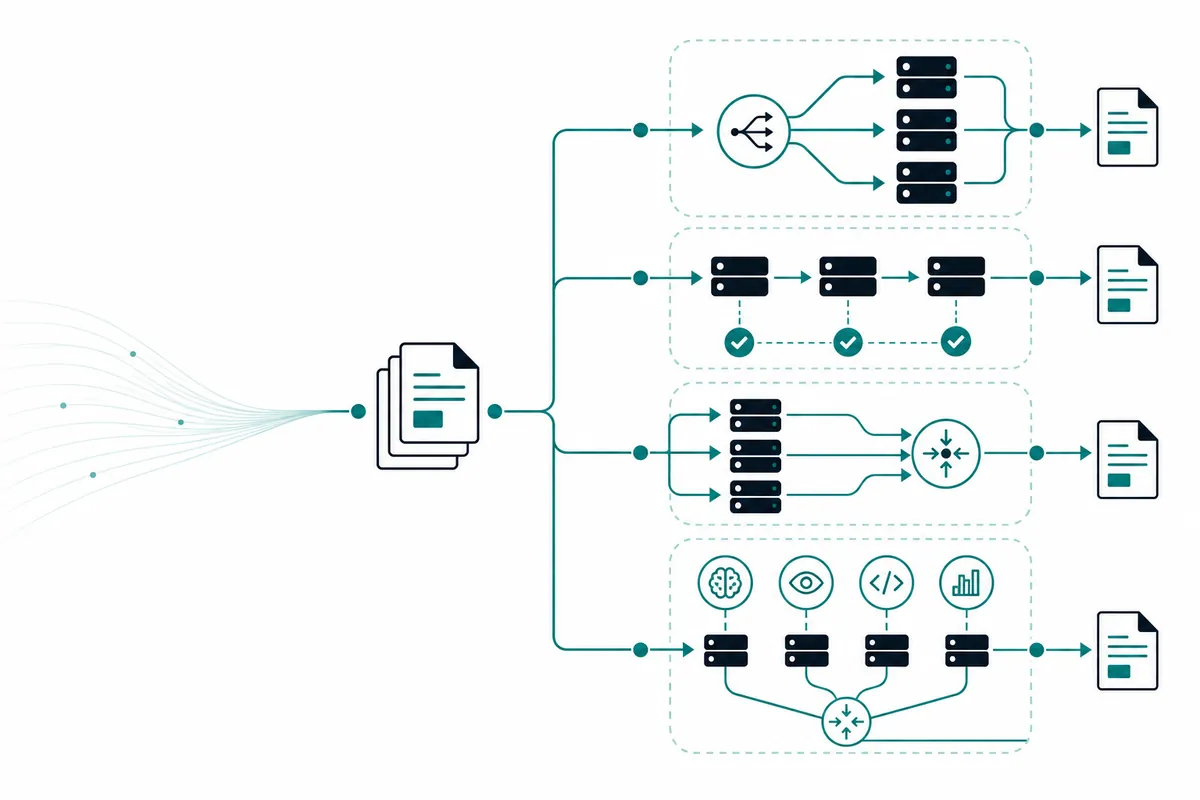
Using one model for every request is simple, but rarely optimal. A support classifier, a long-context research task, a coding agent, and a video pipeline have different latency, quality, and cost requirements. Multi-model orchestration routes each job to an appropriate model while preserving a consistent application contract.
What is multi-model orchestration?#
It is the control layer that chooses, sequences, or combines models for a task. The simplest version is a static model switch. Production systems add capability checks, budgets, quality evaluation, fallback behavior, caching, and tracing. A gateway such as Crazyrouter provides one OpenAI-compatible base URL for experimenting with many models.
| Pattern | Flow | Best for | Tradeoff |
|---|---|---|---|
| Static routing | Request → chosen model | Predictable workloads | No adaptation |
| Classifier routing | Classify → specialist | Many task types | Extra latency |
| Cascade | Cheap model → strong model if needed | Cost control | Quality thresholding |
| Ensemble | Several models → judge/merge | High-stakes answers | Highest cost |
| Fallback | Primary → alternate on failure | Availability | Capability mismatch |
Start with a capability registry#
Do not route by model name alone. Define capabilities such as vision, json_schema, tool_calling, long_context, language coverage, and maximum output. Add measured latency and effective cost from your own traffic.
MODELS = {
    "fast": {"name": "gemini-2.5-flash", "vision": True, "cost": 1},
    "reasoning": {"name": "claude-sonnet-4-6", "vision": True, "cost": 5},
    "cheap": {"name": "deepseek-v3.2", "vision": False, "cost": 0.5},
}

def choose(task):
    if task["needs_reasoning"]: return MODELS["reasoning"]
    if task["needs_vision"]: return MODELS["fast"]
    return MODELS["cheap"]
Implement a cascade#
A cascade sends easy tasks to a low-cost model and escalates uncertain results. Use a structured confidence field, rule-based checks, or a small evaluator. Never let a model's unsupported confidence number be your only quality signal.
const first = await ask("deepseek-v3.2", input);
const valid = first.json && first.answer.length > 20;
const answer = valid ? first : await ask("claude-sonnet-4-6", input);
Log why escalation happened. Otherwise, you cannot distinguish a better model from a broken validator. For user-facing systems, expose a stable response shape regardless of which model answered.
Cost and pricing comparison#
| Component | Direct providers | Crazyrouter approach |
|---|---|---|
| Provider accounts | Several credentials | Central gateway credential |
| Model rates | Official rates | Current usage-based rates by model |
| Routing code | Build and maintain | Use gateway access plus your policy layer |
| Fixed fee | Varies | No monthly fee or minimum consumption in the documented plan |
See current pricing and calculate effective cost after escalations, retries, and evaluator calls.
Evaluation and operations#
Create a replay set of representative requests. Measure task success, factuality, schema validity, latency, token usage, and escalation rate. Deploy routing changes behind a feature flag. Keep a per-request trace containing selected model, policy version, and outcome. Add a circuit breaker when a provider's error rate or latency exceeds a threshold.
A practical rollout sequence#
First ship a static model map with a manual override. Next add a fallback for transient failures, then a cost-aware route for clearly simple tasks. Only after those paths are observable should you add a classifier or ensemble. Shadow-test new models on copied, privacy-safe evaluation traffic before making them user-visible. Compare outcomes by request class; a single global average can hide a serious regression in coding, vision, or multilingual requests.
Keep orchestration state explicit#
Pass a routing decision object through the workflow: task class, required capabilities, budget remaining, selected model, attempt, and policy version. This prevents hidden decisions inside prompt code and makes support tickets reproducible. If a model changes, replay the same request with the captured policy and compare the result. For multi-step agents, set a maximum total token budget and a maximum number of model turns. A strong model can still enter a loop when a tool returns an unexpected shape.
Use queues for slow evaluators and batch comparisons. Keep interactive traffic on a short deadline, and let offline jobs use a cheaper route with a longer completion window. This separation protects user latency while giving the team enough data to improve routing.
FAQ#
Is multi-model orchestration the same as an AI agent?#
No. Orchestration chooses and sequences model calls; an agent usually adds planning, tools, memory, and iterative action.
Which routing pattern should a startup use first?#
Start with static routing and a fallback. Add cascades only after you have a labeled evaluation set.
Does routing always reduce cost?#
No. Classifiers, judges, retries, and poor thresholds can cost more than one strong model. Measure the complete workflow.
How do I avoid incompatible fallbacks?#
Route by capability and validate structured output before selecting a fallback.
Can one API key access multiple models?#
A multi-model gateway can provide that experience; confirm model availability, terms, and pricing in its current documentation.
Summary#
Good multi-model orchestration is measurable policy: capability-aware routing, bounded cascades, safe fallbacks, and continuous evaluation. Use Crazyrouter to compare models behind a consistent API, then let your application own business and safety decisions.