 简体中文
简体中文 繁體中文
繁體中文 English
 Français
 Русский
 日本語
日本語 Tiếng Việt
 한국어
한국어 Deutsch
 Español
 Italiano
 Português
 العربية
 ไทย
ไทย Bahasa Indonesia
 Bahasa Melayu
 Türkçe
 Polski
 Nederlands
 Dansk
Dansk Norsk
Norsk Қазақша
Streaming AI API with SSE and WebSockets in 2026: A Practical Latency Guide
Implement responsive streaming AI interfaces with Server-Sent Events and WebSockets, including buffering, cancellation, reconnects, usage accounting, and code examples.
Streaming AI API with SSE and WebSockets in 2026: A Practical Latency Guide#
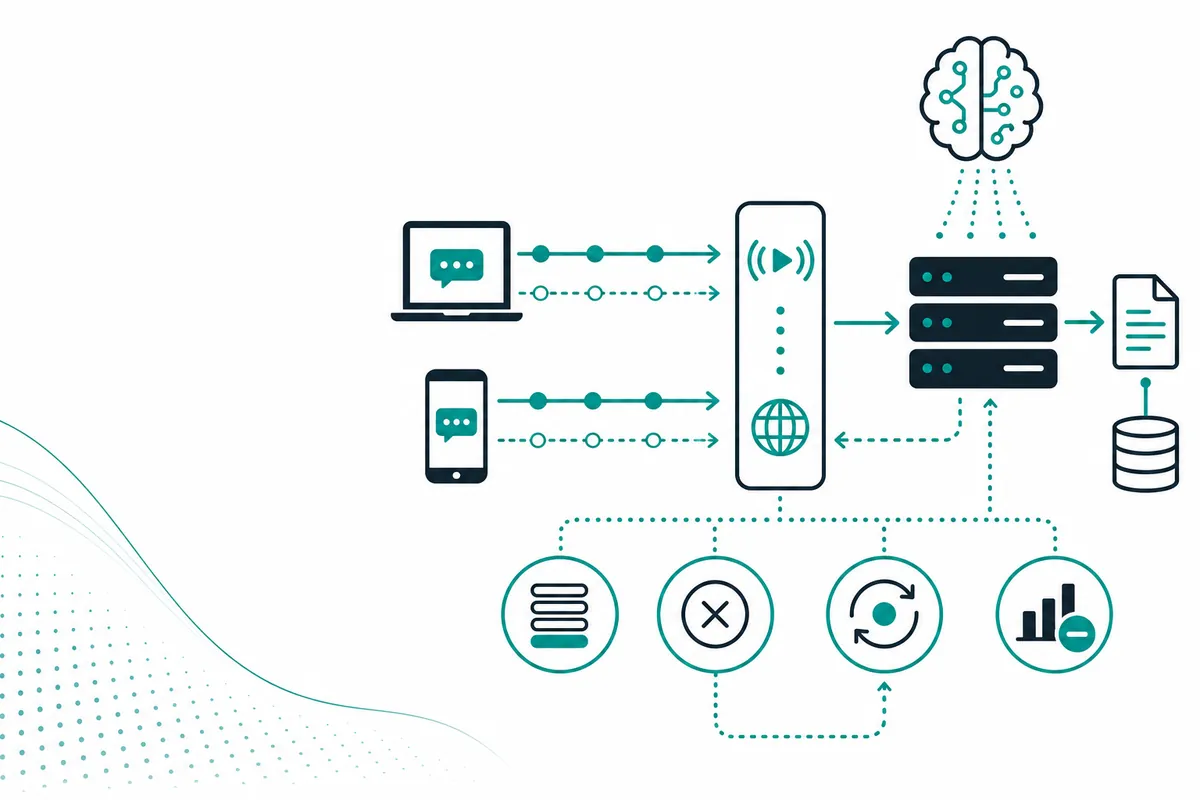
Streaming sends partial model output as it becomes available instead of waiting for the complete response. Users perceive the application as faster because time-to-first-token is separated from time-to-last-token. Streaming is especially useful for chat, coding assistants, and long explanations, but it adds state management, disconnect handling, and usage accounting.
What Is This Topic?#
Streaming sends partial model output as it becomes available instead of waiting for the complete response. Users perceive the application as faster because time-to-first-token is separated from time-to-last-token. Streaming is especially useful for chat, coding assistants, and long explanations, but it adds state management, disconnect handling, and usage accounting. In practical engineering terms, the important unit is not the model name but the capability contract: accepted inputs, maximum context, output format, latency, rate limits, and data handling. Before integrating, check the provider’s current model catalog and run a small evaluation set using the exact prompts your product will send.
Streaming AI API with SSE and WebSockets in 2026 vs Alternatives#
Server-Sent Events are usually the simplest choice for one-way server-to-browser token delivery: they work over HTTP and are easy to reconnect. WebSockets are better when the client and server need continuous two-way events, such as collaborative agents or voice interfaces. Streaming does not reduce token cost by itself; it changes delivery timing. Choose the protocol that matches interaction complexity.
A useful comparison matrix is:
| Decision factor | Direct provider | Multi-model gateway | Self-hosted/open model |
|---|---|---|---|
| Setup speed | Fast for one provider | Fast for many models | Slowest |
| Model choice | Limited to provider | Broad | Depends on deployment |
| Billing | Separate accounts | Consolidated usage | Infrastructure cost |
| Portability | Lower | Higher | Depends on API layer |
| Operations | Provider-managed | Shared boundary | Team-managed |
Do not compare only headline benchmark scores. Measure successful task rate, p95 latency, output validity, refusal behavior, and cost per successful task. A model that is 20% cheaper but requires frequent repair calls may be more expensive in production.
How to Use It with an API#
For a browser-facing chat response, an SSE endpoint can consume an OpenAI-compatible stream. The server should translate provider chunks into a stable event format and terminate with an explicit done event:
Python#
from openai import OpenAI

client = OpenAI(api_key="CRAZYROUTER_API_KEY", base_url="https://crazyrouter.com/v1")
stream = client.chat.completions.create(
    model="gpt-5-mini", messages=[{"role":"user","content":"Explain SSE in three steps."}], stream=True
)
for chunk in stream:
    delta = chunk.choices[0].delta.content if chunk.choices else None
    if delta: print(delta, end="", flush=True)
Node.js#
const r = await fetch("https://crazyrouter.com/v1/chat/completions", {
  method: "POST", headers: { Authorization: `Bearer ${process.env.CRAZYROUTER_API_KEY}`, "Content-Type": "application/json" },
  body: JSON.stringify({ model: "gpt-5-mini", stream: true, messages: [{ role: "user", content: "Explain SSE in three steps." }] })
});
for await (const chunk of r.body) process.stdout.write(Buffer.from(chunk));
cURL#
curl https://crazyrouter.com/v1/chat/completions \
  -H "Authorization: Bearer $CRAZYROUTER_API_KEY" \
  -H "Content-Type: application/json" \
  -d '{"model":"streaming-ai-api-sse-websockets-2026-latency","messages":[{"role":"user","content":"Give a concise developer example."}]}'
For production, add timeouts, request IDs, structured logs, schema validation, and a clear policy for transient errors. Never put an API key in browser code. Keep provider-specific model IDs in configuration, not scattered through business logic. If media inputs are involved, validate MIME type, size, duration, and user authorization before forwarding them.
Pricing Breakdown#
Streaming and non-streaming calls normally use the same underlying token pricing. The extra costs are connection duration, server concurrency, and engineering complexity. A gateway such as Crazyrouter helps you route short interactive responses to fast models and reserve slower models for jobs where quality matters. Track time-to-first-token, completion time, disconnect rate, and tokens generated after the user has cancelled.
| Cost component | What to measure | Practical control |
|---|---|---|
| Input tokens | Prompt and context size | Trim, summarize, cache |
| Output tokens | Completion length | Set limits and concise formats |
| Media | Images, audio, or video volume | Resize, sample, batch |
| Retries | Transient and repair calls | Backoff and retry budgets |
| Operations | Logs, queues, storage, GPUs | Retention and autoscaling policy |
For current rates, compare the official provider price with the live Crazyrouter pricing page. A gateway is most valuable when it reduces integration and switching costs, not when a static comparison table hides changing vendor rates. Start with a small test budget and record actual usage before committing to a monthly forecast.
Production Checklist#
- Pin a tested model ID or configuration alias.
- Validate outputs before storing or executing them.
- Add rate limits per user, team, and route.
- Redact secrets and personal data from logs.
- Track cost per successful task, not just request count.
- Keep a tested fallback for provider or model failures.
- Evaluate updates before changing the default route.
- Add human approval for destructive or external actions.
Frequently Asked Questions#
Is SSE or WebSocket better for AI chat?#
SSE is usually simpler for server-to-browser output; WebSockets fit bidirectional and multi-event applications.
Does streaming lower API cost?#
Not automatically. It improves perceived latency but token usage remains similar.
How should cancellation work?#
Propagate the browser disconnect or cancel event to the server, then abort the upstream request when supported.
What should a stream send on errors?#
Send a structured error event and a final termination marker so clients do not wait forever.
Summary#
The fastest path from an AI model experiment to a dependable feature is a narrow contract, representative evaluation data, bounded cost, and observable failure handling. Start with one use case, compare at least two alternatives, and keep the provider boundary replaceable. If you want one API surface for evaluating multiple models, compare live rates and start building with Crazyrouter.