 简体中文
 繁體中文
 English
 Français
 Русский
 日本語
 Tiếng Việt
 한국어
 Deutsch
 Español
 Italiano
 Português
 العربية
 ไทย
 Bahasa Indonesia
 Bahasa Melayu
 Türkçe
 Polski
 Nederlands
 Dansk
 Norsk
 Қазақша
GPT Agent Workflows: A Bounded Tool Loop with a Tested Stop Condition
A GPT-5-mini stock lookup completes a model-tool-model loop. Six local executor cases and a three-turn cap make the application boundary explicit without claiming ChatGPT agent-mode parity.
An API agent workflow is an application loop: receive a tool proposal, validate it, run an allowed operation and return its result to the model. This example completes that loop with synthetic stock data and stops after a final answer or a three-turn limit.
Crazyrouter was the gateway for this 1-case experiment: 1 cases met the declared complete-output criterion; the results below retain the failures and their limits.
By Sophie M · Tested November 3, 2026
How do I build a bounded GPT agent tool loop?#
ChatGPT agent experiences and a developer-built tool loop are different products and interfaces. This article tests Chat Completions with gpt-5-mini and one custom stock_lookup function. It does not claim that adding an “agent mode” flag activates browser use, computer control or every ChatGPT capability.
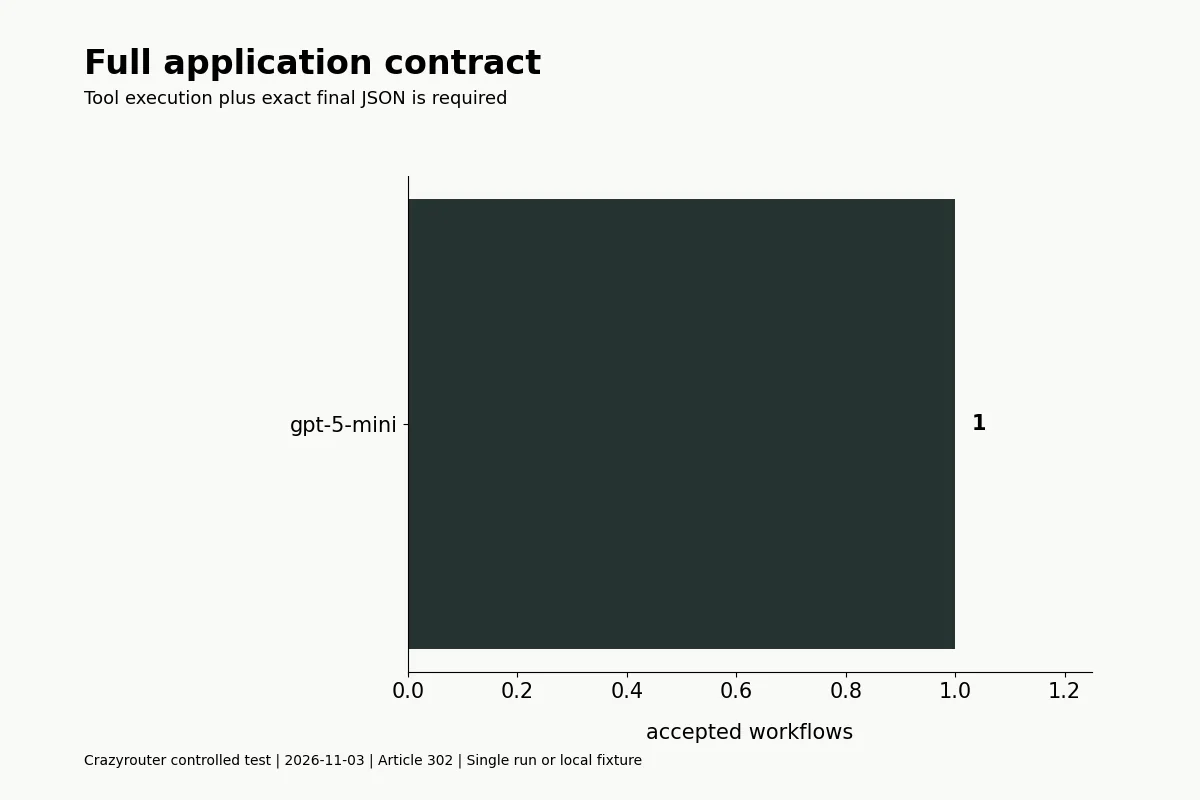
The model receives the tool schema and a request about DEMO-7. The application accepts one tool call, validates its arguments, returns a synthetic quantity of seven and checks the final JSON. The recorded run completed those steps.
November 3 experiment and observed results#
The scripts ran on Windows with Python 3.10.2 and synthetic inputs. Gateway generation and catalog requests use https://api.crazyrouter.com; paths and complete payloads appear in the code. Each result describes this run only. A test program exiting successfully means its observations were recorded, not that every model response passed.
| Requested model ID | Visible to this credential |
|---|---|
| gpt-5-mini | Yes |
| Route / case | HTTP or turns | Finish / outcome | Accepted | Observed output or error |
|---|---|---|---|---|
| gpt-5-mini / stock tool loop | 200, 200 | final | Yes | {"sku":"DEMO-7","available":7} |
Observed successful-envelope response IDs (failed acceptance can still have an ID):
resp_000b61dc0dbe3994016ae9ebba17b8819486a52c3a8039e87f
resp_01d72d7a24b6cd84016ae9ebbb966081978ae20a6fb415bea0
| Executed local case | Expected behavior met |
|---|---|
| valid | Yes |
| duplicate | Yes |
| unknown | Yes |
| bad JSON | Yes |
| extra field | Yes |
| wrong SKU | Yes |
Bound both execution and generation#
The executor permits only stock_lookup and exactly one sku field with the expected synthetic value. It rejects unknown functions, malformed JSON, extra arguments, another SKU and repeated tool-call IDs. Six local fixtures exercise these decisions before any live request.
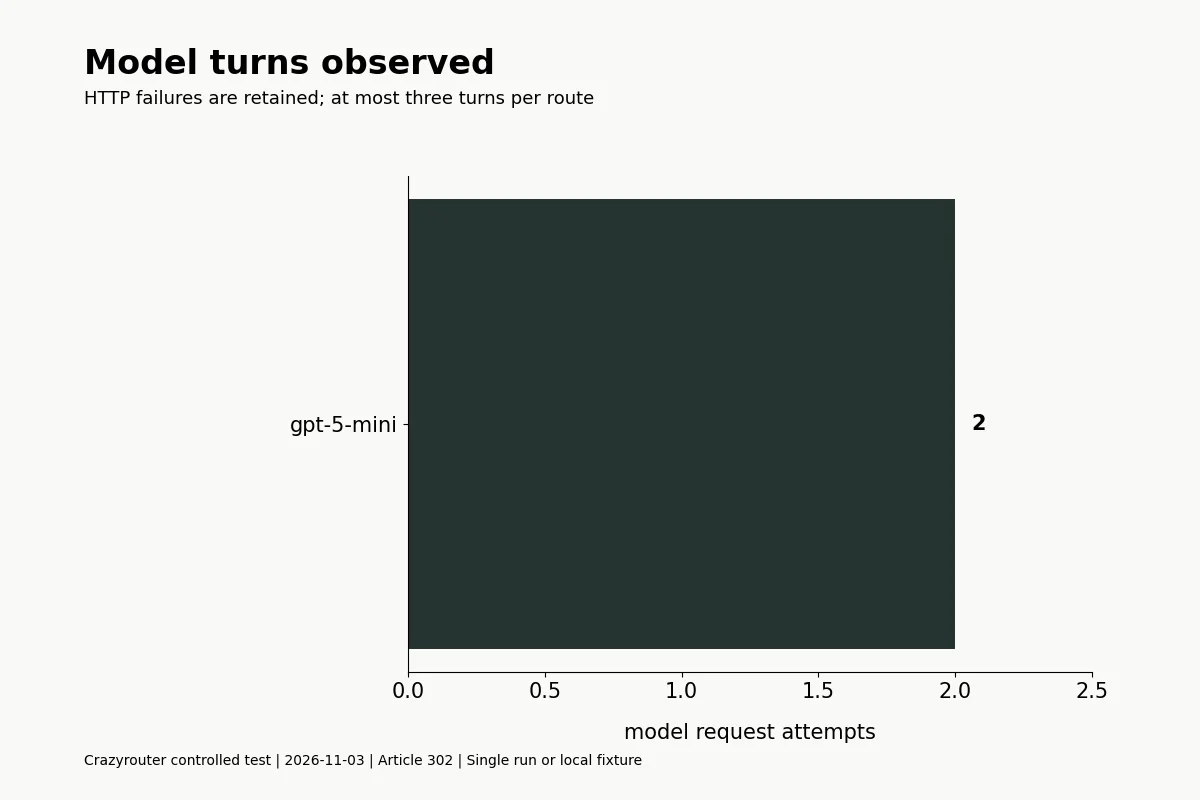
The loop accepts at most three model turns and requires the correct tool_calls finish state before executing. The final result needs stop, one actual lookup and the expected JSON. A final answer that guessed seven without a lookup would fail. A repeated semantic operation under a new call ID is not covered by the ID set, so external writes need a stronger business idempotency design.
Use a read-only tool before adding side effects#
This tool reads a local synthetic dictionary; it does not contact a warehouse or change a record. Real inventory operations need trusted identity, authorization and current-state checks. Keep those checks inside the application, not in model-generated arguments.
Network errors, invalid tool turns and turn-limit exhaustion produce explicit failed outcomes. No retry is hidden in the loop. If you add retries, decide which operations are safe to replay and preserve the corresponding result IDs.
Reproduce the experiment#
Install requests, set CRAZYROUTER_API_KEY in the process environment, save this complete script and run it with Python 3.10 or later. Requests use your authorized credential and can consume usage. Authorization headers are not printed.
import json
import os
import time
import requests

BASE = "https://api.crazyrouter.com/v1"

def catalog(models):
    with requests.Session() as s:
        s.trust_env=False
        r=s.get(BASE+"/models",headers={"Authorization":"Bearer "+os.environ["CRAZYROUTER_API_KEY"]},timeout=(10,40),allow_redirects=False)
        r.raise_for_status();names={x["id"] for x in r.json()["data"]}
    return {m:m in names for m in models}

def chat(model,prompt,**options):
    payload={"model":model,"messages":[{"role":"user","content":prompt}],**options}
    record={"model":model,"request":payload};start=time.perf_counter()
    try:
        with requests.Session() as s:
            s.trust_env=False
            r=s.post(BASE+"/chat/completions",headers={"Authorization":"Bearer "+os.environ["CRAZYROUTER_API_KEY"]},json=payload,timeout=(10,65),allow_redirects=False)
        record["http"]=r.status_code
        if r.status_code==200:
            d=r.json();c=d["choices"][0];record.update(response_id=d.get("id"),output=c["message"].get("content"),finish=c.get("finish_reason"),usage=d.get("usage",{}))
        else:record["error"]="HTTP_"+str(r.status_code)
    except (requests.RequestException,ValueError,KeyError,IndexError) as e:record["error"]=type(e).__name__
    record["seconds"]=round(time.perf_counter()-start,3)
    return record

def parsed(row):
    if row.get("finish")!="stop":return None
    try:return json.loads(row.get("output") or "null")
    except (ValueError,TypeError):return None

def emit(**data):print(json.dumps(data,ensure_ascii=False))

def execute(call,seen):
    if call.get("id") in seen:return {"error":"duplicate"}
    if call.get("function",{}).get("name")!="stock_lookup":return {"error":"unknown_tool"}
    try:args=json.loads(call["function"]["arguments"])
    except (ValueError,KeyError,TypeError):return {"error":"invalid_json"}
    if type(args) is not dict or set(args)!={"sku"} or args["sku"]!="DEMO-7":return {"error":"invalid_arguments"}
    seen.add(call["id"])
    return {"sku":"DEMO-7","available":7}

def loop(model):
    messages=[{"role":"user","content":'Use stock_lookup for SKU DEMO-7, then return only JSON {"sku":"DEMO-7","available":7}. The tool is the source of stock data.'}]
    tool={"type":"function","function":{"name":"stock_lookup","description":"Read synthetic stock, no external operation","parameters":{"type":"object","properties":{"sku":{"type":"string"}},"required":["sku"],"additionalProperties":False}}}
    seen=set();turns=[];outcome="turn_limit";output=None
    with requests.Session() as s:
        s.trust_env=False
        for turn in range(3):
            payload={"model":model,"messages":messages,"tools":[tool],"tool_choice":"auto"}
            if model.startswith("gpt-5"):payload.update(max_completion_tokens=1024,reasoning_effort="none" if model=="gpt-5.5" else "minimal")
            else:payload["max_tokens"]=1024
            started=time.perf_counter()
            try:
                response=s.post(BASE+"/chat/completions",headers={"Authorization":"Bearer "+os.environ["CRAZYROUTER_API_KEY"]},json=payload,timeout=(10,65),allow_redirects=False)
                row={"turn":turn+1,"http":response.status_code,"request":json.loads(json.dumps(payload))}
                if response.status_code!=200:outcome="http_failure";turns.append(row);break
                data=response.json();choice=data["choices"][0];msg=choice["message"]
                row.update(response_id=data.get("id"),finish=choice.get("finish_reason"),output=msg.get("content"),usage=data.get("usage",{}),seconds=round(time.perf_counter()-started,3));turns.append(row)
                calls=msg.get("tool_calls") or []
                if calls:
                    if choice.get("finish_reason")!="tool_calls" or len(calls)!=1:outcome="invalid_tool_turn";break
                    result=execute(calls[0],seen);row["tool_result"]=result
                    if "error" in result:outcome="executor_rejected";break
                    messages.append({"role":"assistant","content":msg.get("content"),"tool_calls":calls})
                    messages.append({"role":"tool","tool_call_id":calls[0]["id"],"content":json.dumps(result)})
                else:
                    output=msg.get("content");outcome="final" if choice.get("finish_reason")=="stop" else "incomplete";break
            except (requests.RequestException,ValueError,KeyError,IndexError) as e:
                outcome=type(e).__name__;turns.append({"turn":turn+1,"error":outcome});break
    try:answer=json.loads(output or "null")
    except ValueError:answer=None
    return {"model":model,"case":"stock tool loop","turns":turns,"outcome":outcome,"output":output,"passed":outcome=="final" and len(seen)==1 and answer=={"sku":"DEMO-7","available":7}}

valid={"id":"call-test","function":{"name":"stock_lookup","arguments":'{"sku":"DEMO-7"}'}}
tests=[]
cases=[("valid",valid,set(),None),("duplicate",valid,{"call-test"},"duplicate"),("unknown",{"id":"x","function":{"name":"delete"}},set(),"unknown_tool"),("bad JSON",{"id":"x","function":{"name":"stock_lookup","arguments":"{"}},set(),"invalid_json"),("extra field",{"id":"x","function":{"name":"stock_lookup","arguments":'{"sku":"DEMO-7","tenant":"other"}'}},set(),"invalid_arguments"),("wrong SKU",{"id":"x","function":{"name":"stock_lookup","arguments":'{"sku":"OTHER"}'}},set(),"invalid_arguments")]
for name,call,seen,error in cases:
    result=execute(call,seen);assert result.get("error")==error;tests.append({"case":name,"passed":True})
models=['gpt-5-mini'];available=catalog(models)
emit(catalog=available,requests=[loop(m) for m in models if available[m]],local_tests=tests,scope="At most three model turns; read-only synthetic dictionary, no external side effect")
Sources and related guides#
Sources checked November 3, 2026: OpenAI function calling. Official descriptions and gateway observations are separate evidence.
- Authorize LLM Tool Calls: Tenant Isolation with a Tested Python Executor
- Claude tool_use_id Errors: Fix Missing and Misordered tool_result Blocks
- Function Calling Across AI Models: Two Completed Loops and One Timeout
- Kimi Agent Action Verification: Test State Versions Before a Write
- Multi-Model Fallback in Python: Bound Attempts and Control Replay
FAQ#
Is this the ChatGPT agent product?#
No. It is an application-built Chat Completions tool loop.
How many model turns are allowed?#
At most three, including the final response.
What proves the tool was used?#
The receipt contains the tool turn, local result and completed final response; the criterion also requires one executed call.
Can the model call any function?#
No. Only the exact stock_lookup schema and synthetic SKU are accepted.
Does duplicate-ID detection guarantee exactly-once writes?#
No. This read-only example does not implement business-level idempotency.
Were real inventory records touched?#
No. All tool data was synthetic and local.
Last actually tested: November 3, 2026. This API-dependent article is due for review December 3, 2026.
Implementation Guides
Podcast
AI Dev Tools: The Crazyrouter Podcast
Short episodes for developers on AI APIs, gateways, cost control and coding tools.
Latest episodes
EP196 · Oct 29, 2026 · 6:53
AI API Security Posture — Turn Controls Into Continuous Evidence
A practical guide to AI API security posture: inventory exposure, verify controls continuously, protect keys and data, constrain tools, and turn security assumptions into evidence that operators can act on.
EP195 · Oct 28, 2026 · 7:21
AI API Policy Drift — Detect When Production Rules Stop Matching Intent
A practical guide to policy drift in AI APIs: version routing and safety rules, detect stale enforcement, compare intended and observed behavior, and restore control before small gaps become incidents.