 简体中文
 繁體中文
 English
 Français
 Русский
 日本語
 Tiếng Việt
 한국어
 Deutsch
 Español
 Italiano
 Português
 العربية
 ไทย
 Bahasa Indonesia
 Bahasa Melayu
 Türkçe
 Polski
 Nederlands
 Dansk
 Norsk
 Қазақша
AI API Reseller vs Official API: What a Synthetic Probe Can Verify
Two synthetic gateway requests returned HTTP 200, but only one matched the expected answer. Separate functional checks from unverified retention, upstream identity and contractual claims.
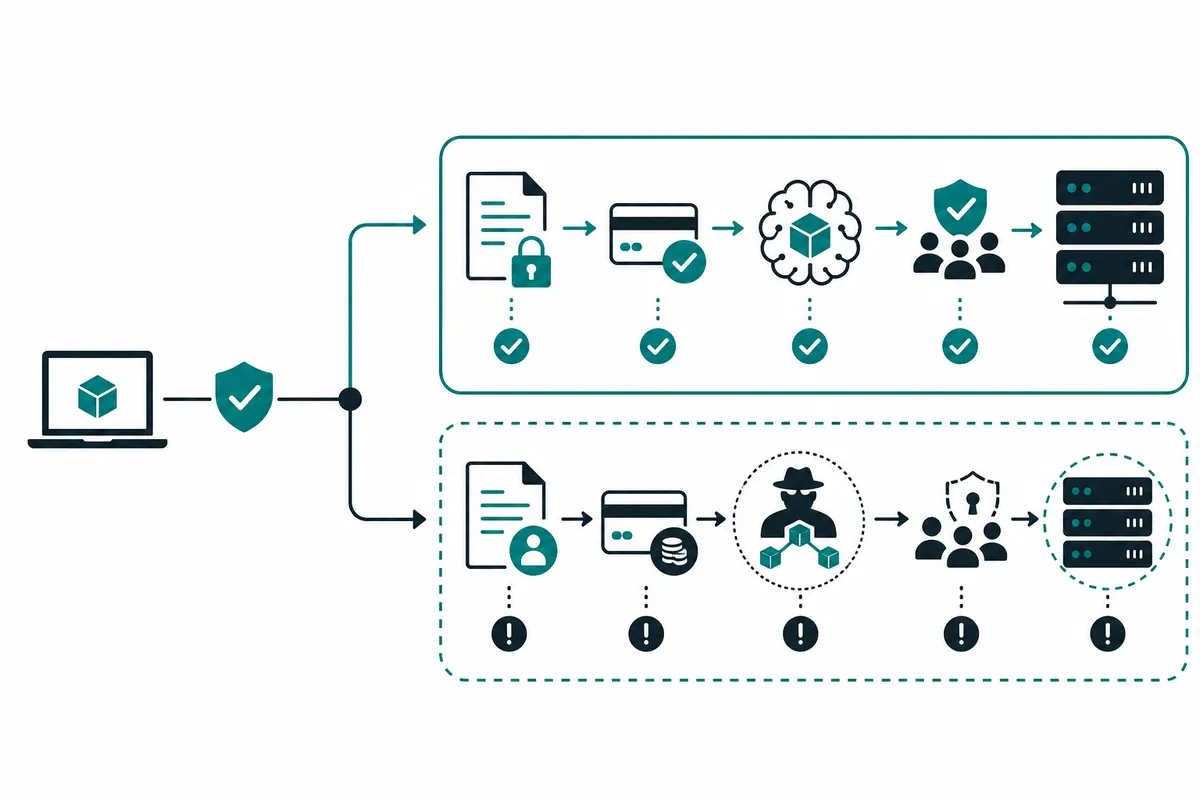
An official API connects you to a model provider; a reseller or gateway adds another service between your application and inference. Decide what evidence you need for the data and workflow involved. A working endpoint alone cannot establish retention, upstream identity or contractual suitability.
Crazyrouter is the gateway tested with two synthetic strings here: both requests returned HTTP 200, but only one produced the exact requested output.
By Brian J · Tested November 3, 2026
AI API reseller vs official API: is it safe?#
The endpoint category does not settle the safety question. A synthetic functional probe can verify specific response behavior, while data handling, contractual terms and upstream access require separate evidence. In this test, even the basic exact-output criterion failed once despite a successful HTTP response.
Keep a separate evidence column for every claim#
A direct provider API and a gateway can both be evaluated for authentication, required features, completion criteria and documented data handling. Their service boundaries differ: the gateway adds its own operator and routing behavior. Review the actual service documents for the intended workload rather than assuming all services in one category have the same policy.
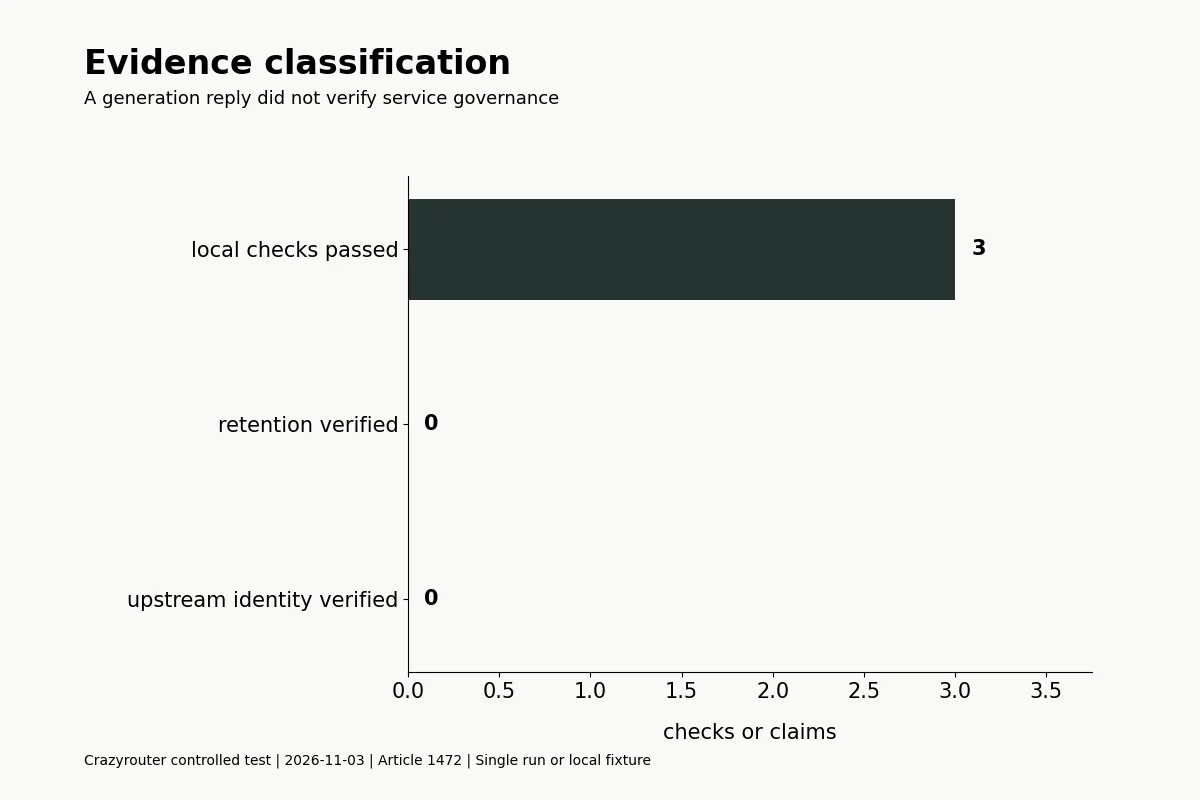
The script intentionally never upgrades retention_verified, upstream_identity_verified or contract_reviewed to true from a generation response. Three local cases exercise that rule for a successful fixture, an HTTP-successful wrong answer and a timeout. This is bookkeeping discipline, not a security certification.
November 3 test results#
The tests ran on Windows with Python 3.10.2 and synthetic inputs. The API host was https://api.crazyrouter.com; the complete request path, model and parameters appear in the runnable code below. These are dated observations, not a guarantee of future behavior.
| Case | HTTP | Finish | Exact fixture | Observed output |
|---|---|---|---|---|
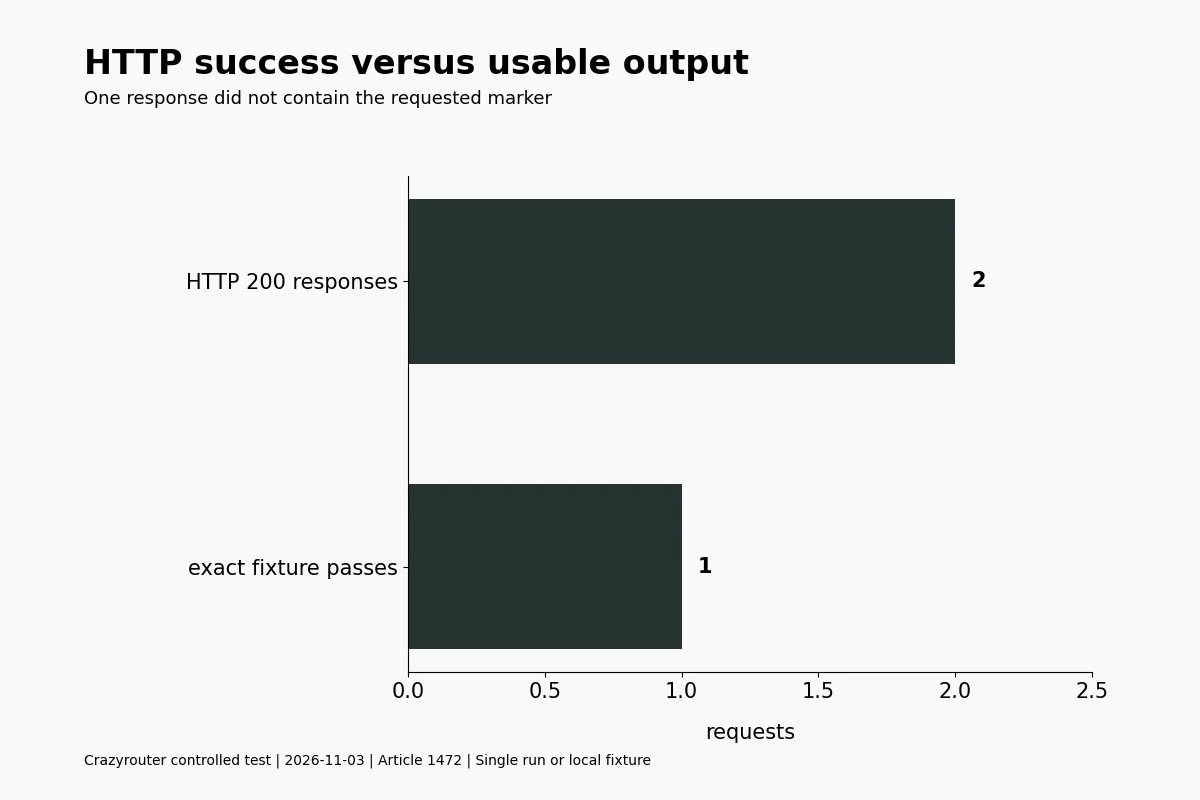
| 1 | 200 | stop | Pass | SYNTHETIC-A-1472 |
| 2 | 200 | stop | Fail | Understood. How can I assist you further? |
Local fixtures: 3 passed. The live-response criteria are evaluated separately.
Observed response or request IDs (including failed-output responses):
chatcmpl-Eg90hq3x8wSrUBpBfSfSBDBqTAhph
chatcmpl-Eg90iveNC63yyryE0sXHEeqHGxXee
The second successful HTTP response was not a successful task#
The first request returned SYNTHETIC-A-1472 as asked. The second request asked for SYNTHETIC-B-1472 and returned “Understood. How can I assist you further?” instead. Both ended with stop and HTTP 200. This two-request sample demonstrates why the content check is needed; it does not estimate a long-run failure rate or identify the cause.
Response IDs and model labels are operational metadata. They are not cryptographic proof of which upstream weights ran. Avoid identity claims based on a model saying its own name, an output style, a familiar ID prefix, or one benchmark answer.
Evaluate with minimal data first#
Start with synthetic inputs that exercise the feature you require: an ordinary response, complete stream, structured output, or tool round trip. Store the request shape and a safe outcome, then test access controls separately in an authorized environment. Do not send customer records merely to see whether the endpoint answers.
Before a sensitive deployment, obtain the current terms and data-handling information, understand deletion and retention responsibilities, identify applicable service boundaries, and decide whether they meet your requirements. This article has not audited those controls for either Crazyrouter or an official provider. The old price table was removed because a price comparison does not answer these questions.
Key facts from the November 3 test#
- Two synthetic ordinary-text calls used the same gateway model route.
- Both returned HTTP 200 and a terminal stop reason.
- One exact-output fixture passed and one failed.
- Three local evidence-classification checks passed.
- No customer data was sent.
- Retention, upstream identity and contracts were not verified by these calls.
Reproduce the test#
Install requests, set CRAZYROUTER_API_KEY in the process environment, save the complete script below, and run it with Python. It sends the synthetic requests shown in the code using your own authorized credential. It does not print authorization headers. Output includes the observed fixture outcomes; completing the script does not mean every model answer passed.
import json
import os
import time
import requests

BASE = "https://api.crazyrouter.com/v1"
def chat(model, messages, **options):
    client=requests.Session();client.trust_env=False
    payload={"model":model,"messages":messages,**options}
    start=time.perf_counter()
    record={"model":model,"request":payload}
    try:
        r=client.post(BASE+"/chat/completions",headers={"Authorization":"Bearer "+os.environ["CRAZYROUTER_API_KEY"]},json=payload,timeout=(10,45),allow_redirects=False)
        record["http"]=r.status_code
        if r.status_code!=200:
            record["error"]="HTTP_"+str(r.status_code)
        else:
            data=r.json();choice=data["choices"][0]
            record.update(response_id=data.get("id"),output=choice["message"].get("content"),finish_reason=choice.get("finish_reason"),usage=data.get("usage",{}))
    except (requests.RequestException,ValueError,KeyError,IndexError) as e:
        record["error"]=type(e).__name__
    finally:client.close()
    record["seconds"]=round(time.perf_counter()-start,3)
    return record

def catalog_selection(legacy,selected):
    client=requests.Session();client.trust_env=False
    try:
        r=client.get(BASE+"/models",headers={"Authorization":"Bearer "+os.environ["CRAZYROUTER_API_KEY"]},timeout=(10,30),allow_redirects=False)
        r.raise_for_status();names={x["id"] for x in r.json()["data"]}
        if selected not in names:raise ValueError("Selected model is not visible to this credential")
        return {"legacy_id":legacy,"legacy_visible":legacy in names,"selected_id":selected,"selected_visible":True,"scope":"this credential at test time"}
    finally:client.close()

def assess(record):
    return {"http_ok":record.get("http")==200,"fixture_completed":record.get("passed") is True,
            "retention_verified":False,"upstream_identity_verified":False,"contract_reviewed":False}
def main():
    tests=[]
    for label,record in [("200 with wrong output",{"http":200,"passed":False}),("completed fixture",{"http":200,"passed":True}),("timeout",{"error":"ReadTimeout"})]:
        result=assess(record)
        assert not any(result[k] for k in ["retention_verified","upstream_identity_verified","contract_reviewed"])
        assert result["fixture_completed"]==(record.get("passed") is True)
        tests.append({"case":label,"passed":True})
    rows=[]
    for marker in ["SYNTHETIC-A-1472","SYNTHETIC-B-1472"]:
        r=chat("gpt-4.1-mini",[{"role":"user","content":"Reply only "+marker}],max_tokens=64)
        r["passed"]=r.get("output","").strip()==marker and r.get("finish_reason")=="stop"
        r["assessment"]=assess(r);rows.append(r)
    print(json.dumps({"endpoint":BASE+"/chat/completions","local_tests":tests,"requests":rows,"data_class":"synthetic non-customer strings"}))
if __name__=="__main__":main()
Sources and related implementation guides#
Official references checked November 3, 2026: OWASP prompt-injection prevention. Their documented behavior is distinct from the gateway results measured here.
- AI API Key Safety: Build Logs That Exclude Credentials and Prompts
- Claude API Keys: Bind Credentials to the Right Host and Validate the Reply
- One API Key for Multiple AI Models: Catalog Access and Live Route Tests
- OpenAI-Compatible Claude and Gemini: Normal and Streaming SDK Tests
- Authorize LLM Tool Calls: Tenant Isolation with a Tested Python Executor
FAQ#
Crazyrouter AI API gateway review#
This probe found one exact-output pass and one mismatch in two synthetic calls. It is a functional observation, not a comprehensive service or security review.
Does a lower price prove an API is unsafe?#
No. Price alone proves neither safety nor unsafety. Evaluate the service behavior and the evidence relevant to your data.
Does OpenAI compatibility prove an OpenAI upstream?#
No. Compatibility describes an interface; this test cannot authenticate the identity of the underlying model.
Did both requests work?#
Both returned HTTP 200, but only one met the exact requested-output criterion.
Should I provide my official provider key to a gateway?#
This test used a separately issued gateway credential. Any bring-your-own-key arrangement needs its own deliberate trust and configuration decision.
Can I infer retention from a response header?#
No. Review actual data-handling evidence and terms; this script leaves retention unverified.
Last actually tested: November 3, 2026. This API-dependent article is due for review December 3, 2026.
Implementation Guides
Podcast
AI Dev Tools: The Crazyrouter Podcast
Short episodes for developers on AI APIs, gateways, cost control and coding tools.
Latest episodes
EP196 · Oct 29, 2026 · 6:53
AI API Security Posture — Turn Controls Into Continuous Evidence
A practical guide to AI API security posture: inventory exposure, verify controls continuously, protect keys and data, constrain tools, and turn security assumptions into evidence that operators can act on.
EP195 · Oct 28, 2026 · 7:21
AI API Policy Drift — Detect When Production Rules Stop Matching Intent
A practical guide to policy drift in AI APIs: version routing and safety rules, detect stale enforcement, compare intended and observed behavior, and restore control before small gaps become incidents.