 中文
中文 English
 Français
 Русский
 日本語
日本語 Tiếng Việt
 한국어
한국어 Deutsch
 Español
 Italiano
 Português
 العربية
 ไทย
ไทย Bahasa Indonesia
 Bahasa Melayu
 Türkçe
 Polski
 Nederlands
 Dansk
Dansk Norsk
Norsk Қазақша
Qwen2.5-Omni Guide: Multimodal API Integration for Developers
Learn what Qwen2.5-Omni does, when to use it, how to call multimodal inputs, and how to design cost-aware production integrations.

Qwen2.5-Omni Guide: Multimodal API Integration for Developers#
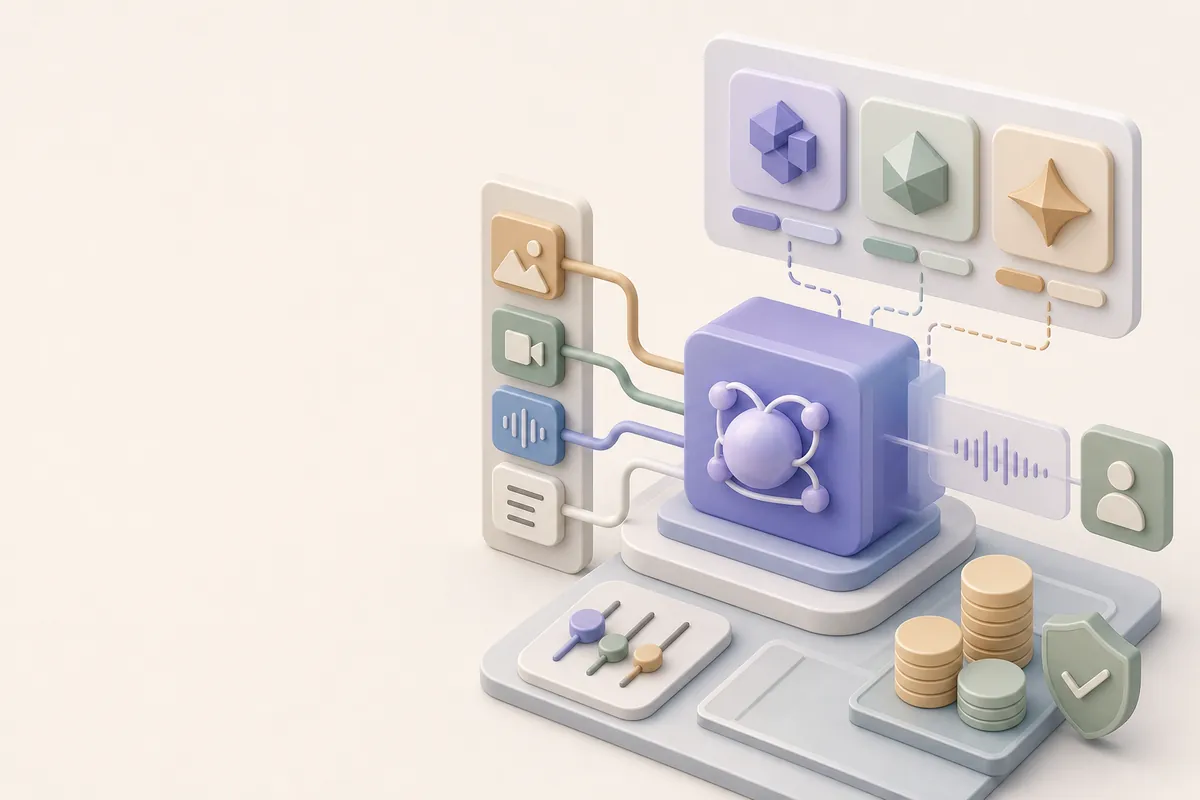
Qwen2.5-Omni is designed for applications that combine more than one input or output modality. Instead of maintaining separate pipelines for every text, image, and audio operation, a multimodal model can help an application understand mixed user input in one conversational context. That makes it interesting for document assistants, meeting tools, visual support agents, and content workflows.
What is Qwen2.5-Omni?#
Qwen2.5-Omni belongs to Alibaba's Qwen model family and is intended for multimodal interaction. In practical terms, a request can include text plus an image or other supported media, depending on the currently exposed API capabilities. The exact accepted formats and model identifiers can change, so confirm them in the provider documentation and gateway model list.
The model is not a replacement for every specialized service. A dedicated OCR model may be better for high-volume text extraction, while a speech model may be better for transcription. Omni models are valuable when the application needs cross-modal context and a single conversational result.
Qwen2.5-Omni vs alternatives#
| Approach | Strength | Limitation |
|---|---|---|
| Qwen2.5-Omni | Mixed-modal understanding in one workflow | Capability and media limits require testing |
| Text-only LLM plus OCR | Simple text reasoning | Loses visual context and adds pipeline steps |
| Vision-language model | Strong image and text analysis | May not cover audio workflows |
| Separate specialist APIs | Best-of-breed components | More integrations, billing, and failure modes |
Choose based on your input distribution. If most requests are plain text, a smaller text model is usually more efficient. If users send screenshots, documents, or recordings alongside questions, an omni model can simplify orchestration.
Calling Qwen through Crazyrouter#
Use the OpenAI-compatible endpoint and pass a multimodal content array when the selected model supports it. Replace the model identifier with the current identifier shown in your account.
from openai import OpenAI

client = OpenAI(api_key="your-crazyrouter-key", base_url="https://crazyrouter.com/v1")
response = client.chat.completions.create(
    model="qwen2.5-omni",
    messages=[{
        "role": "user",
        "content": [
            {"type": "text", "text": "Read this screenshot and list the three visible errors."},
            {"type": "image_url", "image_url": {"url": "https://example.com/screenshot.png"}}
        ]
    }]
)
print(response.choices[0].message.content)
For a quick cURL test:
curl https://crazyrouter.com/v1/chat/completions \
  -H 'Authorization: Bearer your-crazyrouter-key' \
  -H 'Content-Type: application/json' \
  -d '{"model":"qwen2.5-omni","messages":[{"role":"user","content":[{"type":"text","text":"Describe the chart."},{"type":"image_url","image_url":{"url":"https://example.com/chart.png"}}]}]}'
Node.js follows the same schema:
import OpenAI from "openai";
const client = new OpenAI({ apiKey: process.env.CRAZYROUTER_KEY, baseURL: "https://crazyrouter.com/v1" });
const answer = await client.chat.completions.create({ model: "qwen2.5-omni", messages: [{
  role: "user", content: [
    { type: "text", text: "What does this product label say?" },
    { type: "image_url", image_url: { url: "https://example.com/label.jpg" } }
  ]
}] });
console.log(answer.choices[0].message.content);
Do not place private customer media in public URLs. For production, use short-lived signed URLs, validate MIME types, enforce size limits, and remove media after processing.
Pricing and architecture#
The live Crazyrouter pricing page should be used for current rates. The following is an architecture comparison, not a fixed price quote.
| Dimension | Direct Qwen access | Crazyrouter |
|---|---|---|
| Billing | Provider-specific | Centralized gateway usage |
| Integration | Provider SDK and endpoint | OpenAI-compatible endpoint |
| Alternatives | Application-managed | Change model IDs within one gateway |
| Availability | Depends on provider region | Check current gateway model list |
Control cost by resizing images before upload, limiting conversation history, hashing repeated documents for caching, and routing text-only turns to a smaller model. Log media bytes as well as tokens; media processing can dominate the bill.
FAQ#
What does Qwen2.5-Omni do?#
It handles multimodal conversations, allowing applications to combine supported media with text in a single interaction.
Can it read every image or audio format?#
No. Supported formats, limits, and output modes depend on the current deployment. Test the exact files your application receives.
Is Qwen2.5-Omni better than separate APIs?#
It can simplify cross-modal context, while separate specialist APIs may offer better accuracy or throughput for one modality.
How can I protect uploaded media?#
Use private storage, signed URLs, MIME validation, size limits, retention policies, and strict logging that excludes raw content.
How do I access it?#
Check the model list in Crazyrouter, then run a small multimodal test before production rollout.
Summary#
Qwen2.5-Omni is useful when a product must understand mixed media without scattering context across many services. Start with a narrow evaluation set, validate supported inputs, secure media URLs, and track both tokens and bytes. Crazyrouter gives developers one compatible gateway for testing Qwen alongside other language, vision, audio, and video models.