 简体中文
 繁體中文
 English
 Français
 Русский
 日本語
 Tiếng Việt
 한국어
 Deutsch
 Español
 Italiano
 Português
 العربية
 ไทย
 Bahasa Indonesia
 Bahasa Melayu
 Türkçe
 Polski
 Nederlands
 Dansk
 Norsk
 Қазақша
GLM-5.4 vs. DeepSeek V4.1 Flash: Chinese Tasks and Strict JSON
Across 10 types of everyday tasks in Chinese, with three runs per task, GLM-5.4 got 25/25 shared objective answers right versus DeepSeek’s 21/25. DeepSeek was more reliable at strict JSON output. Here’s how they compared on accuracy, formatting, availability, and latency.

By Brian J · Test date: November 24, 2026
Does order B still count as a valid order if it received 80 yuan and then had the full 80 yuan refunded? The prompt explicitly says it does not. In one run, DeepSeek V4.1 Flash calculated total revenue correctly but still included B in the list of valid orders. GLM-5.4 got it right in all three runs. But ask a different question—whose response can go straight to a JSON parser?—and DeepSeek comes out ahead.
Same tasks, two different winners#
Crazyrouter gave both models the same prompts across 10 types of everyday tasks in Chinese, with three runs per task. Start with the fairest comparison: across the 25 objective task runs both models answered, GLM got 25 right and DeepSeek got 21. This measures answer content, not whether the model wrapped its JSON in Markdown.
| What we measured | GLM-5.4 | DeepSeek V4.1 Flash |
|---|---|---|
| Shared objective tasks, correct answers | 25/25 | 21/25 |
| All valid objective answers from each model, correct | 25/25 | 23/27 |
| Explicit JSON requests, raw output directly parseable | 3/19 | 16/21 |
| Chinese customer notices meeting both factual and length requirements | 3/3 | 0/3 |
| Tasks completed on the first attempt | 25/30 | 29/30 |
| Tasks completed after one retry for failed runs | 28/30 | 30/30 |
| Median completion time for successful tasks | 4.28 seconds | 5.24 seconds |
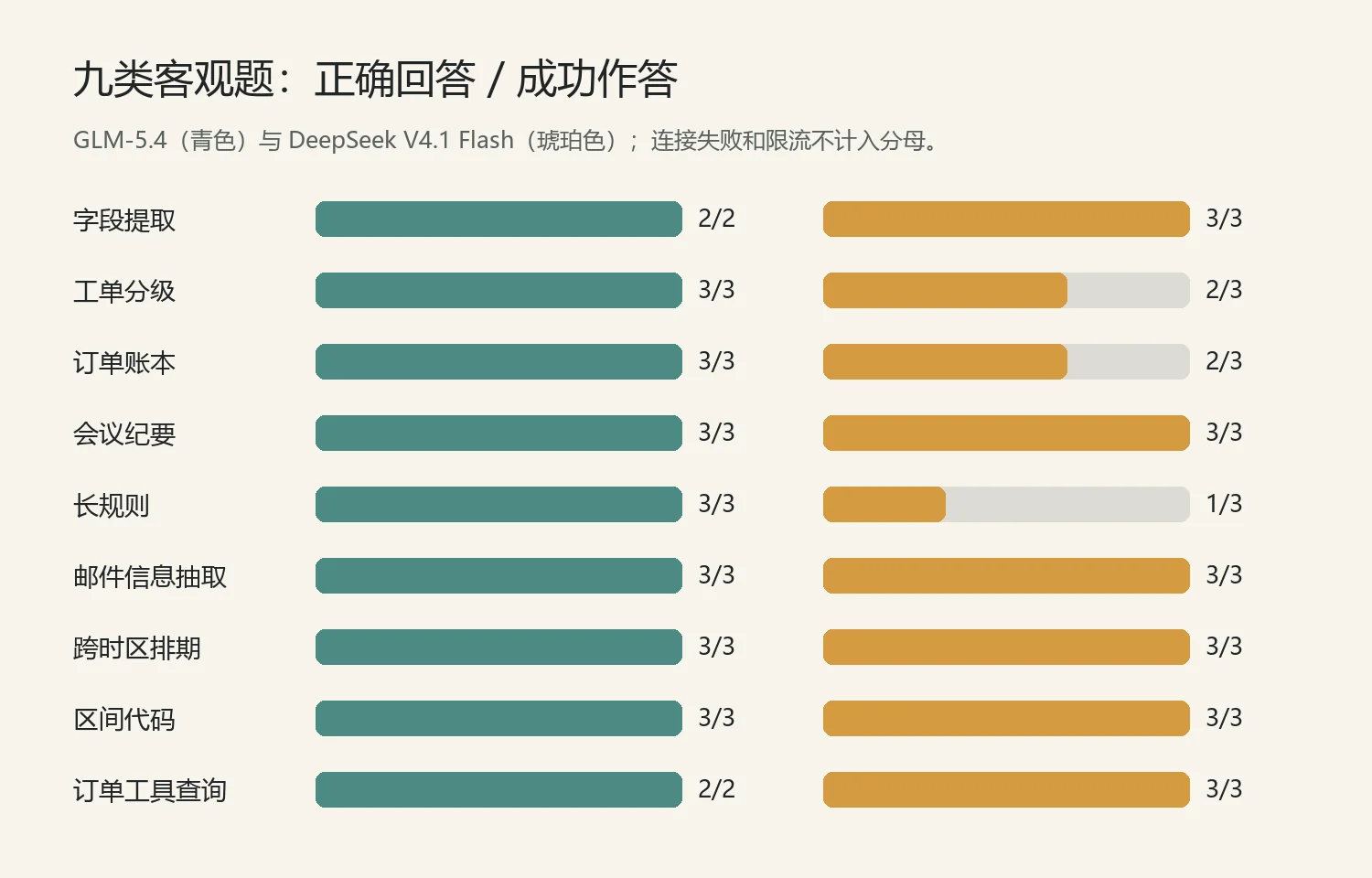
Four content errors came down to three business judgments#
Refunds: getting the total right doesn’t mean the ledger is right. The correct answer was net revenue of 167.50 yuan, with orders A and D as the two valid orders. In one run, DeepSeek also returned 167.50 yuan, but listed A, B, and D. A downstream check that verifies only the total would miss the extra order.
Rule lookup: finding the maximum isn’t enough—you must return all and only the tied rules. Among 180 rules, both models found the maximum value of 117 days. The matching rules were R087 and R177. In two runs, DeepSeek also listed R117 and R147; GLM returned the correct set in all three runs.
Support tickets: the reporter’s identity doesn’t determine the scope of an outage. A free-tier user reported that “all users are unable to log in.” The rules classify an issue affecting everyone as P1, but DeepSeek labeled it P2 in one run. Other tasks showed no difference: both models passed all three runs for meeting notes, cross-time-zone scheduling, and merging Python half-open intervals.
Writing for customers and writing for software are different tasks#
The customer notice prompt required 80–120 Chinese characters and asked the model to preserve the impact window, the slowdown affecting some requests, the fact that service had been restored, and a progress update by 18:00 that day. Both models included all those facts, and neither promised compensation. GLM’s three notices were 100, 98, and 90 characters; DeepSeek’s were 71, 68, and 72. DeepSeek fell short of the minimum length, not on the underlying facts. If your use case calls only for a brief notice, with no minimum length, there’s no reason to mark it down here.
Software is less forgiving about formatting. Content scoring allowed us to strip code fences before checking fields and values; format scoring parsed the raw response as-is. Among successful responses to prompts explicitly requesting pure JSON, DeepSeek returned 16/21 responses that could be parsed directly, compared with 3/19 for GLM. The test did not use JSON Schema or enforce JSON mode, so these results should not be extrapolated to applications that enable those features.
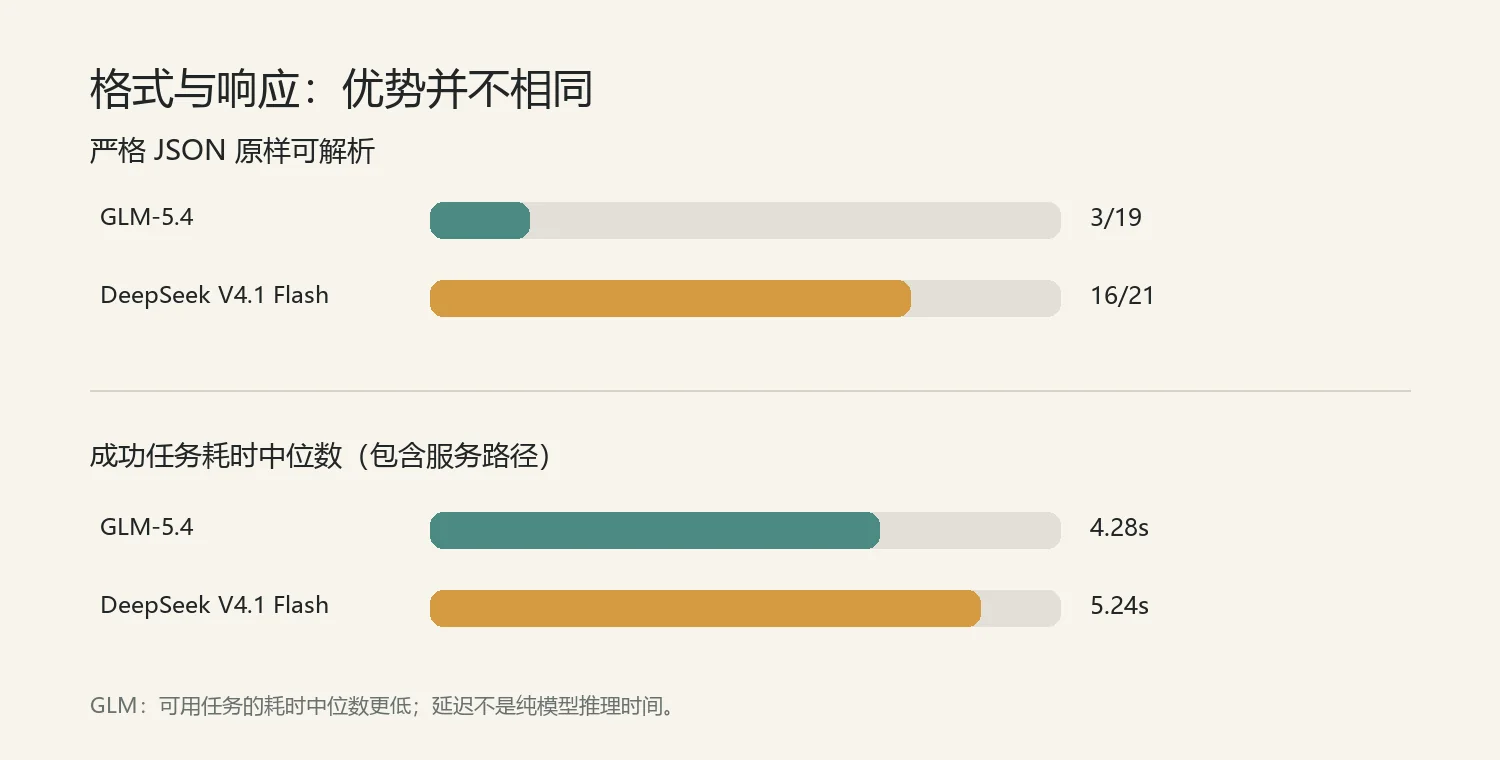
Which model to choose—and what this test didn’t cover#
For checking orders, applying multiple Chinese-language rules, and drafting notices with hard requirements, GLM-5.4 was the pick in this test. For raw JSON that can be parsed without extra text cleanup, DeepSeek V4.1 Flash was the pick. Even in the latter case, validate the business conditions—for example, whether every order in the list actually has a net amount greater than zero. Valid JSON is not necessarily a correct answer.
Both models used the same chat interface, with a fixed service route for each. They received the same system instructions, had an output limit of 2,048 token, were asked not to think, and had no temperature specified. Tool tasks first called a read-only simulated order lookup, then answered based on its results, so 60 task runs did not mean 60 API requests. GLM still had one field-extraction run and one tool-lookup run that failed to return an answer because of rate limits. These were not content errors, but they were incomplete tasks.
Latency includes network and upstream service time, but not the wait before a retry after a failure. The test did not include an itemized cost audit, large codebases, multimodal tasks, or long-running agent workflows. GLM-5.4 led this sample of everyday tasks in Chinese; that does not establish it as the top model across all Chinese models.
Testing and data review were performed by an AI execution agent; Brian J is credited as the article editor.
Implementation Guides
Podcast
AI Dev Tools: The Crazyrouter Podcast
Short episodes for developers on AI APIs, gateways, cost control and coding tools.
Latest episodes
EP196 · Oct 29, 2026 · 6:53
AI API Security Posture — Turn Controls Into Continuous Evidence
A practical guide to AI API security posture: inventory exposure, verify controls continuously, protect keys and data, constrain tools, and turn security assumptions into evidence that operators can act on.
EP195 · Oct 28, 2026 · 7:21
AI API Policy Drift — Detect When Production Rules Stop Matching Intent
A practical guide to policy drift in AI APIs: version routing and safety rules, detect stale enforcement, compare intended and observed behavior, and restore control before small gaps become incidents.