 简体中文
 繁體中文
 English
 Français
 Русский
 日本語
 Tiếng Việt
 한국어
 Deutsch
 Español
 Italiano
 Português
 العربية
 ไทย
 Bahasa Indonesia
 Bahasa Melayu
 Türkçe
 Polski
 Nederlands
 Dansk
 Norsk
 Қазақша
GPT-6.2 Sol vs. GPT-6 Sol: Is Better Accuracy Worth the Extra Cost? 32 Test Runs
32 same-route tests: GPT-6.2 Sol 16/16, GPT-6 Sol 13/16. Three failures, per-task latency, discounts, actual charges, and reasoning_effort migration.

If GPT-6 Sol already handles your daily work, the case for switching to GPT-6.2 Sol comes down to specific tasks. Does it get right what the older model tended to get wrong? Does it cut wait times? Are those improvements worth the extra cost?
Across 32 tests run through the same Crazyrouter route, GPT-6.2 Sol passed 16/16 and GPT-6 Sol passed 13/16. The newer model took 38.4% less time on average on the constrained optimization task, but actual spending was 53.2% higher. These results support trying 6.2 Sol first for work that requires exact counts or optimal solutions. If your current tasks already pass consistently and cost is a priority, 6 Sol is still worth keeping.
We reused the eight task types and scoring method from the earlier Astra comparison and ran every Sol request afresh. The two series were tested at different times and under different cache conditions, so combining costs from the two articles into a single ranking would be misleading.
Official specs and pricing: Same context window, same input and output list prices#
We checked the official documentation for both models on November 20, 2026. The table reflects what the documentation says. The version numbers alone do not establish these differences.[1][2]
| Item | GPT-6.2 Sol | GPT-6 Sol |
|---|---|---|
| Model ID | gpt-6.2-sol | gpt-6-sol |
| Input / output | Text and image input, text output | Text and image input, text output |
| Context window | 1,050,000 tokens | 1,050,000 tokens |
| Maximum input / maximum output | 922,000 / 128,000 tokens | 922,000 / 128,000 tokens |
| Knowledge cutoff | 2026-06-01 | 2026-04-20 |
| Official uncached input rate | $2 / million tokens | $2 / million tokens |
| Official cache read rate | $0.10 / million tokens | $0.20 / million tokens |
| Official output rate | $10 / million tokens | $10 / million tokens |
reasoning_effort: none | Official documentation says this value is rejected | Official documentation lists this value as supported |
Prices are for the Standard tier with inputs of up to 272K tokens. The documentation for both models says that above 272K input tokens, input and cache rates double, and the output rate rises to 1.5 times the short-input rate.[1][2]
It's easy to read this as “the newer model is cheaper.” The official uncached input and output prices are the same for both Sol models. The cache read rate fell by 50%. Whether you save money depends on your cache hit share, actual token usage, and platform discounts.
The official model pages also list image and tool capabilities. We tested only text Chat Completions. The official capability lists do not establish that every feature has been verified on Crazyrouter.
Test setup: 32 main requests, with separate parameter and code checks#
The main test ran on November 20, 2026, from 12:55 to 12:59 Beijing time. We first verified both models through /v1/models, then compared them on the same upstream route.
| Condition | Test setup |
|---|---|
| Service entry point | Crazyrouter, https://api.crazyrouter.com/v1 |
| Endpoint | POST /chat/completions |
| Routing control | Fixed upstream route for both models, verified against each of the 32 billing logs |
| Prompts | Identical system and user messages for the same task |
| Reasoning / output budget | reasoning_effort: high, max_completion_tokens: 8192 |
| Response mode | Non-streaming, stream: false |
| Request schedule | 8 task types × 2 runs per model, randomized order, total concurrency of 2 |
| Full-task pass criteria | HTTP 200, finish_reason=stop, parseable JSON, and an exact field-by-field match with the predetermined reference answer |
The tasks covered rule lookup, checking a false premise, dependency graph optimization, constrained subset selection, billing replay, transaction visibility, deduplication order, and interval boundaries. We determined the reference answers before sending the requests and kept them out of the prompts.
We measured time from the moment the client sent the request until the complete response arrived, including networking, queuing, reasoning, and output. First-token latency was outside the scope of this measurement. The first six tasks came from an earlier test set, and we did not clear the cache. The costs therefore reflect the actual run under those cache conditions.
We tested parameter compatibility and the example in this article separately, outside the 32 main requests. A few supplemental requests overlapped with the main test window, so this was a partially overlapping performance test. The largest reported input in the main test was 14,377 tokens. We did not verify million-token context, test changes across a full repository, or execute model-generated code.
Results: 6.2 Sol passed every run, and 6 Sol missed two types of tasks#
| Task | 6.2 Sol passes | 6 Sol passes | 6.2 average time | 6 average time |
|---|---|---|---|---|
| Long rule table lookup | 2/2 | 2/2 | 15.60 seconds | 15.12 seconds |
| Correcting a false premise | 2/2 | 0/2 | 15.39 seconds | 19.60 seconds |
| Dependency graph optimization | 2/2 | 2/2 | 8.43 seconds | 9.74 seconds |
| Optimal subset selection under constraints | 2/2 | 1/2 | 20.24 seconds | 32.86 seconds |
| Billing replay | 2/2 | 2/2 | 14.44 seconds | 11.32 seconds |
| Transaction visibility | 2/2 | 2/2 | 8.54 seconds | 6.20 seconds |
| Deduplicate before filtering | 2/2 | 2/2 | 8.79 seconds | 6.52 seconds |
| Interval boundary reasoning | 2/2 | 2/2 | 8.51 seconds | 5.70 seconds |
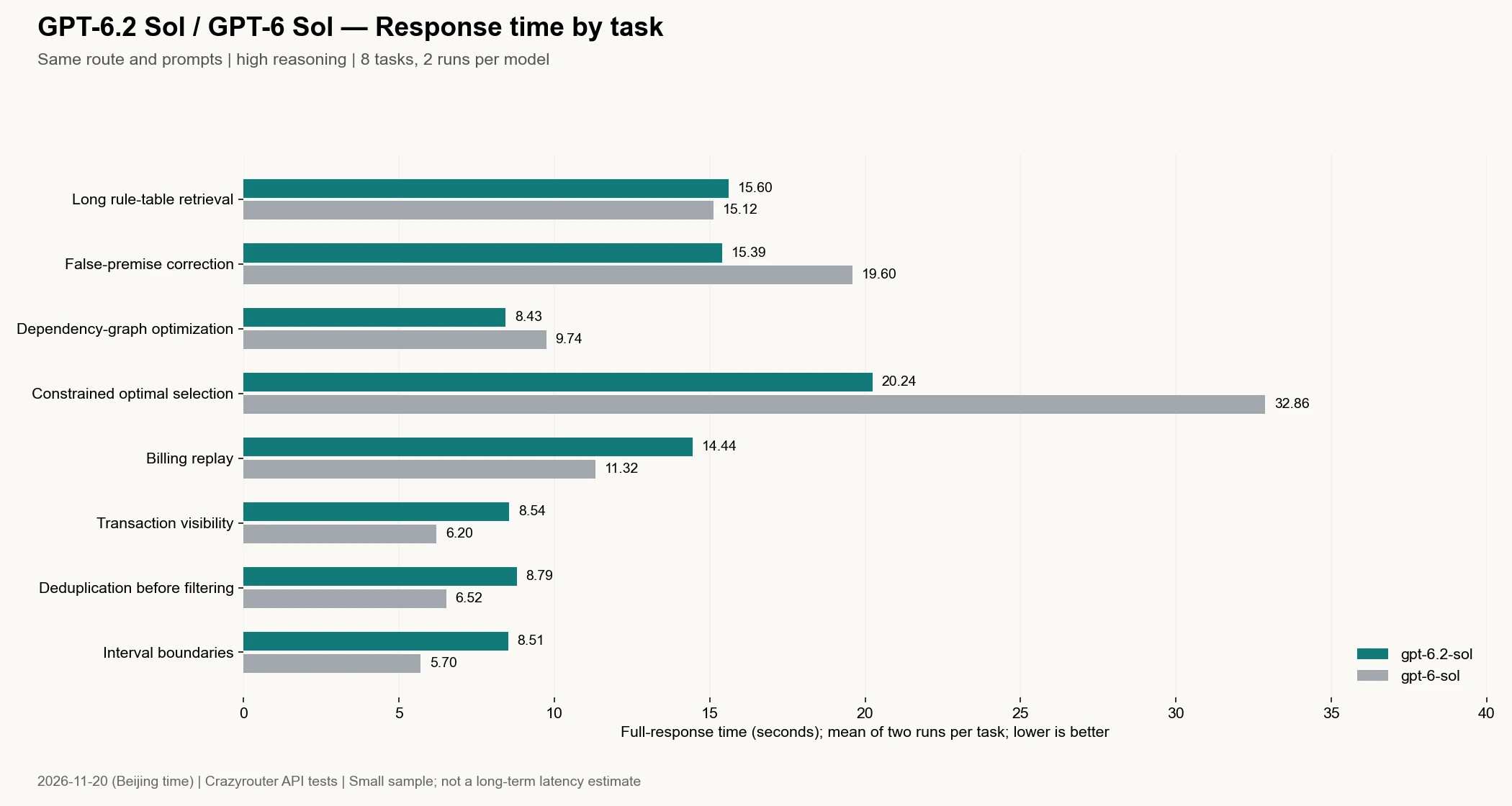
Timing includes all requests, including those with incorrect answers. Each cell represents only two runs, so small gaps in response time are insufficient to establish a consistent lead.
All 32 requests across the two models returned HTTP 200, produced valid JSON, and ended with stop. Answer correctness was what separated the models. All three GPT-6 Sol failures were semantic errors.
Error one: Correctly rejected the false premise but got the count wrong#
The task provided 360 rules and asked the model to verify the claim that “exactly two SETTLED rules trigger at delay=8” and return the total number of matching rules.
The rule statuses repeat in a cycle of five, yielding 72 SETTLED rules. Every delay_gt value falls between 1 and 7, so all 72 rules meet the trigger condition at delay=8.
Both models correctly rejected “exactly two,” but their counts differed.
| Response field | Reference answer | GPT-6.2 Sol, both runs | GPT-6 Sol, both runs |
|---|---|---|---|
exactly_two | false | false in both runs | false in both runs |
matching_count | 72 | 72, 72 | 69, 71 |
winner_policy_specified | false | Correct in both runs | Correct in both runs |
max_days_among_matches | 116 | Correct in both runs | Correct in both runs |
If you only check whether the models disagreed with the colleague's claim, all four responses look correct. A field-by-field check showed that the older model undercounted in both runs, so both failed the full task.
This distinction matters more for billing reconciliation, rule audits, and batch filtering. A plausible explanation still needs an accurate count, and valid JSON still needs business logic validation.
Error two: Found a feasible solution but missed the true optimum#
The constrained subset selection task asked for the highest-value set of 12 candidate projects, subject to a weight limit, a maximum of 5 selections, dependencies, and mutual exclusions.
Enumerating all 4,096 subsets yielded a unique optimal solution.
{"best_value":78,"optimal_sets":[[0,2,6,9,11]]}
GPT-6.2 Sol got both runs right. GPT-6 Sol got the first run right and returned the following on the second.
{"best_value":77,"optimal_sets":[[0,2,4,6,9],[0,4,6,8,11]]}
The second solution met the constraints and did have a value of 77, but it missed the solution worth 78. It solved “find a good feasible solution” and fell short of the actual requirement to “find the optimal solution.”
On this task, 6.2 Sol averaged 20.24 seconds, versus 32.86 seconds for 6 Sol, a reduction of about 38.4%. That makes similar constrained tasks worth including when you try the newer model, although two runs are insufficient to establish that it will be faster or more accurate on every optimization problem.
Mixed speed results: Slightly lower mean, higher median#
| Statistics for 16 main requests | GPT-6.2 Sol | GPT-6 Sol |
|---|---|---|
| HTTP 200 / valid JSON | 16/16 | 16/16 |
| Full-task passes | 16/16 | 13/16 |
| Full-task pass rate in this run | 100% | 81.25% |
| Mean full-response time | 12.49 seconds | 13.38 seconds |
| Median full-response time | 12.48 seconds | 11.14 seconds |
| Shortest / longest response time | 5.29 / 20.28 seconds | 5.58 / 34.79 seconds |
6.2 Sol was faster on average on three task types: correcting a false premise, dependency graph optimization, and constrained subset selection. It had no average speed lead on the other five. The time saved on constrained subset selection brought down the overall mean, while the median was higher.
The case for upgrading is that the newer model was more accurate on specific tasks in this run and reduced the wait for the slower constrained optimization task. The results do not support calling 6.2 Sol faster across the board. Likewise, 100% and 81.25% are scores for this sample only. They cannot serve as general capability ratings or guarantees of long-term reliability.
Costs: The same official list prices, but Crazyrouter discounts and actual usage affect the bill#
In the Crazyrouter default group we checked, GPT-6 Sol had a 35% discount (pay 65%), while GPT-6.2 Sol was billed at the original rates. Crazyrouter's short-input prices after discounts were as follows.
| Per million tokens | GPT-6.2 Sol | GPT-6 Sol |
|---|---|---|
| Uncached input | $2.00 | $1.30 |
| Cache reads | $0.10 | $0.13 |
| Output | $10.00 | $6.50 |
Cache reads are cheaper on the newer model, while uncached input and output are cheaper on the older model. To estimate your own costs, check the Crazyrouter pricing page again. Version numbers and official list prices alone are insufficient.
We matched all 32 main requests to billing records by request ID. We divided the actual quota deductions by Crazyrouter's quota_per_unit=500000 to obtain the costs below.
| Actual usage and costs | GPT-6.2 Sol | GPT-6 Sol |
|---|---|---|
| Main requests | 16 | 16 |
| Upstream-reported input tokens | 125,998 | 112,964 |
| Of which cache read tokens | 56,576 | 55,168 |
| Cached share of input | 44.9% | 48.8% |
| Output tokens (including reasoning usage) | 5,460 | 7,325 |
| Actual cost | $0.199104 | $0.129922 |
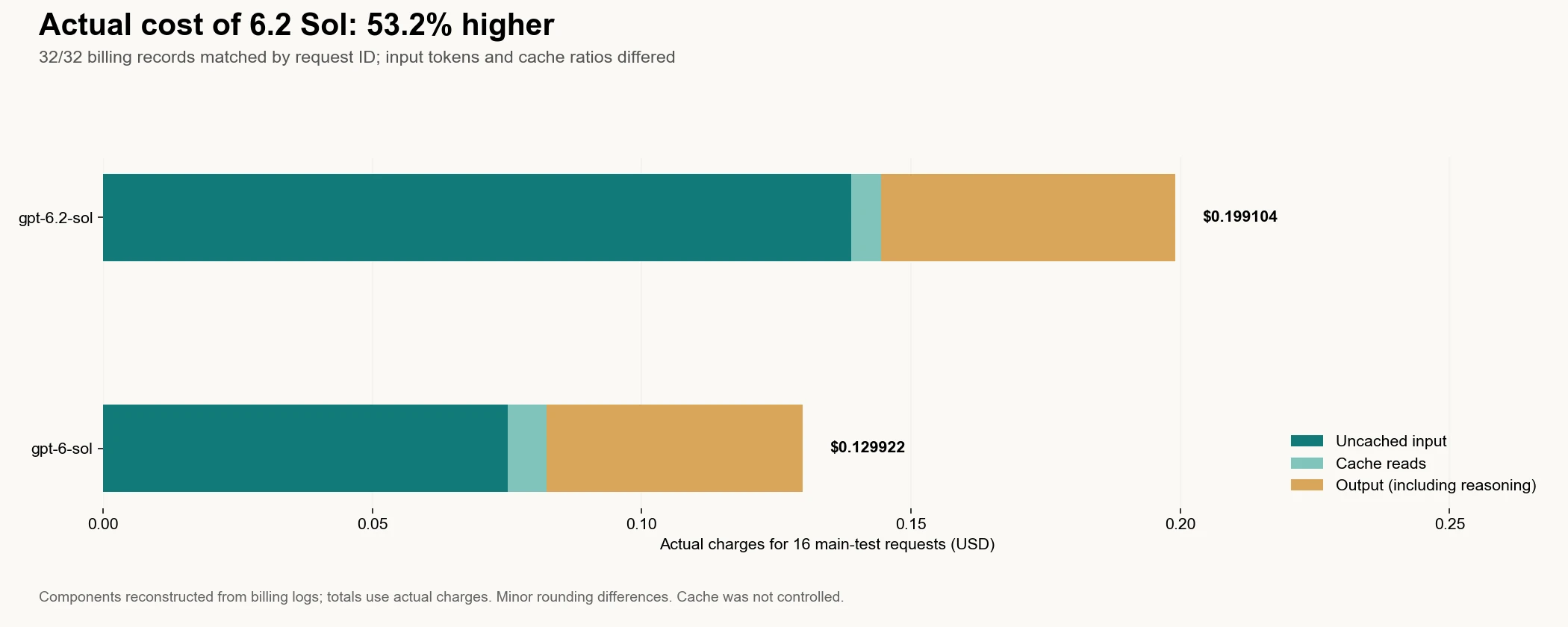
Totals are based on actual charges, and the line items were reconstructed from the logs. Minor differences come from rounding. Costs include requests with incorrect answers and exclude parameter probes, the code example, and cover image generation.
The newer model cost 53.2% more in this run and passed every run of the tasks the older model missed. The older model's three incorrect answers still incurred charges. The table excludes the costs of manual review, retries, and corrections in production.
The upstream reported different input token counts for the same visible prompts, and the newer model used fewer output tokens. We did not determine the specific reason for the difference in reported input tokens, and we did not control whether caches were warm or cold. The 53.2% increase applies only to this run. Individual users should not expect a fixed increase of that size.
Migration check: Existing none settings cannot carry over directly#
The official documentation lists reasoning_effort: none as supported by GPT-6 Sol and rejected by GPT-6.2 Sol.[1][2] In a separate check, we sent each model one short JSON request on the same route with none explicitly set.
| Additional parameter probe | GPT-6.2 Sol | GPT-6 Sol |
|---|---|---|
| HTTP status | 400 | 200 |
| Response | provider_temporarily_unavailable, with a generic service-unavailable message | {"ok":true}, completed normally |
The result is consistent with the documented parameter difference, but Crazyrouter maps the 6.2 error to a generic message, so the response did not identify none explicitly. A “service temporarily unavailable” message alone does not establish the root cause. Avoid repeatedly retrying the same incompatible configuration.
Before migrating, check your existing request parameters and test with an explicitly supported reasoning level. The main test and the example in this article both use high. The official GPT-6 Sol page also lists reasoning-level restrictions for function calling in Chat Completions. Applications that use tools need separate regression testing. We did not verify tool calling or the Responses API.
A two-model example we ran#
The example below asks both models to merge overlapping or adjacent half-open intervals. Install requests and set your key in the CRAZYROUTER_API_KEY environment variable before running it. The API URL has no UTM parameters.
import json
import os
import requests

BASE_URL = "https://api.crazyrouter.com/v1"
MODELS = ["gpt-6.2-sol", "gpt-6-sol"]
PROMPT = ('Merge overlapping OR TOUCHING half-open intervals [[-3,2],[1,5],[5,9]] into maximal intervals. '
          'Return JSON only: {"merged":[[start,end]],"length":integer}.')


def run():
    session = requests.Session()
    session.trust_env = False
    results = []
    for model in MODELS:
        response = session.post(
            BASE_URL + "/chat/completions",
            headers={"Authorization": "Bearer " + os.environ["CRAZYROUTER_API_KEY"]},
            json={
                "model": model,
                "messages": [{"role": "user", "content": PROMPT}],
                "reasoning_effort": "high",
                "max_completion_tokens": 8192,
                "stream": False,
            },
            timeout=(15, 180),
        )
        response.raise_for_status()
        data = response.json()
        choice = data["choices"][0]
        if choice["finish_reason"] != "stop":
            raise RuntimeError("Incomplete output: " + str(choice["finish_reason"]))
        answer = json.loads(choice["message"]["content"])
        assert answer == {"merged": [[-3, 9]], "length": 12}, answer
        result = {"model": model, "answer": answer,
                  "request_id": response.headers.get("x-oneapi-request-id")}
        print(json.dumps(result, ensure_ascii=False))
        results.append(result)
    return results


if __name__ == "__main__":
    run()
We tested the final version with both models. Each returned {"merged":[[-3,9]],"length":12} with finish_reason=stop. These two calls used standard user routing and were counted separately from the fixed-route main test.
The initial prompt only said “merge half-open intervals.” 6.2 Sol returned [[-3,5],[5,9]]. The length was still 12, but the result failed the program's single-interval assertion. Once we specified “merge overlapping or adjacent intervals into maximal intervals,” both models passed. We kept a record of that change. The interval task in the main test required merging adjacent intervals from the start. We did not change that task or replace any results with reruns.
For request fields, see the Crazyrouter API documentation. Teams using Codex or Cursor should run regression tests on their own tasks and toolchains. Passing a text-only example does not validate an entire agent workflow.
When is it worth switching to GPT-6.2 Sol?#
| Use case | What this test supports |
|---|---|
| Exact counting or rule filtering with known omissions | Try 6.2 Sol first and keep programmatic validation in place |
| Optimal selection with dependencies and mutual exclusions | Try 6.2 Sol. It got both runs right and had a shorter average wait in this test |
| Routine data processing that already passes business regression tests, with cost as the priority | Keep 6 Sol if it meets your needs. Its current Crazyrouter rates after the discount are lower |
| Shorter response times are the main priority | Test your own task types first. The newer model was faster on average in only three categories here |
Existing requests always use reasoning_effort: none | Update the reasoning level before switching the model ID |
| Image understanding, tool calling, or long-running agents | Verify those capabilities separately. This test does not establish their performance |
You can use Model Arena for an initial comparison on identical tasks, then turn real failures into a fixed regression suite. Setting acceptance criteria for each critical field makes it easier to tell whether an upgrade solves a real problem than judging the fluency of a single answer.
Reproducing the constrained optimization task#
The full user prompt for this task appears below. The main test used high reasoning effort and an output budget of 8192, and the system message required JSON only. The reference answer was used only for local scoring and was kept out of the request.
Items IDs 0..11 have weights [4, 7, 2, 9, 5, 3, 8, 6, 4, 7, 1, 5] and values [13, 18, 7, 26, 14, 9, 23, 16, 12, 20, 4, 15]. Select total weight <=26 and at most 5 items. Constraints: selecting 3 requires 1; 6 and 7 cannot both be selected; selecting 9 requires 2; at least one of 0 and 4 must be selected. Maximize total value. Return JSON with best_value and optimal_sets (ALL optimal ID lists sorted ascending, and lists lexicographically sorted).
The precomputed reference answer is below.
{"best_value": 78, "optimal_sets": [[0, 2, 6, 9, 11]]}
To verify the optimum, enumerate every subset of the 12 candidates and apply the weight, item count, dependency, and mutual exclusion constraints. We archived the original requests, responses, and individual billing records for review. The tables and charts in this article are based on those records.
The request IDs for the two independent calls in the minimal example were as follows.
gpt-6.2-sol:8f830a249943b0b13a1ec388dbf882f6.gpt-6-sol:f08d86841a979c9bf2d8928816e31789.
Frequently asked questions#
Is GPT-6.2 Sol more accurate than GPT-6 Sol?#
Across eight task types with two runs each, the newer model scored 16/16 and the older model scored 13/16. The difference was concentrated in rule count verification and constrained optimization. These results cannot be extrapolated to accuracy across all tasks.
How much faster is GPT-6.2 Sol than GPT-6 Sol?#
In this run, average time on constrained subset selection fell by 38.4%, and average time across all requests fell by about 6.6%. The median, however, increased from 11.14 seconds to 12.48 seconds. The newer model was faster on some task types and slower on others.
Did GPT-6.2 Sol API prices go down?#
The official list prices for uncached input and output stayed the same. The cache read rate fell from 0.10 per million tokens. Crazyrouter currently offers a 35% discount (pay 65%) on the older model, so the newer model's actual total cost was higher in this run.
Is the higher cost worth it?#
If undercounting or missing the optimal solution with the older model can cause business losses, the newer model is worth testing. If your current tasks already pass consistently, you can keep the older model for now. This test did not measure manual correction or retry costs, so the payoff will depend on your business.
Why does the article count an answer as wrong when the API call succeeded?#
HTTP 200, valid JSON, and normal completion establish only that the request completed. In all three failures, the older model returned a correctly structured answer with field values that did not match the predetermined reference answer. Each of those responses failed the full task.
Can I just change the model ID to gpt-6.2-sol?#
You can keep the same base URL and text request format, but check your reasoning parameters first. The documentation explicitly says the new model rejects none, and the Crazyrouter probe returned HTTP 400. Streaming, tools, and image inputs still need separate testing.
Sources
- OpenAI: GPT-6.2 Sol model documentation, checked on 2026-11-20.
- OpenAI: GPT-6 Sol model documentation, checked on 2026-11-20.
- PostgreSQL: Transaction Isolation and Read Committed, used to verify the rules for the transaction task.
By Brian J. The tests were run by an automated script. This article records actual service performance on Crazyrouter's route. We did not independently audit the upstream model weights. Each task was run only twice, using a single route in a single time window, and existing cache entries were not isolated. We archived the original requests, responses, reference answers, and de-identified billing records. Information subject to change is scheduled for review on 2026-12-20.
Implementation Guides
Podcast
AI Dev Tools: The Crazyrouter Podcast
Short episodes for developers on AI APIs, gateways, cost control and coding tools.
Latest episodes
EP196 · Oct 29, 2026 · 6:53
AI API Security Posture — Turn Controls Into Continuous Evidence
A practical guide to AI API security posture: inventory exposure, verify controls continuously, protect keys and data, constrain tools, and turn security assumptions into evidence that operators can act on.
EP195 · Oct 28, 2026 · 7:21
AI API Policy Drift — Detect When Production Rules Stop Matching Intent
A practical guide to policy drift in AI APIs: version routing and safety rules, detect stale enforcement, compare intended and observed behavior, and restore control before small gaps become incidents.