 简体中文
 繁體中文
 English
 Français
 Русский
 日本語
 Tiếng Việt
 한국어
 Deutsch
 Español
 Italiano
 Português
 العربية
 ไทย
 Bahasa Indonesia
 Bahasa Melayu
 Türkçe
 Polski
 Nederlands
 Dansk
 Norsk
 Қазақша
GPT-6.2 Astra vs. GPT-6 Astra: Is It Worth Upgrading After 32 Test Runs?
Same route and prompts, 16 runs each, tied accuracy. Compare optimization speed, overall latency, official prices, and actual costs to see when to upgrade.

If you already use GPT-6 Astra, you probably have three questions about GPT-6.2 Astra. Can it get right what the older model gets wrong? Will you spend less time waiting? Will your bill go up?
In 32 tests run through Crazyrouter on the same route, both models passed 16/16 tasks in full. GPT-6.2 Astra cut average response time on the constrained optimization task by 54.3%, but its median response time across all requests was longer and its actual cost was 37.6% higher. If you already use GPT-6 Astra, these results support trying the new model on selected tasks before making it the default.
This was a small-sample test of everyday development tasks. We checked the official specifications, Crazyrouter’s current billing configuration, and the actual charge for each request. The sections below report those separately.
What changed in the official specifications?#
As of 2026-11-20, OpenAI’s model pages listed the following key specifications.[1][2]
| Item | GPT-6.2 Astra | GPT-6 Astra |
|---|---|---|
| API model name | gpt-6.2-astra | gpt-6-astra |
| Input / output modalities | Text and image input, text output | Text and image input, text output |
| Context window | 1,050,000 tokens | 1,050,000 tokens |
| Maximum input | 922,000 tokens | 922,000 tokens |
| Maximum output | 128,000 tokens | 128,000 tokens |
| Knowledge cutoff | 2026-05-18 | 2026-04-30 |
| Official uncached input price | $8 / million tokens | $10 / million tokens |
| Official cache read price | $0.40 / million tokens | $1 / million tokens |
| Official output price | $40 / million tokens | $50 / million tokens |
The prices shown are for the official Standard tier with inputs of up to 272K tokens. Above that threshold, input and cache rates double and output rates rise to 1.5 times the listed rates for both models. The table therefore applies only within that input limit.[1][2]
The specifications show that 6.2 Astra’s official uncached input and output prices are both 20% lower, and the advertised context window has stayed the same. A more recent knowledge cutoff does not give the model real-time information beyond that date.
OpenAI also lists tool and Responses API capabilities. This article tested text calls through Crazyrouter’s Chat Completions endpoint. The official feature list alone cannot establish that those capabilities work across all Crazyrouter endpoints.
How we tested: 8 task types, two runs per task on the same route#
Testing took place in the early morning of 2026-11-20 Beijing time, corresponding to 2026-11-19 UTC. We verified both models through /v1/models before starting the main test.
| Condition | Test setting |
|---|---|
| API entry point | Crazyrouter, https://api.crazyrouter.com/v1 |
| Endpoint | POST /chat/completions |
| Routing | Pinned to the same upstream route, verified individually in all 32 billing logs |
| Prompts | Identical system and user messages for each task |
| Reasoning effort | reasoning_effort: high |
| Output budget | max_completion_tokens: 8192 |
| Response mode | Non-streaming, stream: false |
| Sample and order | 8 task types × 2 runs per model, randomized order, overall concurrency of 2 |
| Scoring | Compared JSON field by field against predefined answers and required HTTP 200 and finish_reason=stop |
The tasks covered lookup across 360 rules, checking a false premise, dependency graph optimization, constrained subset selection, billing replay, transaction visibility, deduplication order, and interval boundaries. The first six tasks came from an existing internal test set, and the last two added edge cases. The inputs and reference answers were kept in the evidence files, and the reference answers were withheld from the models.
These tasks reflect work developers often do, such as reading rules, calculating results, and checking edge cases. They did not cover changes across a full code repository, and we did not run any programs generated by the models. The results therefore cannot rank the models’ overall performance as coding agents.
We measured elapsed time from the moment the client sent the request until it received the complete response, including network, queueing, inference, and output time. We did not measure time to first token or tokens/s.
Accuracy tied. Which tasks differed in speed?#
| Task | 6.2 Astra passes | 6 Astra passes | 6.2 average time | 6 average time |
|---|---|---|---|---|
| Lookup in a long rule table | 2/2 | 2/2 | 10.05 seconds | 10.20 seconds |
| Correcting a false premise | 2/2 | 2/2 | 9.95 seconds | 7.16 seconds |
| Dependency graph and single-point optimization | 2/2 | 2/2 | 9.05 seconds | 8.42 seconds |
| Optimal subset selection under constraints | 2/2 | 2/2 | 18.49 seconds | 40.46 seconds |
| Deduplication and billing replay | 2/2 | 2/2 | 10.28 seconds | 10.41 seconds |
| Database transaction visibility | 2/2 | 2/2 | 4.94 seconds | 9.66 seconds |
| Deduplication before time filtering | 2/2 | 2/2 | 3.81 seconds | 7.18 seconds |
| Reasoning about half-open interval boundaries | 2/2 | 2/2 | 4.12 seconds | 7.08 seconds |
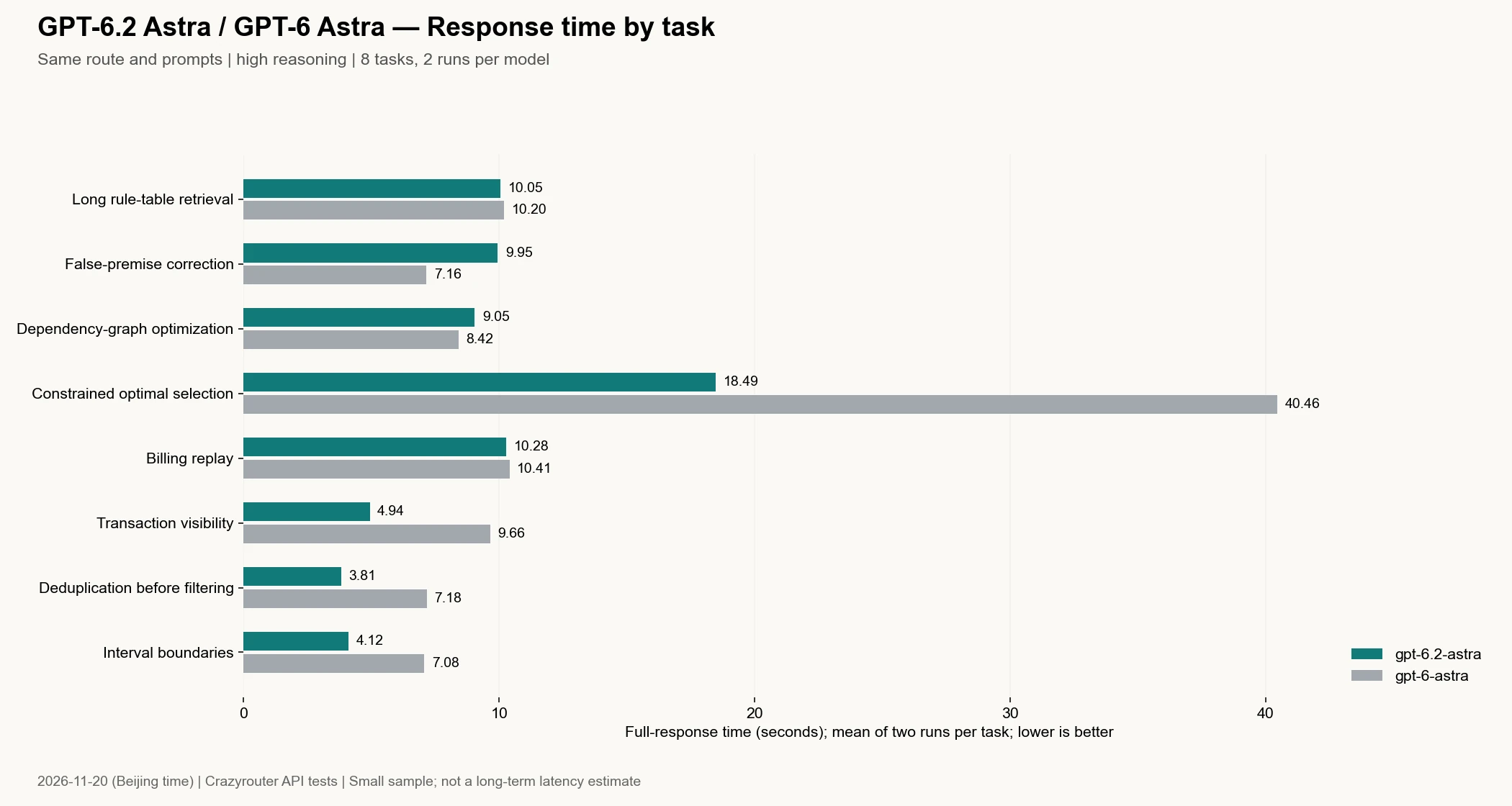
Each cell represents only two requests, so small differences should not be treated as consistent advantages. Both models returned complete JSON matching the reference answers on every task in this test.
The largest difference came on the constrained subset selection task. It gave the models 12 candidates and asked them to list all optimal solutions while satisfying a total weight limit, a maximum item count, dependencies, and mutual exclusions. Both models found the same unique optimal set, [0, 2, 6, 9, 11], with a total value of 78.
6.2 Astra took 18.21 and 18.78 seconds on its two runs. 6 Astra took 37.52 and 43.41 seconds. The 54.3% reduction in average wait time makes similar combinatorial optimization tasks worth including in an upgrade trial. Two runs are too few to conclude that the new model is “twice as fast at all complex reasoning.”
The deduplication task tested another common mistake. An event first appears outside the time window, and a later event with the same ID falls inside it. The task requires global deduplication before time filtering, so the later duplicate cannot be counted. Both models correctly calculated Alice’s net amount of 25 cents and excluded Bob, whose final net amount was zero.
The edge cases in this set produced no accuracy gap. The 16/16 tie establishes that both models passed this set of tasks. It does not establish that their capabilities have the same upper limit.
Why was the average faster while the median was slower?#
| Statistics across all 16 requests | GPT-6.2 Astra | GPT-6 Astra |
|---|---|---|
| Complete and correct responses | 16/16 | 16/16 |
| Average response time | 8.84 seconds | 12.57 seconds |
| Median response time | 9.57 seconds | 8.16 seconds |
| Shortest / longest | 3.39 / 18.78 seconds | 6.67 / 43.41 seconds |
Both statistics are correct. GPT-6 Astra had two substantially longer requests on the constrained subset selection task, which pulled up its average. 6.2 Astra shortened both waits, bringing down its overall average.
When the requests are ordered by response time, the middle of the distribution is about 9.57 seconds for 6.2 Astra and about 8.16 seconds for 6 Astra. 6.2 Astra was also slower on the false-premise check and dependency graph tasks.
Consider which tasks you run when choosing a model. If combinatorial optimization accounts for most of your wait time, the improvement in the average matters in practice. If most of your everyday requests are short rule-based questions, these results do not support switching across the board.
Official prices fell, but the Crazyrouter bill was higher in this test#
Official unit prices differ from what Crazyrouter users actually pay. In the Crazyrouter default group configuration we checked for this test, GPT-6 Astra received a 35% discount (users paid 65% of the original rate), while GPT-6.2 Astra was billed at the original rates. The resulting rates for requests with inputs of up to 272K tokens were as follows.
| Crazyrouter rates per million tokens | GPT-6.2 Astra | GPT-6 Astra |
|---|---|---|
| Uncached input | $8.00 | $6.50 |
| Cache reads | $0.40 | $0.65 |
| Output | $40.00 | $32.50 |
6.2 Astra currently has the lower cache read rate, while 6 Astra has lower uncached input and output rates. The official price cut for the new version alone cannot tell you which model costs less on Crazyrouter. Group settings and discounts can change the result, so check the Crazyrouter pricing page again before purchasing or integrating.
We matched all 32 actual billing records by request ID and converted the charges to USD using the site’s quota_per_unit=500000 setting.
| Actual usage in the main test | GPT-6.2 Astra | GPT-6 Astra |
|---|---|---|
| Requests | 16 | 16 |
| Upstream-reported input tokens | 128,692 | 108,708 |
| Of which, cache read tokens | 49,536 | 48,512 |
| Cached share of input | 38.5% | 44.6% |
| Output tokens (including reasoning usage) | 2,625 | 3,946 |
| Actual cost | $0.758064 | $0.551052 |
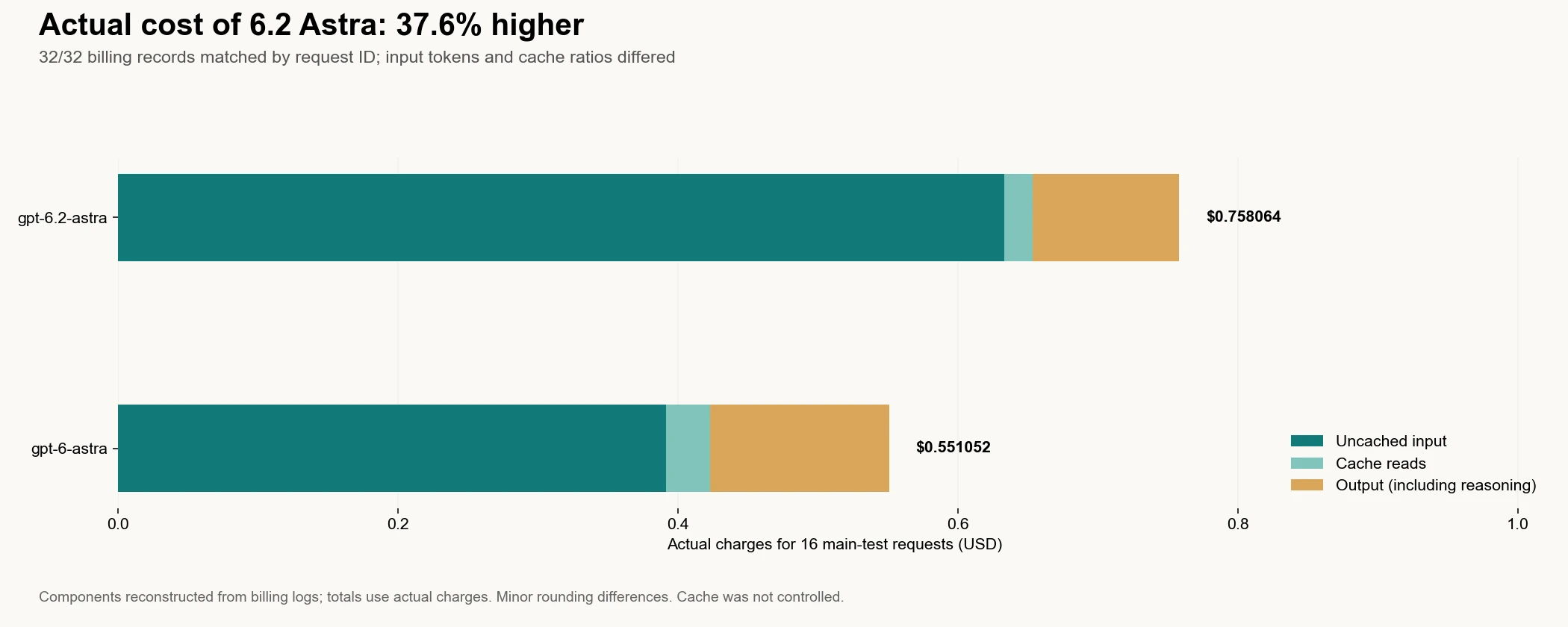
Totals come from the actual charges. The chart’s breakdown was reconstructed from billing logs, and small differences from the totals are due to rounding. The two separate example calls later in the article are excluded.
6.2 Astra used fewer output tokens in this test, yet its bill was 37.6% higher. The rates, reported input volume, and cached share of input all affected the final cost. Identical visible prompts did not yield identical upstream-reported input token counts. We did not investigate the cause of that difference further.
We did not clear the cache, and some tasks came from an existing test set. These are the actual charges for this workload. The test did not use uniform cold-cache conditions, and the result cannot be extrapolated to a 37.6% monthly cost increase for every user.
Integration: Keep the model configurable and run your own regression tests first#
If you already call GPT-6 Astra, you can keep your current default, change the model field in a test environment, and compare the two models on your own tasks. The example below calls both models at the same base URL and asks each to merge half-open intervals.
Before running the example, install requests and set the CRAZYROUTER_API_KEY environment variable to your API key. The code does not print the key.
import json
import os
import requests

BASE_URL = "https://api.crazyrouter.com/v1"
MODELS = ["gpt-6.2-astra", "gpt-6-astra"]
PROMPT = ('Merge half-open intervals [[-3,2],[1,5],[5,9]]. '
          'Return JSON only: {"merged":[[start,end]],"length":integer}.')


def run():
    session = requests.Session()
    session.trust_env = False
    results = []
    for model in MODELS:
        response = session.post(
            BASE_URL + "/chat/completions",
            headers={"Authorization": "Bearer " + os.environ["CRAZYROUTER_API_KEY"]},
            json={
                "model": model,
                "messages": [{"role": "user", "content": PROMPT}],
                "reasoning_effort": "high",
                "max_completion_tokens": 8192,
                "stream": False,
            },
            timeout=(15, 180),
        )
        response.raise_for_status()
        data = response.json()
        choice = data["choices"][0]
        if choice["finish_reason"] != "stop":
            raise RuntimeError("Incomplete output: " + str(choice["finish_reason"]))
        answer = json.loads(choice["message"]["content"])
        assert answer == {"merged": [[-3, 9]], "length": 12}, answer
        result = {"model": model, "answer": answer,
                  "request_id": response.headers.get("x-oneapi-request-id")}
        print(json.dumps(result, ensure_ascii=False))
        results.append(result)
    return results


if __name__ == "__main__":
    run()
We ran this code separately. Both models returned {"merged":[[-3,9]],"length":12} with a finish reason of stop. These two calls are excluded from the 32-run benchmark above. The example used standard user routing, while the main test pinned requests to one route to reduce routing differences.
To check the integration fields, see the Crazyrouter API documentation. Teams using the Codex integration setup or Cursor integration setup should also run regression tests on their actual toolchains. The successful text calls in this article did not verify every feature of those tools.
If you already use GPT-6 Astra, should you upgrade to 6.2 Astra?#
Use your workload to decide where to start.
| Your main need | What these results support |
|---|---|
| Your existing rule checks and data organization tasks consistently pass, and cost is the priority | Keep GPT-6 Astra. Its current discounted Crazyrouter rates are lower for uncached input and output. |
| Combinatorial optimization tasks take a long time | Try GPT-6.2 Astra first and use more real tasks to confirm the speed gain. |
| You frequently deal with deduplication order, transaction semantics, and boundary cases | Add 6.2 Astra to your regression comparison. It was faster on these tasks in this test, and both models answered correctly. |
| You expect higher accuracy based on the version number alone | This test offers no evidence for that. Include tasks your current model actually gets wrong. |
| You need image understanding, long-running agents, or coordination across tools | Test those scenarios separately. This benchmark did not cover them. |
You can use Model Arena to start comparing the models on the same tasks. For a production migration, keep the exact prompts, scoring rules, and billing records. The GPT-6 Astra model page can help you check your old configuration, but you still need your own regression results.
Reproducing the constrained optimization task#
The full user prompt for this task appears below. In the main test, we used high reasoning effort and an output budget of 8192, and the system message required JSON only. We kept the reference answer for local scoring and did not send it to the models.
Items IDs 0..11 have weights [4, 7, 2, 9, 5, 3, 8, 6, 4, 7, 1, 5] and values [13, 18, 7, 26, 14, 9, 23, 16, 12, 20, 4, 15]. Select total weight <=26 and at most 5 items. Constraints: selecting 3 requires 1; 6 and 7 cannot both be selected; selecting 9 requires 2; at least one of 0 and 4 must be selected. Maximize total value. Return JSON with best_value and optimal_sets (ALL optimal ID lists sorted ascending, and lists lexicographically sorted).
The precomputed reference answer is below.
{"best_value": 78, "optimal_sets": [[0, 2, 6, 9, 11]]}
To verify the optimal solution, enumerate every subset of the 12 candidates and filter by weight, item count, dependencies, and mutual exclusions. The original requests, responses, and individual billing records were archived for verification. All tables and charts in this article draw from those records.
The two separate requests in the minimal calling example have the following IDs.
gpt-6.2-astra:83b6190a33a5765d75070b0cf645e4ca.gpt-6-astra:6a229d1cd68136b18781f531d8a5d77e.
Frequently asked questions#
Is GPT-6.2 Astra necessarily smarter than GPT-6 Astra?#
This test cannot establish that. Both models passed 16/16 tasks in full across 8 task types with two runs each. Assessing capability gains requires more difficult tasks, real cases where the model failed, and independent scoring.
How much faster is GPT-6.2 Astra than GPT-6 Astra?#
It depends on the task and the metric. In this test, average response time for constrained subset selection fell by 54.3%, and the average across all requests fell from 12.57 seconds to 8.84 seconds. The median rose from 8.16 seconds to 9.57 seconds. The newer model was not faster on every call.
Is GPT-6.2 Astra cheaper?#
Its official Standard prices for uncached input and output are both 20% lower in the short-input tier. In this test, the older model had a 35% discount on Crazyrouter, and token usage and caching differed between the models. The total cost of completing the same set of tasks was higher for 6.2 Astra.
Does GPT-6.2 Astra have a larger context window?#
According to the official model pages we checked, both have a context window of 1,050,000 tokens and a maximum input of 922,000 tokens.[1][2] The highest reported input count in our requests was 14,326 tokens, so we did not test performance at a million tokens of context.
Does getting JSON back mean structured outputs were verified?#
No. We prompted the models to return JSON, then parsed and checked the answers programmatically. We did not test JSON Schema enforcement, streaming, tool calling, or the Responses API.
Do 32 successful requests demonstrate long-term reliability?#
The result establishes only that these 32 main requests had no HTTP failures, truncation, or incorrect answers. The sample came from one time period and one route, with only two runs per task. It cannot establish long-term availability or serve as a production SLA.
References and reproduction
- OpenAI model documentation for GPT-6.2 Astra, checked on 2026-11-20.
- OpenAI model documentation for GPT-6 Astra, checked on 2026-11-20.
- PostgreSQL documentation on transaction isolation and Read Committed, used to verify the rules for the transaction task.
By Boluo Z. Automated scripts ran the tests. This article documents service performance through Crazyrouter’s routing. We did not independently audit the upstream model weights. We plan to recheck pricing and capability details that may change on 2026-12-20.
Implementation Guides
Podcast
AI Dev Tools: The Crazyrouter Podcast
Short episodes for developers on AI APIs, gateways, cost control and coding tools.
Latest episodes
EP196 · Oct 29, 2026 · 6:53
AI API Security Posture — Turn Controls Into Continuous Evidence
A practical guide to AI API security posture: inventory exposure, verify controls continuously, protect keys and data, constrain tools, and turn security assumptions into evidence that operators can act on.
EP195 · Oct 28, 2026 · 7:21
AI API Policy Drift — Detect When Production Rules Stop Matching Intent
A practical guide to policy drift in AI APIs: version routing and safety rules, detect stale enforcement, compare intended and observed behavior, and restore control before small gaps become incidents.