 简体中文
简体中文 繁體中文
繁體中文 English
 Français
 Русский
 日本語
日本語 Tiếng Việt
 한국어
한국어 Deutsch
 Español
 Italiano
 Português
 العربية
 ไทย
ไทย Bahasa Indonesia
 Bahasa Melayu
 Türkçe
 Polski
 Nederlands
 Dansk
Dansk Norsk
Norsk Қазақша
AI API Testing and Evaluation Guide for Developers in 2026
Build a practical test and evaluation system for AI APIs with fixtures, schema checks, regression sets, latency budgets, and human review.
AI API Testing and Evaluation Guide for Developers in 2026#
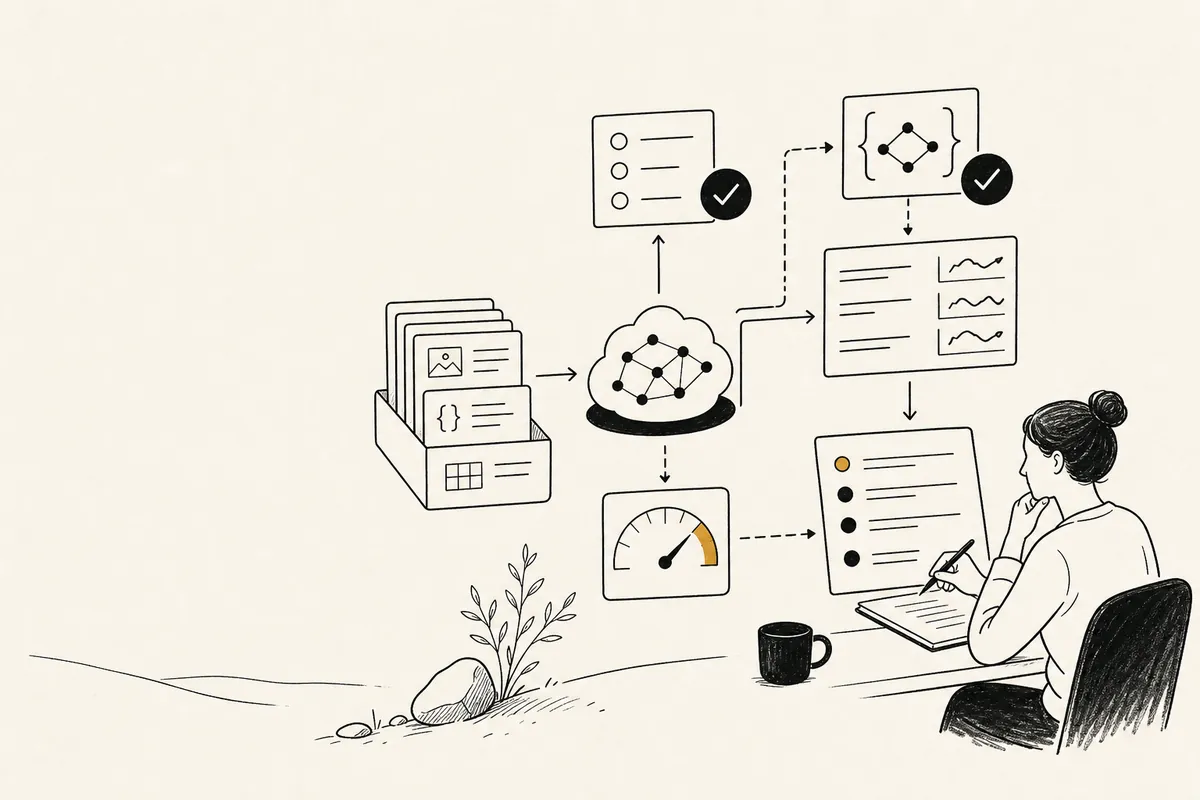
AI API testing is different from testing a calculator. The same prompt can produce valid but different wording, providers can change models behind an alias, and a response can be fluent while factually wrong. Reliable teams combine deterministic integration tests, capability checks, offline evaluations, and production monitoring.
What is AI API evaluation?#
Evaluation measures whether a model-powered workflow meets a task-specific definition of success. For extraction, that may be schema validity and field accuracy. For support, it may be resolution rate, policy compliance, and escalation quality. For coding, it may be test pass rate. A public benchmark is useful context, but it is not a substitute for your own requests.
| Test layer | What it catches | Frequency |
|---|---|---|
| Unit tests | Prompt assembly and parsers | Every change |
| Contract tests | Provider envelope and capabilities | Every release |
| Replay set | Quality regressions | CI or nightly |
| Load tests | Rate limits and latency | Before launch |
| Production evals | Drift and real failures | Continuous |
Test the boundary with an OpenAI-compatible client#
import os
from openai import OpenAI

client = OpenAI(api_key=os.environ["CRAZYROUTER_API_KEY"],
                base_url="https://crazyrouter.com/v1")

def extract_ticket(text):
    return client.chat.completions.create(
        model="gpt-5-mini",
        messages=[{"role": "user", "content": text}],
        response_format={"type": "json_object"},
        max_tokens=300,
    )
Mock the client for unit tests, then run a small live contract suite against staging. Assert status, required fields, finish behavior, and error mapping. Keep test prompts free of production secrets and personal data.
Build a useful evaluation set#
Collect representative examples across languages, input lengths, edge cases, and known failures. Label expected facts or acceptable ranges rather than one exact string. Include adversarial inputs: ambiguous requests, prompt injection, missing fields, malformed documents, and unsupported operations.
For each model version, record quality score, schema validity, p95 latency, input/output tokens, retry rate, and cost per successful outcome. Compare by task category. A model can improve average score while regressing badly on a critical category.
Pricing and evaluation cost#
| Evaluation approach | Direct provider | Crazyrouter |
|---|---|---|
| Test inference | Official model rates | Current usage-based rates |
| Multi-model comparison | Multiple accounts | One compatible access layer |
| Human review | Your team | Your team |
| Fixed monthly fee | Varies | No monthly fee or minimum consumption in documented plan |
Use Crazyrouter pricing when estimating replay-set costs. Cache immutable fixtures where appropriate, but never hide a model regression by reusing old outputs as if they were fresh tests.
Turn failures into permanent tests#
When a user reports a bad answer, save a privacy-safe version of the input, the expected behavior, the model route, and the failure category. Add it to the regression set before changing the prompt. Separate prompt regressions from provider outages and application bugs. Run fast schema and safety checks on every pull request, then run the broader quality set nightly or before a model route changes. This creates a feedback loop that improves the product instead of repeatedly rediscovering the same edge cases.
Set explicit release gates. For example, block deployment if structured-output validity falls below 99%, a safety test fails, p95 latency exceeds the product budget, or cost per accepted task rises above the allowed threshold. Keep thresholds tied to a task's risk: a casual brainstorming feature can tolerate more variation than an invoice extractor. Publish evaluation results with the model and prompt versions so a future maintainer knows what was actually tested.
FAQ#
Can AI output be tested deterministically?#
Some properties can: schema validity, required fields, safety rules, tool allowlists, and latency limits. Natural-language quality needs rubric-based or reference-based evaluation.
How large should an evaluation set be?#
Start with a small, representative set of dozens of cases, then expand it with every important production failure.
Should I test the exact model name or an alias?#
Test the exact production route and record the resolved model/version when available. Aliases can change behavior.
Are LLM judges reliable?#
They are useful for scalable comparison, but calibrate them against human labels and use deterministic checks for safety and schema requirements.
Can a gateway simplify AI API testing?#
Yes. A consistent endpoint makes cross-model replay easier, but your test suite still needs capability and quality assertions for each model.
Summary#
Test AI applications at several layers: deterministic code and schema checks, provider contracts, representative replay sets, load behavior, and production drift. Crazyrouter helps you compare model routes while you build an evaluation system grounded in your own product outcomes.