 简体中文
 繁體中文
 English
 Français
 Русский
 日本語
 Tiếng Việt
 한국어
 Deutsch
 Español
 Italiano
 Português
 العربية
 ไทย
 Bahasa Indonesia
 Bahasa Melayu
 Türkçe
 Polski
 Nederlands
 Dansk
 Norsk
 Қазақша
How to Get a Claude API Key in 2026: Secure Setup for Production Teams
Step-by-step guide to getting a Claude API key, securing it, rotating secrets, and using Crazyrouter as a multi-model alternative.
How to Get a Claude API Key in 2026: Secure Setup for Production Teams#
Developers search for how to get a Claude API key because Claude is excellent for coding, writing, analysis, and long-context reasoning. The setup is simple, but production security is where many teams make mistakes. This guide is written for developers, founders, and platform teams who care about reliable implementation, predictable spend, and avoiding vendor lock-in.
What is how to get claude api key?#
A Claude API key is a secret token that lets your application call Anthropic Claude models. It should be treated like a password: never commit it, never expose it in frontend code, and rotate it when team access changes. In practice, the keyword points to three questions at once: what the product or model does, how it compares with alternatives, and how much it costs when used in real applications.
For production teams, the smartest approach is to separate experimentation from infrastructure. Try the official product when it gives the best user experience, but build your backend around portable APIs, explicit model selection, retries, logs, and fallback behavior. That is where an OpenAI-compatible router such as Crazyrouter becomes useful.
how to get claude api key vs alternatives comparison#
| Option | Best for | Tradeoff |
|---|---|---|
| Anthropic Console | Official Claude access | Best if Anthropic billing is available |
| Cloud partner | Enterprise procurement | More setup |
| Crazyrouter | Claude alternatives plus routing | Useful when you need one key for many providers |
| Local models | Privacy-focused experiments | Operational overhead |
The pattern is simple: use the official tool when it is the best interface, but do not let one vendor become your entire architecture. Developers need observability, budget controls, key rotation, model fallbacks, and repeatable evaluation.
How to use it with code examples#
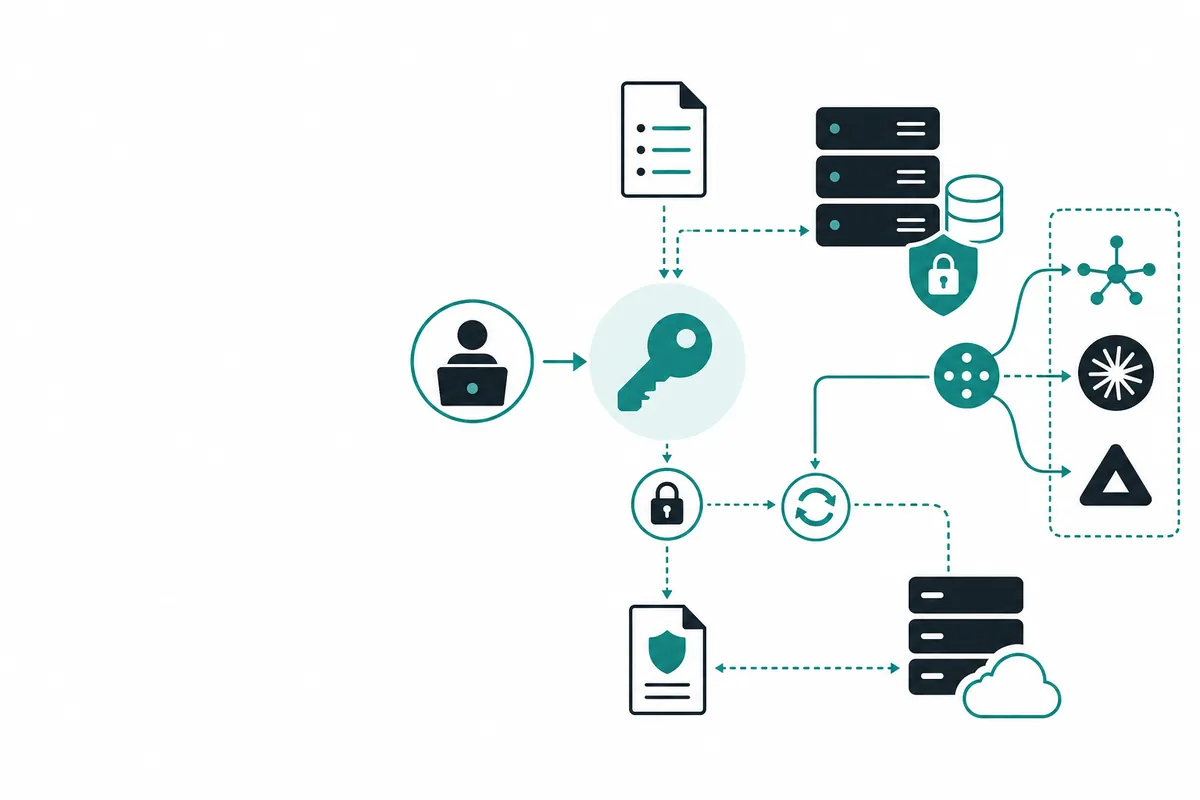
The safest production pattern is to hide provider differences behind one internal service. That service should accept a task type, choose a model, attach tracing metadata, and retry only when the failure is recoverable. Below is a portable OpenAI-compatible example you can adapt for store and use a secret API key safely.
Python example: store and use a secret API key safely#
import os
from openai import OpenAI

client = OpenAI(
    api_key=os.environ["CRAZYROUTER_API_KEY"],
    base_url="https://crazyrouter.com/v1"
)

response = client.chat.completions.create(
    model="openai/gpt-5-mini",
    messages=[
        {"role": "system", "content": "You are a precise developer assistant."},
        {"role": "user", "content": "Build a safe implementation plan for this workflow."}
    ],
    temperature=0.2,
)
print(response.choices[0].message.content)
Node.js example#
import OpenAI from "openai";

const client = new OpenAI({
  apiKey: process.env.CRAZYROUTER_API_KEY,
  baseURL: "https://crazyrouter.com/v1"
});

const result = await client.chat.completions.create({
  model: "anthropic/claude-sonnet-4.5",
  messages: [{ role: "user", content: "Compare two implementation options and return JSON." }],
  response_format: { type: "json_object" }
});

console.log(result.choices[0].message.content);
cURL smoke test#
curl https://crazyrouter.com/v1/chat/completions \
  -H "Authorization: Bearer $CRAZYROUTER_API_KEY" \
  -H "Content-Type: application/json" \
  -d '{"model":"openai/gpt-5-mini","messages":[{"role":"user","content":"Return a one-line health check."}]}'
A production version should also log request IDs, model names, latency, token usage, and user-visible errors. Do not retry every failure blindly: retry timeouts and 429s with backoff, but fail fast on invalid JSON schemas, unsafe prompts, or missing secrets.
Pricing breakdown#
| Path | When to choose it | Pricing note |
|---|---|---|
| Direct Claude API | Best for Claude-only apps | Usage-based, Anthropic account required |
| Claude via cloud reseller | Best for enterprise governance | May require contracts |
| Crazyrouter | Best for teams comparing Claude with GPT, Gemini, Qwen, and DeepSeek | One balance and fallback options |
Pricing should be evaluated per workflow, not per prompt. A coding agent that reads 30 files, summarizes logs, calls tools, and retries twice can cost far more than a simple chat completion. A video workflow may cost by generation instead of token. A RAG workflow may spend money on embedding, retrieval, reranking, and final generation.
A good budget model has three layers:
- Default model for normal traffic.
- Cheap model for classification, extraction, and short summaries.
- Premium model for hard reasoning, code review, or customer-facing answers.
Crazyrouter helps because you can implement this model mix without rewriting every SDK integration.
FAQ#
Is how to get claude api key worth it in 2026?#
Yes, if your workflow matches its strengths. For production apps, evaluate quality, latency, and total cost across several models instead of choosing by brand alone.
Can I use Crazyrouter instead of direct provider APIs?#
Yes. Crazyrouter exposes an OpenAI-compatible API for many models, so teams can test and route requests with one key while keeping code portable.
What is the cheapest way to build with this?#
Use a routing strategy. Send simple tasks to low-cost models, reserve premium models for difficult tasks, and cache repeated prompts or retrieved context.
Do I still need official provider accounts?#
Sometimes. Official accounts are useful for product-specific features, but a router is better when you need multiple model families, fallback, or centralized billing.
What should developers monitor?#
Track latency, error rate, token usage, cost per successful task, retry count, and quality failures. These metrics matter more than headline model prices.
Summary#
If you cannot get Claude API access immediately, or you want a backup path, Crazyrouter gives you an OpenAI-compatible key for many Claude-class alternatives while keeping your app architecture simple. If you are building an AI product in 2026, the winning architecture is flexible: one application, multiple models, clear cost controls, and fast iteration. Start with Crazyrouter when you want to compare providers and ship faster without locking your stack to a single API.