 简体中文
简体中文 繁體中文
繁體中文 English
 Français
 Русский
 日本語
日本語 Tiếng Việt
 한국어
한국어 Deutsch
 Español
 Italiano
 Português
 العربية
 ไทย
ไทย Bahasa Indonesia
 Bahasa Melayu
 Türkçe
 Polski
 Nederlands
 Dansk
Dansk Norsk
Norsk Қазақша
Has Kimi K3 Reached Claude Opus 4.8? A Seven-Dimension API Test
A seven-dimension comparison of Kimi K3 and Claude Opus 4.8 across exact mathematics, physics modeling, constrained reasoning, statistical anti-induction, code review, strict JSON compliance, and uncertainty calibration, measuring correctness, first visible answer, total latency, and reasoning-token efficiency.

Has China’s Kimi Already Reached Opus 4.8?#
In a recent round of model hands-on testing, Kimi K3 left a very particular impression: its thinking process is often long, the wait is noticeably longer, yet it can show strong deductive ability on complex problems. By contrast, Claude Opus 4.8 is faster and more direct, but it occasionally makes mistakes in seemingly basic calculation or modeling steps.
So, has Kimi K3 already reached — or even surpassed — Opus 4.8? We ran a head-to-head comparison using the same API, the same constraints, and problems that can be independently verified.
How the test was run#
Both models were called through the same API gateway, with temperature=1 used consistently. The prompt required the model to give the final answer first, then no more than 10 lines of necessary calculations, so that “produces a lot of text” would not be mistaken for “is highly capable.”
The test also recorded:
- total response time
- time to first reasoning event
- time to first visible answer
- the ratio of reasoning Token to visible Token
- whether the output hit the length limit
- whether the math, physics, code review, and format-following results were correct
The tasks covered exact Markov-chain calculation, two-degree-of-freedom vibration modeling, constrained ordering, statistical anti-induction, code review, strict JSON compression, and benchmark design for model evaluation.
Round 1: Exact mathematics#
The Markov-chain task required computing the first moment, second moment, and variance of the hitting time. The reference answer was:
E[tau] = 5
E[tau^2] = 43
Var(tau) = 18
Kimi K3 used about 2437 reasoning Token, took 103.7 seconds in total, and the first visible answer appeared after 100.1 seconds. The final result was correct.
Opus 4.8 took 28.4 seconds in total, with the first visible answer appearing at about 23.8 seconds. Its result was also correct.
This round did not separate the smarter model from the less smart one, but it did separate two working styles: Kimi K3 spent more time on internal verification, while Opus 4.8 completed the same derivation more quickly.
Round 2: Physics modeling#
The two-degree-of-freedom vibration problem required handling the mass matrix, damping matrix, stiffness matrix, natural frequencies, and complex frequency response at the same time. The correct reference values were:
w1 = 10.0204 rad/s
w2 = 16.2149 rad/s
|X1| = 0.1493 m
|X2| = 0.0717 m
This time, the results were more interesting.
Kimi K3 reasoned for 211.6 seconds, consumed 5997/6000 completion Token, and ultimately produced no visible answer, ending directly with length. It may have done a great deal of internal computation, but for the user it still amounted to no delivered result.
Opus 4.8 took only 9.9 seconds to answer, but it calculated the first natural frequency as 8.5985 rad/s and the second amplitude as 0.10391 m, which is clearly inconsistent with the correct values. The response was complete, and it even wrote out the matrices, but the key matrix coefficients were already wrong.
This shows that “fast” does not mean “stable,” and “thinking for a long time” does not automatically mean “effectively finished.”
Round 3: Five additional dimensions#

Across the five added tests, Kimi K3 received a perfect automatic score, with an average total time of 43.0 seconds, an average time to first visible answer of 40.3 seconds, and 4192 reasoning Token used in total.
Opus 4.8 passed all four knowledge-and-reasoning tasks, with an average total time of 10.4 seconds and an average time to first visible answer of 8.5 seconds. Its only lost point was on the strict JSON task: the JSON content itself was correct, but it added explanatory text before and after, violating the “output only one JSON object” formatting requirement.
| Dimension | Kimi K3 | Opus 4.8 |
|---|---|---|
| Constraint following | Correct, 27.8 s | Correct, 8.5 s |
| Statistical anti-induction | Correct, 50.3 s | Correct, 8.7 s |
| Code review | Correct, 37.4 s | Correct, 22.9 s |
| Strict JSON | Fully compliant | Content correct but format-violating |
| Uncertainty calibration | Correct, 61.1 s | Correct, 3.7 s |
What is Kimi K3 good at?#
Kimi K3’s advantage is not that it is faster on every problem, but that it is more willing to keep checking intermediate steps. For exact mathematics, constrained reasoning, and tasks that require pushing back on incorrect premises, that tendency can translate into higher reliability.
But its problems are equally obvious:
- Internal reasoning takes up too much of the budget, so even simple questions can leave you waiting for tens of seconds.
- On complex tasks, it can spend the entire budget thinking and still fail to produce a visible answer.
- It still lacks stable truncation control between “thinking a lot” and “actually delivering.”
In other words, Kimi K3 looks more like a promising deep-reasoning model than a fully production-hardened high-speed model.
Opus 4.8’s strengths and weaknesses#

Opus 4.8’s biggest strengths are response speed and output efficiency. It can give a structurally clear answer in seconds to tens of seconds, which makes it suitable for interactive workflows.
But this round’s physics problem exposed a serious issue: it can quickly produce a derivation that looks complete without noticing the coefficient error in the stiffness matrix. For mathematics, physics, finance, and code tasks, “this looks like the right answer” is not enough. You still need a calculator, unit tests, or a second-model review.
Final answer: has it reached it?#
If the question is about reasoning potential, Kimi K3 is already close to Opus 4.8, and in some exact derivation tasks it may even be more reliable.
If the question is about overall usability, it is still not accurate to say Kimi K3 has fully reached Opus 4.8.
This round supports a conclusion like this:
Kimi K3 has a high ceiling, but its efficiency is clearly behind; Opus 4.8 leads in delivery efficiency, but it needs guardrails against fast wrong answers.
In practice, the more sensible routing is not either/or, but role-based:
- For latency-sensitive, conversational tasks: prefer Opus 4.8.
- For exact math, complex constraints, and cases needing multiple checks: keep Kimi K3 and give it enough budget.
- For high-risk tasks: have one model generate and another model verify; do not rely on a single final answer.
Limits of this test#
This is not a final model leaderboard. The sample size is still limited, the models were proxied through the same gateway, Opus reasoning Token were not stably exposed, and vendor load also affects latency. Stronger conclusions would require multiple rounds of random tasks, fixed channels, repeated sampling, and external execution verification.
But at least one thing can be confirmed:
Kimi K3 is no longer a model that only “stacks up thinking length”; it does have the ability to stand in direct comparison with Opus 4.8. The gap is just that from capability to efficiency, and then from efficiency to stable delivery, there is still some distance to cover.
Further reading#
- Kimi K3 and Claude Opus 4.8 graduate-level math, physics, and programming benchmark
- Kimi K3 vs GPT-5.6-SOL on hard tasks
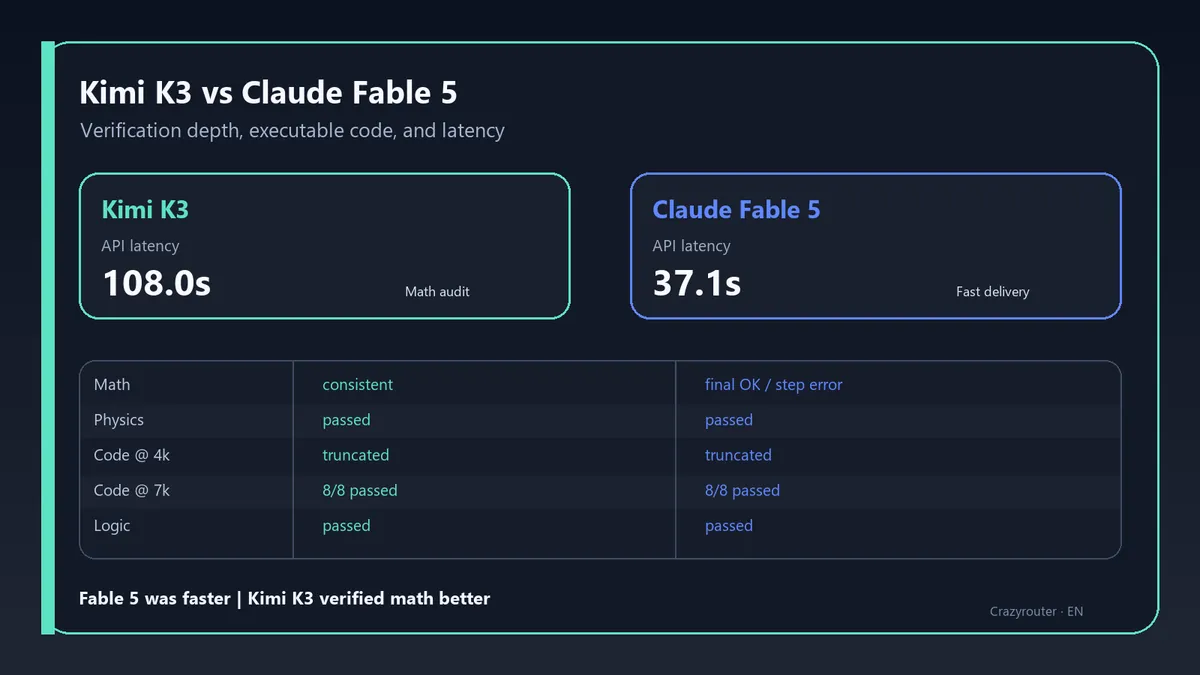
- Verifiable reasoning test for Kimi K3 and Claude Fable 5
- Output budget test for Claude Fable 5 and GPT-5.5
- Hard physics and code testing for GPT-5.6-SOL and GPT-5.5
FAQ#
Has Kimi K3 fully surpassed Opus 4.8?#
No. This round only shows that Kimi K3 is competitive with the same tier on some exact-reasoning, anti-induction, and constraint tasks. Opus 4.8 still has a clear lead in first-answer speed and overall delivery efficiency.
Why does Kimi K3 answer correctly but take so long?#
In the test, Kimi K3 spent a large share of completion Token in the reasoning stage. On the Markov-chain task, about 94.5% of generated Token were reasoning Token; on the more complex physics task, it still had no visible answer even after the full 6000 Token budget was exhausted.
Why did Opus 4.8 get the physics problem wrong?#
It used the wrong coefficients when building the stiffness matrix and in the subsequent characteristic equation, which caused both the natural frequencies and the frequency-response amplitudes to drift away from the reference values. This kind of error shows that high-risk numerical tasks still need external calculation or a second-model review.
How should these two models be chosen in production?#
For latency-sensitive interactive tasks, prioritize Opus 4.8; for tasks that allow longer waits and care more about exact derivation, use Kimi K3. The safer setup is one model generating and another model validating.
Can this test be reproduced?#
Yes. The test used POST https://cn.crazyrouter.com/v1/chat/completions, with model IDs kimi-k3 and claude-opus-4-8, and recorded finish_reason, time to first visible answer, reasoning Token, and the final answer.
How do I call these models through Crazyrouter?#
After registering, use the OpenAI-compatible Base URL https://cn.crazyrouter.com/v1 and specify the corresponding model ID in the request. The API endpoint itself does not need UTM parameters. Create an account and start testing.