 中文
中文 English
 Français
 Русский
 日本語
日本語 Tiếng Việt
 한국어
한국어 Deutsch
 Español
 Italiano
 Português
 العربية
 ไทย
ไทย Bahasa Indonesia
 Bahasa Melayu
 Türkçe
 Polski
 Nederlands
 Dansk
Dansk Norsk
Norsk Қазақша
Claude Code Pricing 2026: Pro vs Max vs Team vs API Costs
A practical Claude Code pricing guide based on live coding workflow tests through https://cn.crazyrouter.com/v1, comparing subscription plans with API routing and cost per successful task.
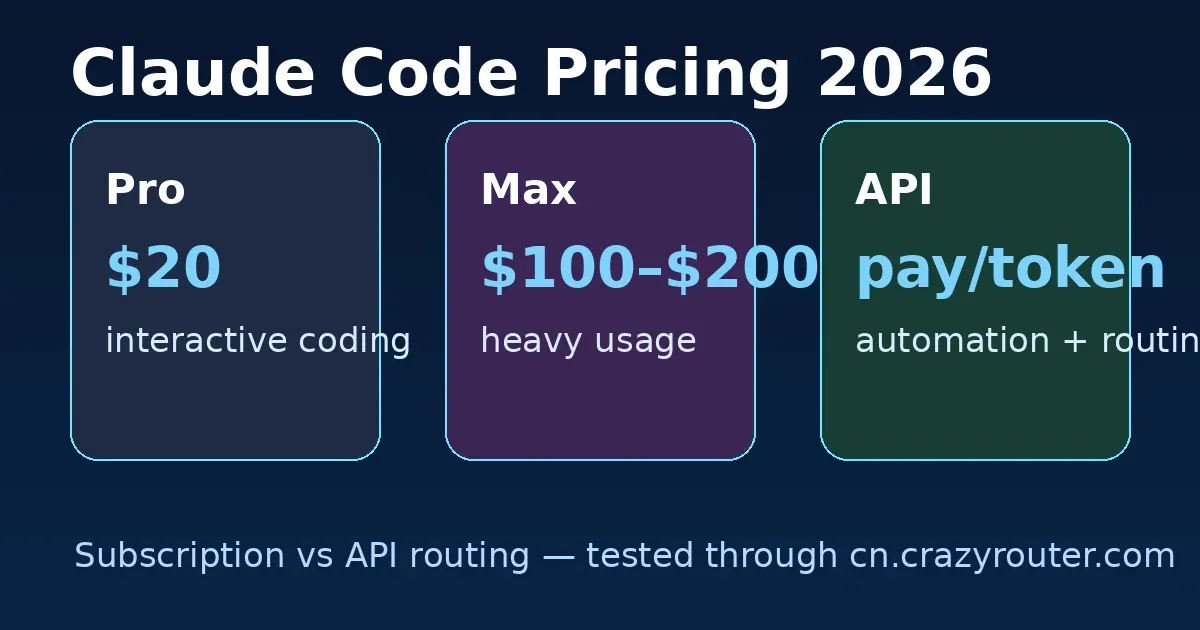
Claude Code Pricing 2026: Pro vs Max vs Team vs API Costs — Real Coding Workflow Math#
Based on live tests through
https://cn.crazyrouter.com/v1. We tested coding tasks across Claude, DeepSeek, and Gemini-style models to understand when Claude Code subscription pricing is enough, and when API routing becomes the better cost-control layer.
Quick answer#
Claude Code pricing in 2026 is not just a question of whether Pro, Max, Team, or Enterprise looks cheaper on a monthly pricing page.
For real developers, the better question is:
Which pricing model gives you the lowest cost per successful coding task?
The short version:
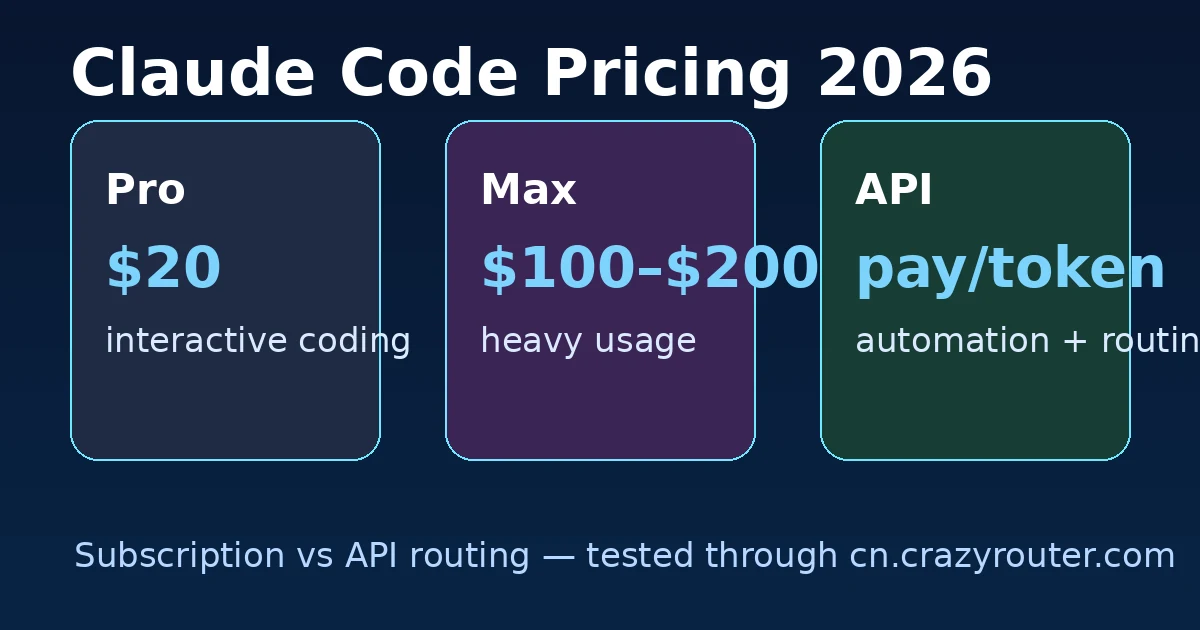
- Use Claude Pro or Max if most of your work is interactive coding in a terminal or IDE.
- Use Team or Enterprise if you need admin controls, shared team workflows, and centralized user management.
- Use API-based routing if you run coding agents, CI automation, batch refactoring, test generation, or multi-model workflows.
- Use Crazyrouter when you want one OpenAI-compatible API key to route coding tasks across Claude, DeepSeek, Gemini, GPT, and other models.
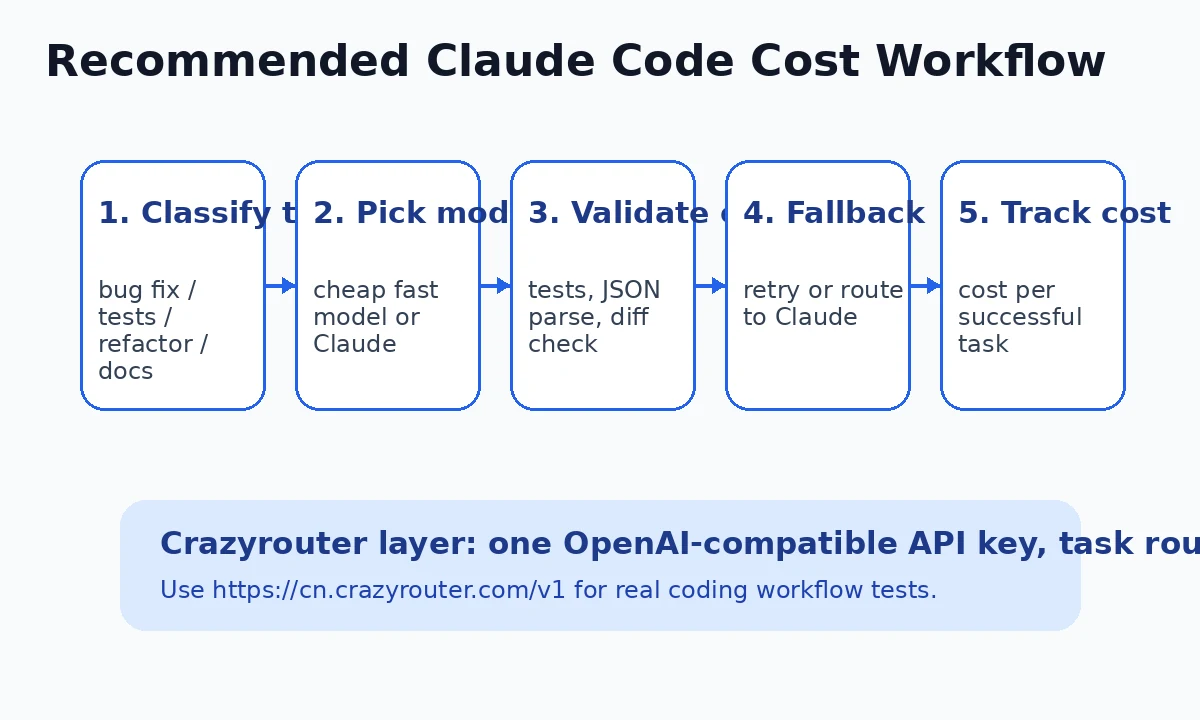
The cheapest workflow is usually not “use the cheapest model everywhere.” It is:
Use Claude for high-risk coding.
Use cheaper models for simple or batch tasks.
Validate every output.
Fallback when the result is empty, invalid, or too slow.
Track cost per successful task.
What Claude Code pricing really includes#
Claude Code itself is best understood as a coding workflow on top of Claude models, rather than a separate pricing universe. Depending on how you access it, your cost usually falls into one of two buckets:
- Subscription access — Free, Pro, Max, Team, or Enterprise style plans.
- API access — pay-per-token usage through an API account or an OpenAI-compatible gateway.
Subscription plans are easy to understand because the monthly price is predictable. API pricing is harder to understand because the bill depends on how many tokens each coding task consumes.
For an individual developer, a subscription can be excellent. For a team running automated coding workflows, subscription pricing alone can become misleading.
Why? Because coding agents behave differently from humans.
A human asks one question, reads the answer, and decides what to do next. A coding agent may read files, generate patches, run tests, retry, summarize logs, and fallback to another model. Every retry and every long context window changes the real cost.
SERP research: what competing pages miss#
Before writing this guide, we checked the current search results for Claude Code pricing 2026, Claude Code Pro vs Max, and Claude Code API cost.
Most ranking pages cover the same surface-level structure:
- Free / Pro / Max / Team / Enterprise pricing
- API token pricing
- basic examples of monthly cost
- short “is it worth it?” sections
The gap is that many articles stop at plan comparison.
Developers need something more practical:
- What happens when coding tasks retry?
- Which tasks actually need Claude?
- When can a cheaper model handle the job?
- How do you avoid paying premium rates for simple test generation or JSON planning?
- How do you compare subscription cost with API cost per successful task?
That is the angle of this article.
Our live Crazyrouter test setup#
To make the article concrete, we ran coding workflow tests through Crazyrouter’s China endpoint:
Base URL: https://cn.crazyrouter.com/v1
Endpoint: /chat/completions
Models tested:
- claude-sonnet-4-6
- claude-opus-4-6
- deepseek-v3.2
- gemini-3-flash-preview
The tasks were intentionally small but representative of real coding work:
- Patch task — fix a retry helper so
retries=3means three retries after the first call and re-raises the last exception. - Test generation — generate pytest tests for
top_k_frequent(words, k)with tie-breaking. - JSON planning — return a structured routing plan for coding tasks.
These are the kinds of steps that appear inside real coding agents, CI assistants, and IDE workflows.
Live benchmark results#
| Model | Patch task | Test generation | JSON plan | Usable outputs | Notes |
|---|---|---|---|---|---|
| Claude Sonnet 4.6 | 5.04s | 8.87s | 6.17s | 3 / 3 | Reliable, complete outputs |
| Claude Opus 4.6 | 3.94s | 7.67s | 6.76s | 3 / 3 | Fastest complete Claude result in this run |
| DeepSeek V3.2 | 5.20s | 9.77s | 5.47s | 2 / 3 | Test generation hit output budget with reasoning tokens |
| Gemini 3 Flash Preview | 6.63s | 6.24s | 3.82s | 1 / 3 | Two tasks ended with empty content due to output budget |
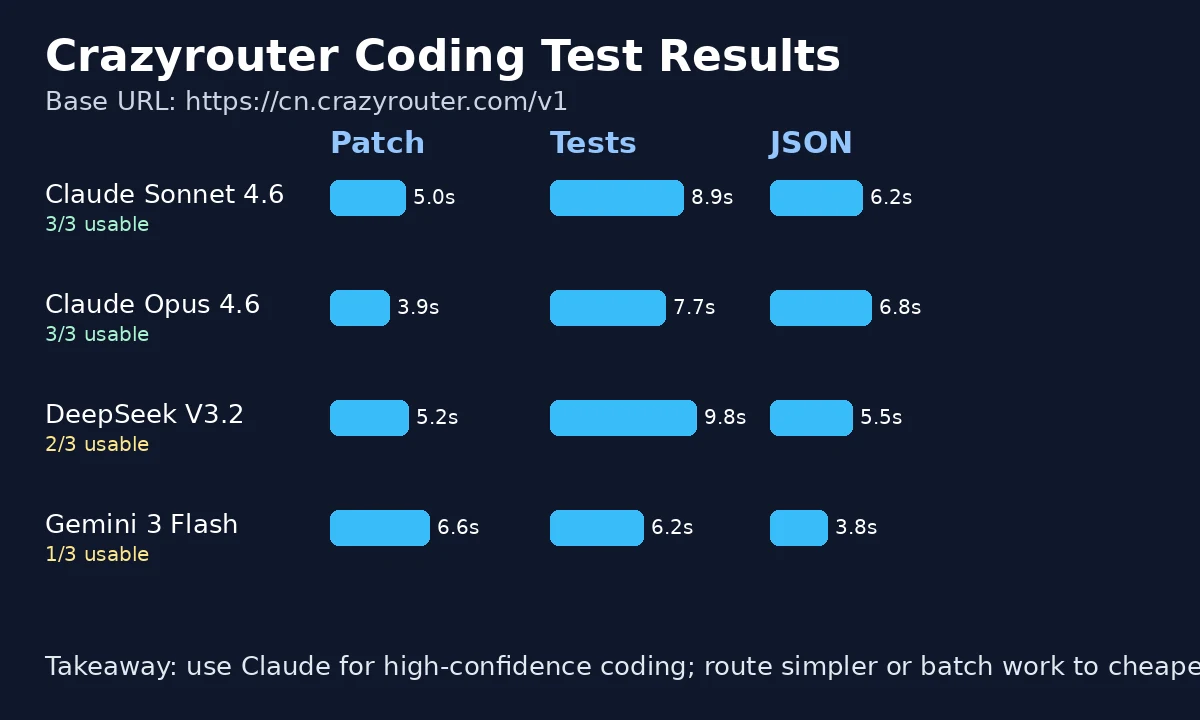
The important detail is not just latency.
The important detail is usable output rate.
In our test, both Claude models returned usable content for all three tasks. DeepSeek handled two tasks well but consumed the full completion budget on the test-generation task, returning no usable content. Gemini 3 Flash Preview returned a usable JSON plan but produced empty content for two coding tasks under the same token budget.
This does not mean those models are bad. It means production coding workflows need routing and validation.
Why subscription pricing can be misleading#
A Claude Code subscription can be a great deal when you are using it manually.
For example:
- You open a repository.
- You ask Claude to explain a bug.
- You request a patch.
- You review it.
- You run tests.
That workflow is interactive and human-paced.
But automated coding workflows are different:
Read issue → inspect files → generate patch → run tests → fix failure → retry → summarize → open PR
If one step fails, the agent may repeat context-heavy calls. If the model returns empty content because the output budget was consumed by reasoning tokens, you pay for the attempt but still need another call.
That is why the real metric is not simply token price.
The real metric is:
cost per successful coding task
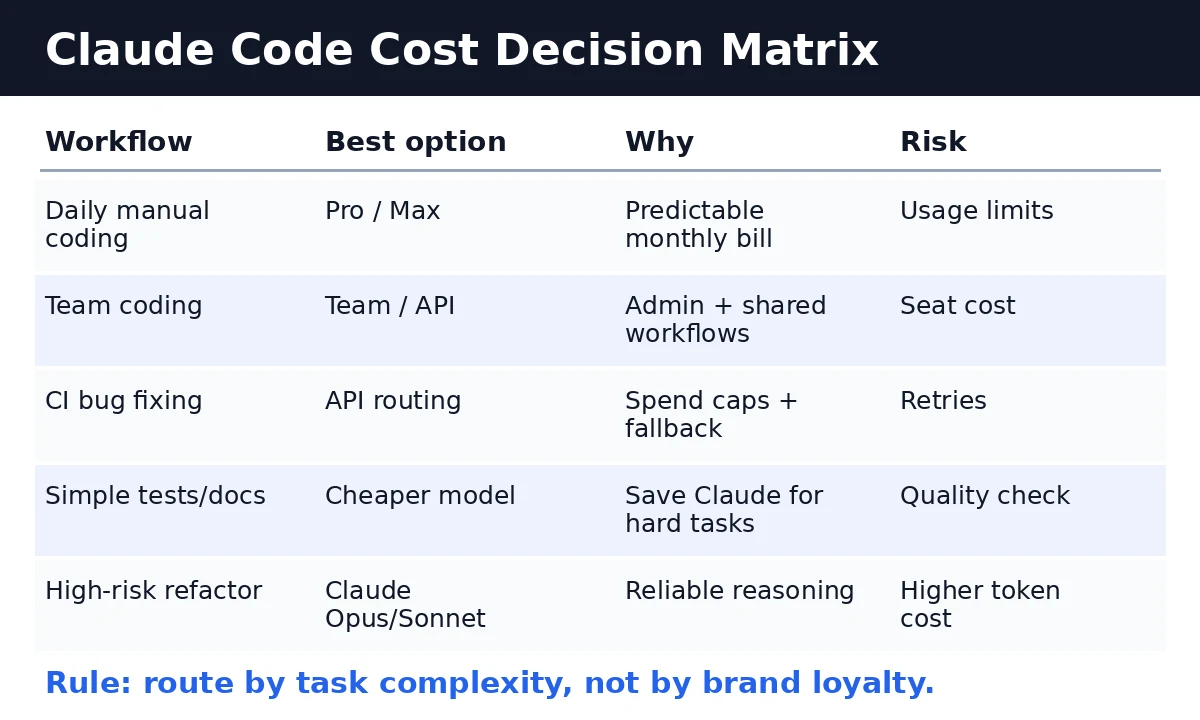
Pro vs Max vs Team vs API#
Here is the practical decision table.
| Workflow | Better fit | Why |
|---|---|---|
| Individual daily coding | Pro or Max | predictable monthly cost, good interactive workflow |
| Heavy solo developer | Max | more room for long sessions and larger tasks |
| Team collaboration | Team / Enterprise | admin controls, shared workspace, governance |
| CI bug fixing | API routing | automation needs spend caps, retries, logs, fallback |
| Batch test generation | cheaper model + validation | many tasks do not need premium Claude reasoning |
| High-risk refactor | Claude Sonnet / Opus | reliability matters more than raw token price |
| Multi-model coding stack | API gateway | route by task type and avoid vendor lock-in |
The key point: Claude Code subscription is great for humans. API routing is better for automated systems.
API cost formula for coding tasks#
For API-based coding workflows, estimate cost like this:
estimated cost = input tokens × input price + output tokens × output price
But for coding agents, add two more variables:
successful task cost = raw call cost × retry count ÷ success rate
A cheap model that fails twice can become more expensive than a premium model that succeeds once.
That is exactly why routing matters.
Recommended routing policy#
A practical policy looks like this:
Simple explanation / docs / comments:
  cheaper fast model

Unit tests / boilerplate / JSON planning:
  cheaper model first, validate output

Bug fixes / production patches:
  Claude Sonnet or Opus

Large refactors / architecture decisions:
  Claude Opus / premium reasoning model

If output is empty, invalid JSON, or tests fail:
  retry with higher max_tokens or fallback to Claude
Where Crazyrouter fits#
Crazyrouter is useful here because it gives you one API layer for multiple models.
Instead of rewriting your coding agent every time you want to test Claude, DeepSeek, Gemini, GPT, or another model, you can keep the same OpenAI-compatible interface:
from openai import OpenAI

client = OpenAI(
    api_key="YOUR_CRAZYROUTER_KEY",
    base_url="https://cn.crazyrouter.com/v1"
)

response = client.chat.completions.create(
    model="claude-sonnet-4-6",
    messages=[
        {"role": "user", "content": "Fix this retry function and explain the edge cases."}
    ],
    max_tokens=1200,
)

print(response.choices[0].message.content)
For coding automation, the gateway layer lets you:
- route easy tasks to cheaper models
- reserve Claude for high-risk tasks
- fallback when a model returns empty content
- measure latency and output validity
- control spend by workflow instead of by seat
- avoid locking your coding stack to one model provider
Claude Code pricing recommendations by user type#
Solo developer#
If most work is manual and interactive, start with a subscription plan. It gives predictable cost and a good coding experience.
Use API routing only for experiments, scripts, or repeated workflows.
Heavy individual developer#
If you use Claude Code for hours every day, Max-style access is easier to justify. But you should still move repeatable tasks to API workflows so you can measure cost and quality.
Small team#
A team should avoid thinking only in seats.
Some work belongs in a subscription tool. Some work belongs in API automation. PR review, test generation, log summarization, and CI patch attempts should be measured separately.
Agency or production engineering team#
Use subscriptions for humans and API routing for automation.
That gives the best balance:
- humans get a strong coding assistant
- automation gets logs, retries, spend caps, and fallback
- finance can measure cost per successful task
What to watch out for#
1. Long context makes coding expensive#
Repository-level tasks can consume a lot of input tokens. If you send too much context into every request, your cost rises quickly.
2. Reasoning tokens can hide failure modes#
In our test, some models consumed the completion budget in reasoning tokens and returned empty content. That is a production risk.
3. Retry loops multiply spend#
If your coding agent retries blindly, your bill can grow without producing a working patch.
4. Not every task needs Claude#
Claude is excellent for difficult coding tasks. But comments, docs, simple tests, and low-risk formatting tasks can often be routed to cheaper models.
Final verdict#
Claude Code pricing in 2026 is best understood as a workflow decision, not just a plan comparison.
Use subscription plans for interactive human coding. Use API routing for automation. Use Claude for high-confidence coding tasks. Use cheaper models where validation is easy. Track cost per successful task.
If your coding workflow already uses scripts, CI jobs, agents, or API-based tools, Crazyrouter gives you a practical control layer:
one API key
multiple coding models
task-based routing
fallback
cost tracking
That is the real way to make Claude Code pricing manageable in 2026.
FAQ#
Is Claude Code free?#
Claude Code access depends on the current Claude plan and API access path. For serious coding workflows, you should compare subscription access with API usage rather than assuming the CLI itself defines the full cost.
Is Claude Code worth it?#
Yes, if you use it for real coding work and value reliable reasoning. For heavy automation, API routing gives better cost control.
Should I choose Pro or Max?#
Choose Pro-style access for lighter interactive use. Choose Max-style access if you spend many hours in coding sessions or regularly work with larger tasks.
Is API cheaper than Claude Code subscription?#
Sometimes. API is cheaper when you route simple tasks to lower-cost models and validate outputs. It can be more expensive if you send huge context windows or retry blindly.
What is the cheapest way to use Claude for coding?#
Use Claude only where it matters most: difficult bugs, refactors, tool use, and production patches. Route simpler tasks to cheaper models and fallback to Claude when validation fails.