 简体中文
简体中文 繁體中文
繁體中文 English
 Français
 Русский
 日本語
日本語 Tiếng Việt
 한국어
한국어 Deutsch
 Español
 Italiano
 Português
 العربية
 ไทย
ไทย Bahasa Indonesia
 Bahasa Melayu
 Türkçe
 Polski
 Nederlands
 Dansk
Dansk Norsk
Norsk Қазақша
Function Calling Across AI Providers: A Portable 2026 Implementation Guide
Design portable function calling across OpenAI-compatible, Claude, Gemini, and open-model APIs with schemas, validation, retries, and fallbacks.
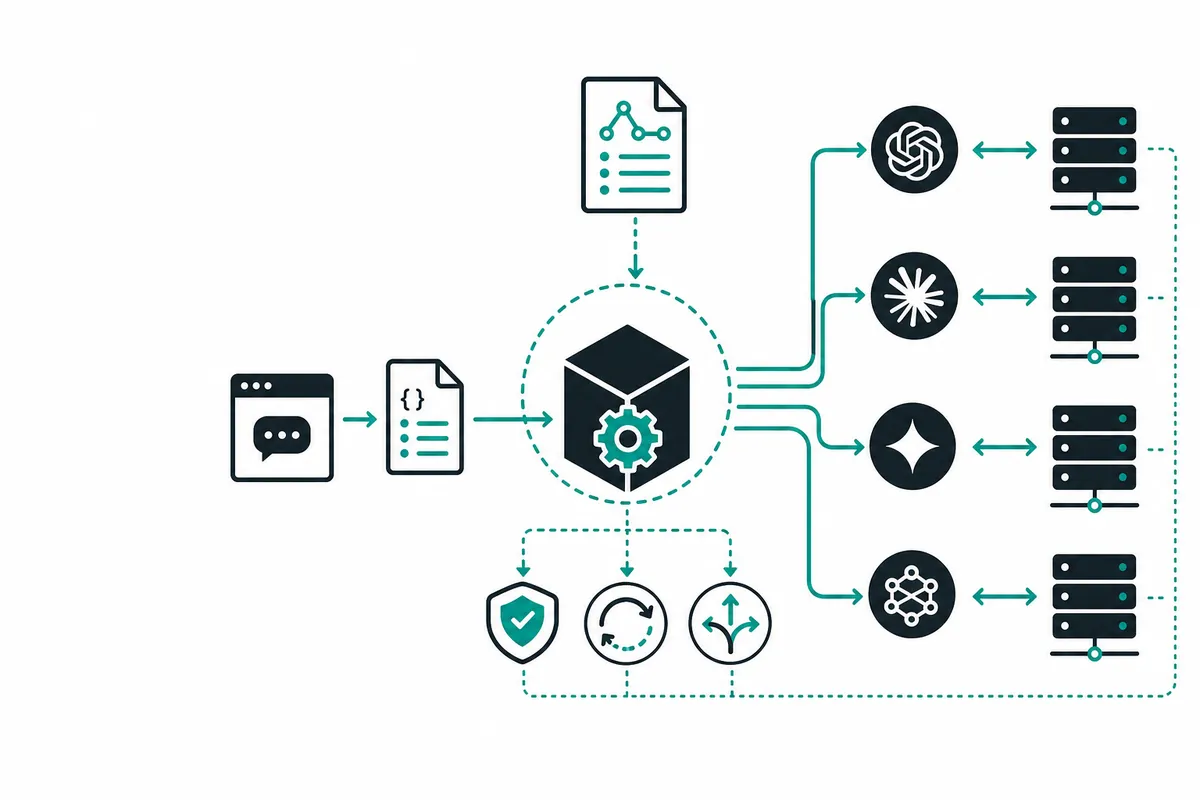
Function Calling Across AI Providers: A Portable 2026 Implementation Guide#
Design portable function calling across OpenAI-compatible, Claude, Gemini, and open-model APIs with schemas, validation, retries, and fallbacks. For developers, the useful question is not whether a model looks impressive in a demo. It is whether the model can be called reliably, evaluated honestly, and operated within a predictable budget. This guide focuses on those practical decisions.
What is function calling AI API?#
Function calling lets a model select a declared application function and return structured arguments instead of pretending it performed an external action. Your server validates those arguments, executes the function, and sends the result back to the model. This pattern is the foundation of tool-using assistants and AI agents. For developers, the useful question is not whether a model looks impressive in a demo. It is whether the model can be called reliably, evaluated honestly, and operated within a predictable budget. This guide focuses on those practical decisions.
function calling AI API vs alternatives#
Provider APIs differ in naming, tool schemas, streaming events, and parallel-call behavior. A portability layer should normalize tool definitions and represent calls internally as name, arguments, call ID, and result. Do not let provider-specific JSON leak into business logic.
| Option | Strength | Trade-off | Best for |
|---|---|---|---|
| function calling AI API | Focused capability and current ecosystem | Limits vary by endpoint | Teams validating this workload |
| Fast general model | Lower latency and cost | May need more prompting | High-volume tasks |
| Premium frontier model | Strong quality and reasoning | Higher unit cost | Difficult or high-value tasks |
| Crazyrouter | One API surface and model choice | Requires evaluation and routing policy | Multi-model production apps |
How to use function calling AI API with code#
The examples below use an OpenAI-compatible request shape. Model IDs and optional parameters can change, so verify the current model catalog and endpoint documentation before shipping.
cURL#
curl https://crazyrouter.com/v1/chat/completions \
  -H "Authorization: Bearer $CRAZYROUTER_API_KEY" \
  -H "Content-Type: application/json" \
  -d '{"model":"function-calling-ai","messages":[{"role":"user","content":"Give a concise, verifiable answer and list assumptions."}]}'
Python#
tools = [{"type":"function","function":{"name":"lookup_order","description":"Find an order by ID","parameters":{"type":"object","properties":{"order_id":{"type":"string"}},"required":["order_id"],"additionalProperties":False}}}]
payload = {"model":"gpt-5-mini","messages":[{"role":"user","content":"Where is order A-1042?"}],"tools":tools,"tool_choice":"auto"}
Node.js#
const tools = [{ type: "function", function: { name: "lookup_order", description: "Find an order by ID", parameters: { type: "object", properties: { order_id: { type: "string" } }, required: ["order_id"], additionalProperties: false } } }];
In production, add a request ID, timeout, structured logs, input limits, output validation, and a bounded retry policy. Never expose the API key in browser JavaScript. For tools or function calling, validate every argument before execution.
Pricing breakdown#
Official pricing changes frequently and can differ by region, plan, modality, context length, and cached-input policy. Use the provider's current pricing page for the authoritative number. For a practical comparison, record the following: input cost, output cost, media or job cost, free quota, minimum spend, rate limits, and the cost of retries.
| Cost item | Official provider path | Crazyrouter path |
|---|---|---|
| Model usage | Provider list price and plan rules | Check live model pricing at Crazyrouter |
| Multiple models | Separate accounts, keys, and billing | One compatible API surface for supported models |
| Development tests | Often spread across provider consoles | Route experiments through one project budget |
| Production control | Provider-specific quotas | Centralize routing, limits, and fallback policy |
A simple monthly estimate is: successful requests × average input/output cost + media cost + retries + infrastructure. Start with a small budget cap, measure cost per accepted result, and only then increase traffic. For video and image generation, draft with a cheaper model and reserve premium generation for approved prompts.
Production checklist#
- Pin a tested model ID and keep a fallback mapping.
- Track latency, empty responses, refusals, retries, and user acceptance.
- Add per-user and per-tenant quotas before launch.
- Store prompts and outputs according to your privacy policy.
- Build a small evaluation set from real tasks, not only benchmark examples.
- Re-check pricing and model availability before every major release.
Frequently asked questions#
Q: Does function calling execute the function automatically?
A: No. The model proposes a call; your trusted application must validate and execute it.
Q: How do I make function calling portable?
A: Use an internal tool schema, strict validation, provider adapters, and contract tests for each model endpoint.
Summary#
function calling AI API is best evaluated as part of a complete application workflow: prompt design, validation, retries, monitoring, and cost controls all affect the result. If you want to compare several models without maintaining a separate integration for each one, explore Crazyrouter and start with a measured, low-risk pilot.