 Crazyrouter
AI API Caching and Context Optimization: Lower Latency and Cost
Learn how prompt caching, semantic caching, context pruning, and retrieval reduce AI API latency and spend without sacrificing answer quality.
September 19, 20265 viewsEnglishTips
Tutorials and updates for image generation models and APIs, including prompt workflows, editing, and production usage.
Learn how prompt caching, semantic caching, context pruning, and retrieval reduce AI API latency and spend without sacrificing answer quality.
A developer checklist for securing AI APIs against leaked keys, prompt injection, sensitive-data exposure, unsafe tools, and runaway spend.
A developer guide to Seedance video AI integration with asynchronous queues, cost controls, prompt versioning, and model fallbacks.
Learn a production-friendly WAN 2.2 Animate workflow for reference poses, shot manifests, asynchronous jobs, and visual QA.
Protect AI API keys, tenant data, prompts, logs, and budgets with practical controls for production applications.
A developer-focused Pika 2.2 review covering video generation use cases, alternatives, API integration patterns, pricing questions, and production tips.
Build a reliable Google Veo3 API integration with async jobs, audio-aware prompts, webhooks, retries, and budget controls.
A practical WAN 2.2 Animate tutorial for controlled character motion, reference images, asynchronous jobs, and production retries.
Design reliable asynchronous AI jobs for image, video, audio, and long-running agent tasks using queues, polling, webhooks, and idempotency.
Reduce AI API spending with prompt budgeting, response caching, model cascades, batching, and usage-based cost attribution.
An AI API is an external boundary, even when it sits behind a friendly SDK. Your application sends prompts, files, tool definitions, and sometimes personal data to a model provider. A leaked key can c...
"A developer-focused Kimi K2 Thinking guide covering reasoning prompts, tool calling, evaluation, latency, and cost-aware routing."
"Learn how to integrate Google Veo3 API workflows with async jobs, webhooks, audio-aware prompts, retries, and a pricing model."
"Build a reliable WAN 2.2 Animate workflow with image inputs, motion prompts, asynchronous jobs, retries, and cost controls."
AI API security best practices for teams: protect keys, isolate tenants, reduce prompt-injection risk, audit routing, and operate a safer multi-model application.
Learn how Seedance video AI fits into a developer pipeline, including prompt contracts, asynchronous jobs, quality checks, pricing considerations, and API alternatives.
A practical Google Veo3 API guide covering asynchronous video generation, audio-aware prompts, webhook design, idempotency, pricing, and fallback routing.
WAN 2.2 Animate tutorial for developers: prepare assets, submit image-to-video jobs, poll safely, handle errors, and control production costs with an API gateway.
Pika 2.2 review for developers: evaluate text-to-video and image-to-video workflows, compare alternatives, estimate costs, and connect through Crazyrouter.
A developer-focused Seedream 4.0 API tutorial guide covering architecture, code, alternatives, cost controls, and production rollout.
Understand Seedance video AI from a developer perspective: prompt design, async generation, evaluation, pricing, and fallback models.
Integrate Google Veo3-style video generation with asynchronous jobs, webhooks, retries, audio validation, and budget controls.
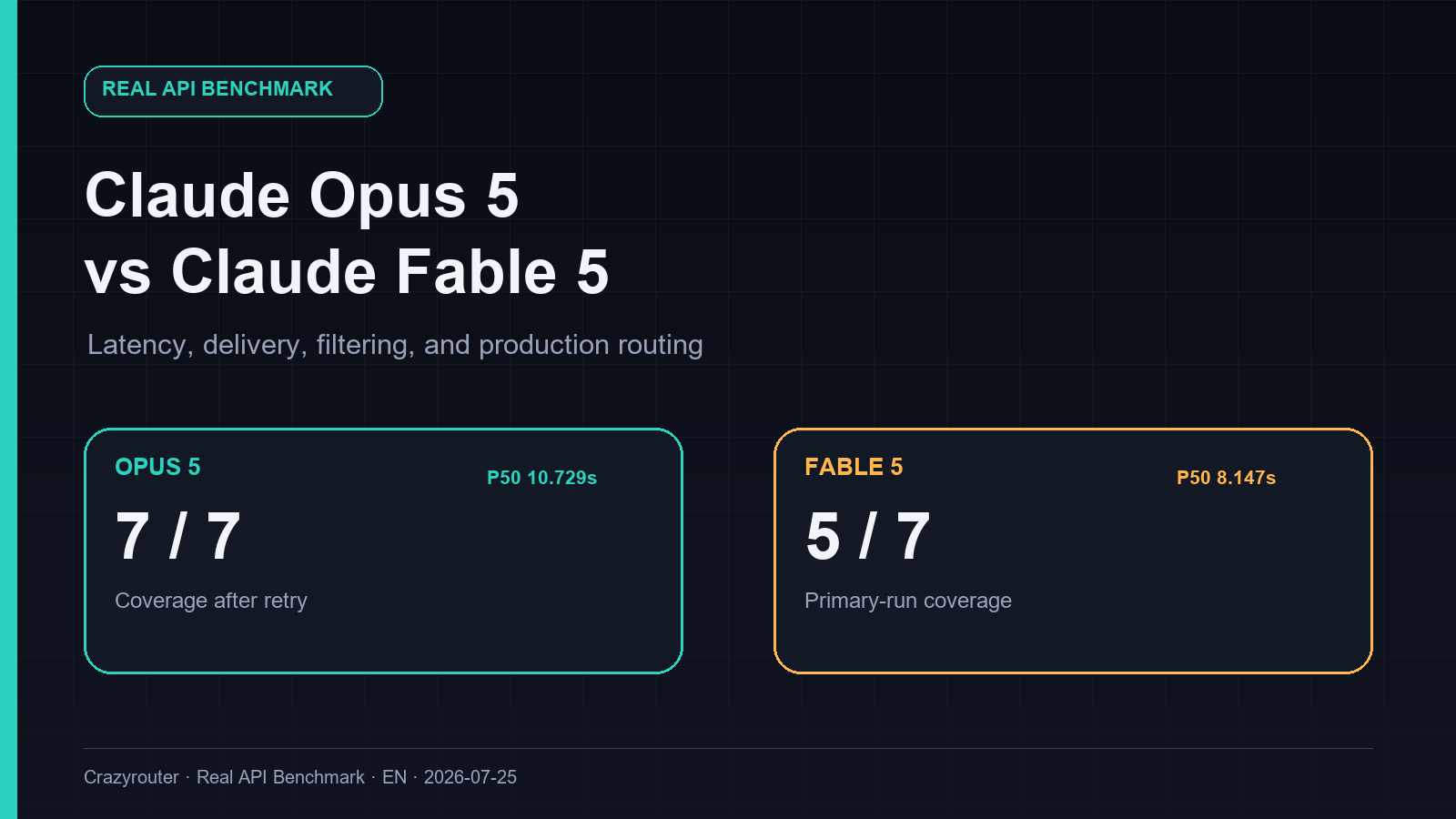
A controlled comparison of Claude Opus 5 and Claude Fable 5 through the same OpenAI-compatible API, using identical prompts and parameters across math, physics, constrained reasoning, code review, strict JSON, and experimental-design tasks, with results tracked for delivery rate, content filtering, latency, token usage, and retries.
Secure AI API integrations with key isolation, least privilege, prompt-injection defenses, data minimization, logging controls, and provider-independent architecture.
A practical Qwen2.5-Omni API guide for developers building audio, image, video, and text applications with Python, Node.js, cURL, pricing controls, and production safeguards.
A Google Veo3 API guide for developers building asynchronous video generation with webhooks, retries, prompt versioning, and budget controls.