 简体中文
简体中文 繁體中文
繁體中文 English
 Français
 Русский
 日本語
日本語 Tiếng Việt
 한국어
한국어 Deutsch
 Español
 Italiano
 Português
 العربية
 ไทย
ไทย Bahasa Indonesia
 Bahasa Melayu
 Türkçe
 Polski
 Nederlands
 Dansk
Dansk Norsk
Norsk Қазақша
Nano Banana 2.1 vs Nano Banana 2: Three API Tests and Price
We ran the same three prompts through both image routes, inspected all six files, and compared latency, prompt compliance, billing, and integration behavior.
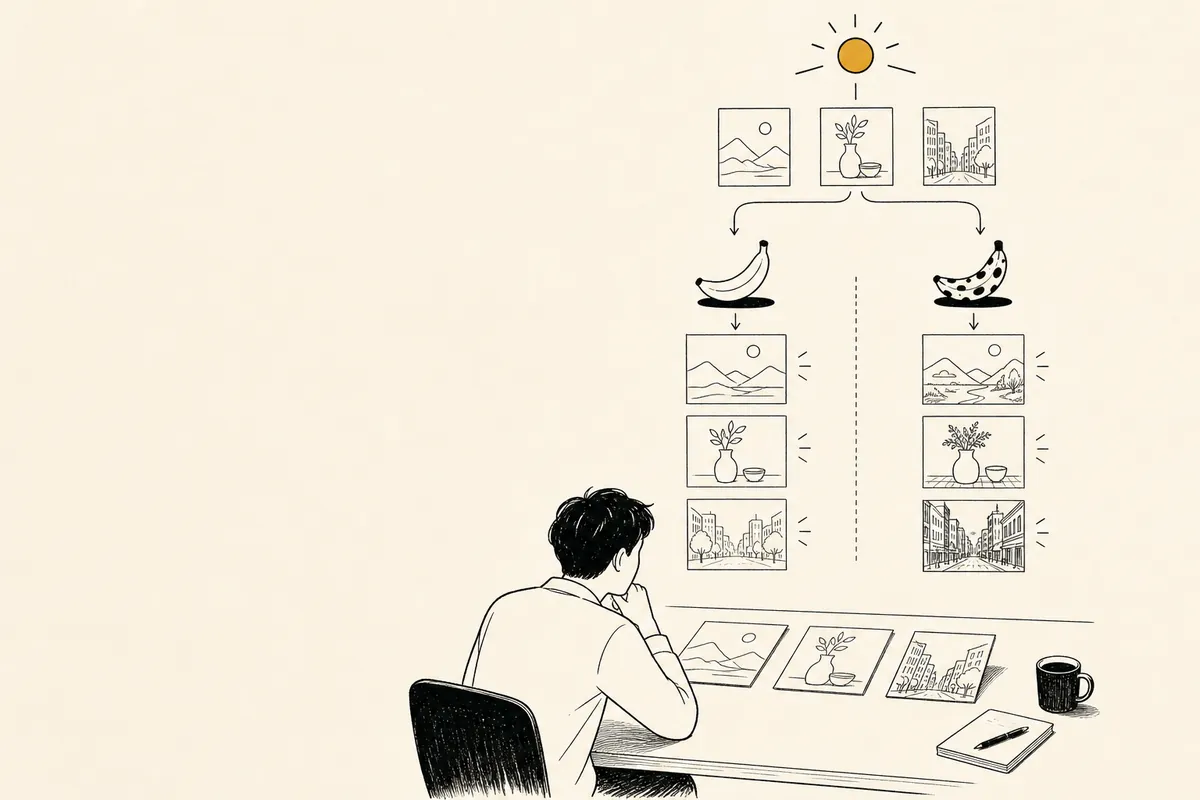
Nano Banana 2.1 vs Nano Banana 2 is not a simple quality win in our three-prompt test. Both models followed the object-layout instruction, both rendered the requested poster sentence exactly, and both produced a convincing rainy-night desk. Nano Banana 2.1 took longer in all three requests, while its published Crazyrouter base price is $0.035 per request. The right choice depends on whether 2.1's newer route improves your own difficult prompts enough to justify a migration.
We ran six calls on October 9, 2026 through the same endpoint, with the same square size and one output per request. This is a practical smoke test, not a statistically significant benchmark. The images were inspected after download rather than judged from the API response alone.
Test setup#
Every request used POST https://api.crazyrouter.com/v1/images/generations, size: 1024x1024, and n: 1. The only request-body changes within each pair were the model values nano-banana-2 and nano-banana-2.1.
The three prompts tested distinct failure modes:
- Layout: three colored objects in an exact left-center-right order.
- Text: a poster containing the exact words
BUILD SMALL, SHIP OFTEN. - Scene: a realistic rainy-night desk with specified objects and no people.
Request time was measured on the client from just before the POST until the complete JSON response arrived. Network and provider load affect this number, so these six timings should not be treated as a service-level guarantee.
Results at a glance#
| Test | Nano Banana 2 | Nano Banana 2.1 | Verdict for this pair |
|---|---|---|---|
| Object layout | 11.84 s; correct order | 15.61 s; correct order | Tie on compliance; 2 was faster |
| Exact poster text | 9.27 s; exact spelling | 18.70 s; exact spelling | Tie on text; 2 was faster |
| Rainy-night scene | 12.05 s; detailed warm scene | 23.22 s; darker, cleaner framing | Style preference; 2 was faster |
| Median response time | 11.84 s | 18.70 s | Nano Banana 2 in this tiny run |
The measured median gap was 6.86 seconds. It would be misleading to turn that observation into a universal speed ratio after only three calls per model.
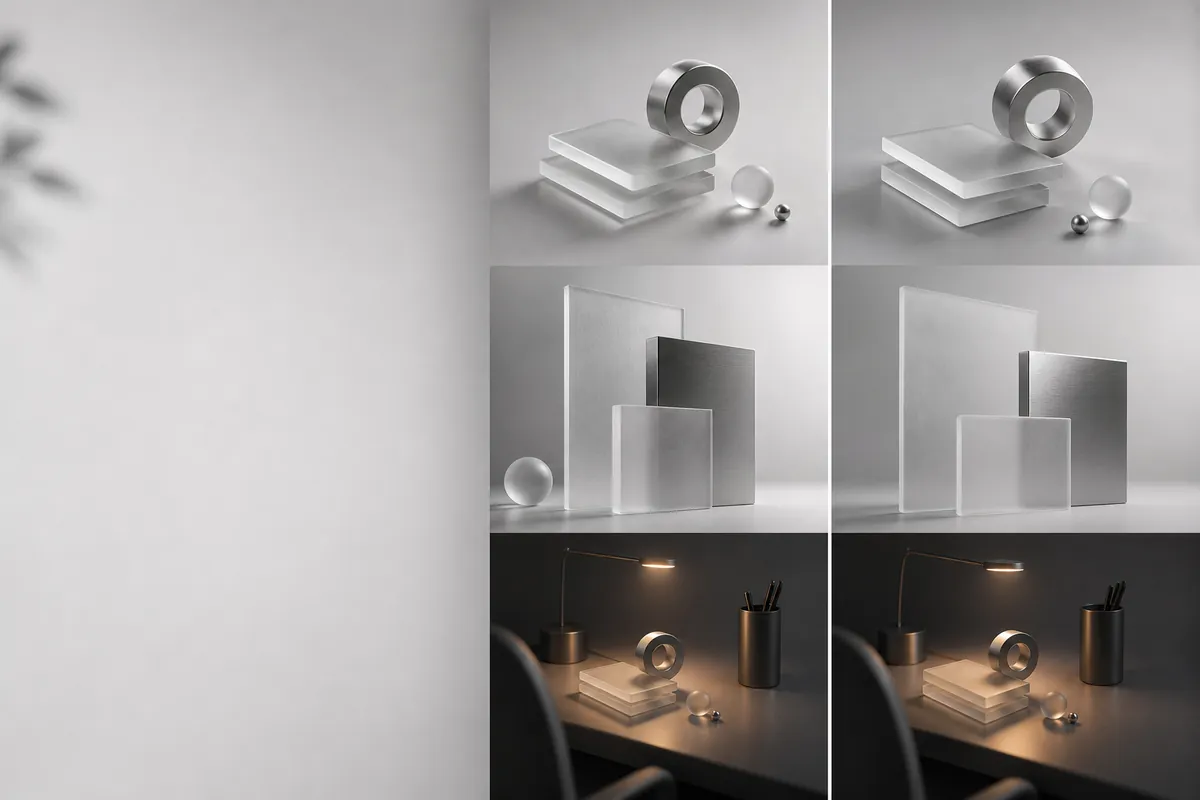
Prompt 1: controlled object layout#
Prompt: “A red ceramic mug centered between a yellow lemon on the left and a blue notebook on the right, overhead product photo, white background, no text.”
Nano Banana 2 output: https://media.crazyrouter.com/task-artifacts/2026/10/09/sync-image/2026100909090848218992TQl3ldsL-1.jpeg
The image placed the lemon, mug, and notebook in the required order. The notebook was cropped at the right edge and included a visible ribbon bookmark.
Nano Banana 2.1 output: https://media.crazyrouter.com/task-artifacts/2026/10/09/sync-image/202610090909198791121334LANUHAw-1.jpeg
The second image also respected the order. It kept the full notebook inside the frame, used a slightly less saturated blue, and omitted the bookmark. Nano Banana 2.1 was better if full-object framing matters; neither model failed the prompt.
Prompt 2: exact text rendering#
Prompt: “A clean white poster with the exact black text: BUILD SMALL, SHIP OFTEN. No other words.”
Nano Banana 2 output: https://media.crazyrouter.com/task-artifacts/2026/10/09/sync-image/20261009090935485236569ryI5KhVU-1.jpeg
It rendered every requested word, the comma, and the final period correctly. The poster appeared pinned to a gray concrete wall.
Nano Banana 2.1 output: https://media.crazyrouter.com/task-artifacts/2026/10/09/sync-image/20261009090944762744438kipp2uMX-1.jpeg
This version also reproduced the sentence exactly. It used a smooth off-white wall, no visible pins, and a more centered text block. The result is a tie for literal text accuracy; choose between them on visual direction, not spelling, for this prompt.
Prompt 3: realistic rainy-night scene#
Prompt: “A cozy reading desk at night, green lamp, open book, rain on the window, realistic photography, no people, no text.”
Nano Banana 2 output: https://media.crazyrouter.com/task-artifacts/2026/10/09/sync-image/20261009091003543362485tEVr1VW4-1.jpeg
The old route created a warm, detailed desk with the lamp on the left, an open handwritten book, glasses, a cup, a plant, a candle, and rain on the window. It met the scene requirements and added plausible props, but the writing in the book did not satisfy a literal reading of "no text."
Nano Banana 2.1 output: https://media.crazyrouter.com/task-artifacts/2026/10/09/sync-image/2026100909101553475466177YL3R2y-1.jpeg
The new route chose a closer, darker angle. It moved the lamp toward the right, used printed text in the book, and showed a double lamp reflection in the glass. Both looked coherent; 2 favored environmental detail, while 2.1 favored a tighter mood. Both included visible writing in their books despite the prompt asking for no text, so neither passed that constraint strictly.
Price difference as of 2026-10#
The live Nano Banana 2.1 row publishes a 0.067 base price, a 0.55 default-group discount, and a per-image billing label. Applying that listed discount to the base field gives about $0.03685, but your actual bill and selected options are the authority.
On those catalog fields, 2.1 is 0.00185 below the calculated default-group figure. This is why “about half the price” is incomplete without the group and billing context. Confirm the account-specific amount in the pricing overview before estimating volume.
Official native-provider pricing is a separate comparison. Consult Google's Gemini API pricing for Google's current list and match resolution, thinking, and image options before comparing totals.
Context and limits#
The Crazyrouter catalog advertises 1K, 2K, and 4K resolution options, URL reference images, aspect-ratio controls, and URL or base64 responses for 2.1. It also says the new model uses the same image request and response format as Nano Banana 2. We did not verify every option in this run.
Neither the topic data nor the live catalog record gives a numeric text-context limit that we can responsibly quote. For image products, reference count, input file rules, output resolution, and request timeout often matter more than a chat-style context-window number. Validate those limits against current documentation and your own requests.
How to reproduce the comparison#
Use a server-side key and run each prompt once per model. Save both URLs immediately, because generated artifacts may not be permanent storage.
for model in nano-banana-2 nano-banana-2.1; do
  curl https://api.crazyrouter.com/v1/images/generations \
    -H "Authorization: Bearer $CRAZYROUTER_API_KEY" \
    -H "Content-Type: application/json" \
    -d "{\"model\":\"$model\",\"prompt\":\"A clean white poster with the exact black text: BUILD SMALL, SHIP OFTEN. No other words.\",\"size\":\"1024x1024\",\"n\":1}"
done
Run more than one seed or repeated call before selecting a production default. For a serious evaluation, blind the files, define scoring rules before viewing them, include your hardest reference edits, and record failed calls as well as successful ones.
Which model is better for what?#
Use Nano Banana 2.1 when you want to test the newest route, need its advertised options, or prefer the tighter framing seen in this sample. Use Nano Banana 2 when your existing prompts are already approved, response time matters, or a visual migration would create unnecessary review work.
For exact poster text, this test offers no reason to switch: both were correct. For the controlled layout, 2.1 kept the notebook fully in frame. For the atmospheric scene, the better output is subjective. Our defensible overall verdict is that Nano Banana 2.1 deserves workload-specific testing, not an automatic replacement decision.
FAQ#
Is Nano Banana 2.1 cheaper than Nano Banana 2?#
Its 0.067 base field. The old catalog entry also shows a 0.55 group discount, which narrows the calculated difference substantially, so check the rate that applies to your account.
Is Nano Banana 2.1 faster than Nano Banana 2?#
Not in these three paired calls. Nano Banana 2 responded faster each time, with medians of 11.84 and 18.70 seconds, but six calls are too few for a general latency claim.
Which version produced more accurate text?#
Both rendered BUILD SMALL, SHIP OFTEN. exactly, including punctuation. More varied fonts, longer copy, and multiple generations would be needed to separate them reliably.
Does Nano Banana 2.1 use a different API format?#
The catalog says it uses the same image request and response format as Nano Banana 2. Changing the explicit model string was enough for our six requests.
Should I replace Nano Banana 2 now?#
Keep the old route until 2.1 passes your own regression set. Compare composition, brand consistency, edits, latency, and actual account usage rather than relying on one public sample.
Summary#
Our real outputs show two capable routes and a clear latency difference in a very small test, not a universal quality winner. Start with saved prompts, evaluate the files blind, and calculate cost from current account usage. To reproduce the calls, create an account, use the exact model IDs above, and retain both routes during evaluation.
<!-- crazyrouter-related-links -->