 简体中文
 繁體中文
 English
 Français
 Русский
 日本語
 Tiếng Việt
 한국어
 Deutsch
 Español
 Italiano
 Português
 العربية
 ไทย
 Bahasa Indonesia
 Bahasa Melayu
 Türkçe
 Polski
 Nederlands
 Dansk
 Norsk
 Қазақша
One API Key for Multiple AI Models: Catalog Access and Live Route Tests
Check model visibility and actual generation with one gateway credential. A three-model probe produced two completed outputs and one timeout; runnable Python included.

You can use one gateway credential to request several permitted models through a shared interface. That does not mean the credential accesses every model, or that every listed route currently works. Verify both catalog visibility and a completed request for each model your application needs.
Crazyrouter is the gateway tested here with one credential: GPT-4.1-mini and Claude Sonnet 4.6 returned the expected answer, while Gemini 2.5 Flash timed out in the same three-model probe. All three names appeared in that credential's model catalog.
By Boluo Z · Tested November 3, 2026
How to use one API key for multiple AI models like GPT Claude Gemini?#
Keep the gateway key on your server, set the gateway's base URL, and choose a model ID supported by that account. The application should keep an explicit allowlist of the model/feature combinations it has tested. A provider's own key is not automatically interchangeable with a gateway key.
This article tests one compatible Chat Completions interface, not a universal entitlement. The OpenAI client documentation describes client configuration; the API protocol comparison explains why different API families still need different request bodies.
Catalog visibility versus completed output#
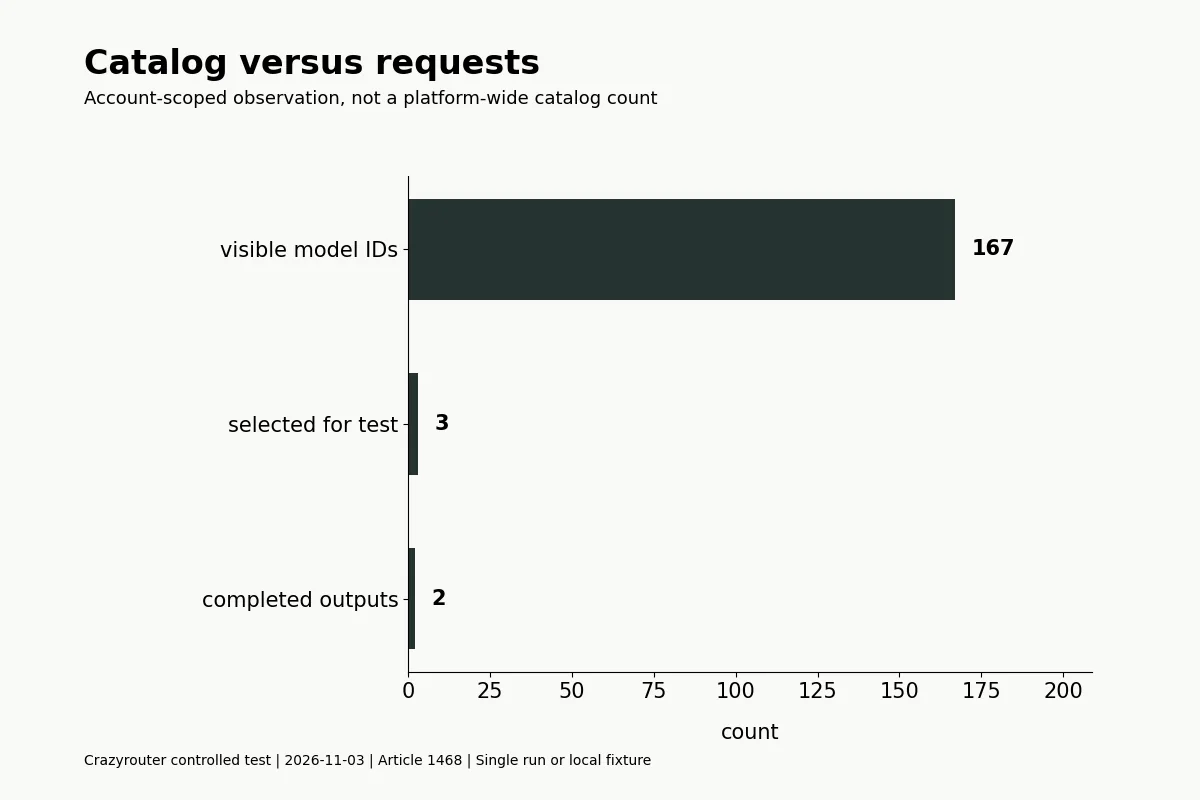
On November 3, 2026, Python 3.10.2 used one session and one environment-supplied key at https://api.crazyrouter.com/v1. The catalog response contained 167 IDs visible to that credential. This is an account-scoped observation, not the total public platform model count.
The probe selected three IDs and submitted the same synthetic task, Reply only ONE-KEY-1468, to /chat/completions with max_tokens: 32. A pass required both finish_reason: stop and an exact marker match.
| Model | Visible in catalog | Completed fixture | Observed result |
|---|---|---|---|
| gpt-4.1-mini | Yes | Yes | ONE-KEY-1468 |
| claude-sonnet-4-6 | Yes | Yes | ONE-KEY-1468 |
| gemini-2.5-flash | Yes | No | ReadTimeout |
Observed response IDs (successful responses only):
chatcmpl-Eg6Cb6pw8JdvaBzh9FWTWhJ7lQBww
msg_011CgfrHgNVihccXQyA8YAKp
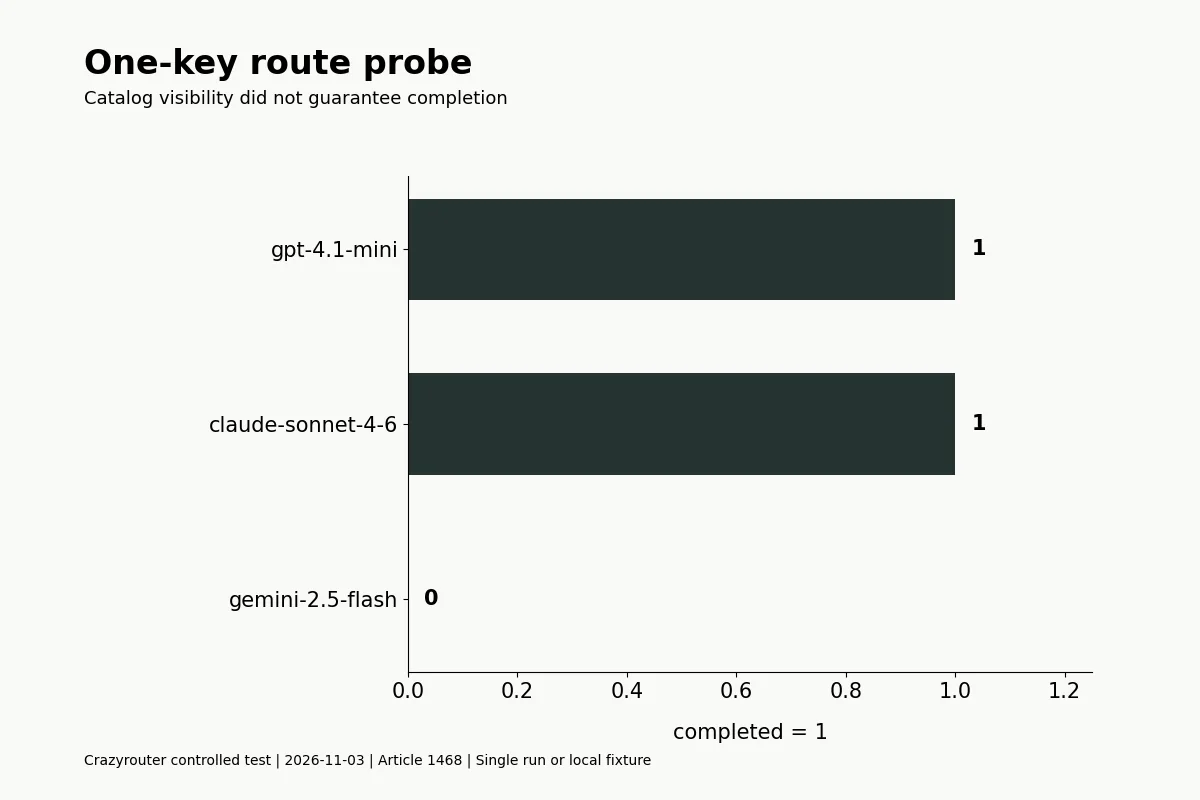
The Gemini route timed out at a 45-second request limit. An earlier uninstrumented run had also aborted on a 90-second timeout. The revised script records failures per model, so one failure does not hide the other results. Neither run establishes the cause or a long-term failure rate.
A runnable account-scoped probe#
Install requests, set CRAZYROUTER_API_KEY in the process environment, save this as one_key_probe.py, and run it. The same key value remains in the session's Authorization header throughout the catalog lookup and three requests. It is never printed.
"""Verify selected models with one credential; catalog presence is not generation."""
import json
import os
import requests

def main():
    s=requests.Session();s.trust_env=False
    s.headers['Authorization']='Bearer '+os.environ['CRAZYROUTER_API_KEY']
    base='https://api.crazyrouter.com/v1'
    r=s.get(base+'/models',timeout=45);r.raise_for_status()
    names={x['id'] for x in r.json()['data']}
    rows=[]
    for model in ['gpt-4.1-mini','claude-sonnet-4-6','gemini-2.5-flash']:
        assert model in names
        payload={'model':model,'max_tokens':32,'messages':[{'role':'user','content':'Reply only ONE-KEY-1468'}]}
        try:
            response=s.post(base+'/chat/completions',json=payload,timeout=45)
            response.raise_for_status();data=response.json();choice=data['choices'][0]
            rows.append({'model':model,'in_catalog':True,'http':response.status_code,'response_id':data['id'],'finish_reason':choice['finish_reason'],'output':choice['message'].get('content'),'passed':choice['finish_reason']=='stop' and choice['message'].get('content','').strip()=='ONE-KEY-1468'})
        except (requests.RequestException,ValueError,KeyError) as error:
            rows.append({'model':model,'in_catalog':True,'passed':False,'error':type(error).__name__})
    print(json.dumps({'base_url':base,'credential_source':'same process environment value for the session','catalog_count':len(names),'requests':rows}))

if __name__=='__main__':main()
The probe completes even when a selected route fails and reports a separate passed value for each model. A successful program exit is therefore not an all-model success result. Do not convert missing outputs into empty successful answers.
Key facts from the November 3, 2026 test#
- One environment-supplied credential authenticated the catalog lookup and selected route requests.
- The account-scoped catalog returned 167 IDs; this was not a platform-wide count.
- Three selected model IDs appeared in that catalog.
- Two selected routes completed the exact synthetic answer; one timed out at a 45-second request limit.
- Each generation request used a 32-token output limit and the same fixture prompt.
Keep the compatibility contract explicit#
| Question | Tested here | Still needs a separate test |
|---|---|---|
| One credential can list selected IDs | Yes | Other accounts, groups or entitlements |
| Same request shape across routes | Three requests attempted | Every model and every parameter |
| Plain text completion | Two validated successes; one timeout | Tools, images, audio and large contexts |
| Crazyrouter shared endpoint | Same host and Chat Completions path | Native API families and all features |
| Billing | Not reconciled | Actual model rates and settled usage |
For SDK normal/streaming behavior, use the Claude and Gemini compatibility matrix. For tool-dependent workflows, use a complete function-call round trip. These are separate capabilities; passing one does not prove the others.
Operate a shared credential deliberately#
Store the key in an appropriate server-side secret source, and keep it out of browser code and client-visible error messages. Build restricted request receipts rather than logging authorization headers. Model selection should come from your approved configuration, not arbitrary user-supplied names.
If a selected route fails, classify the failure before trying another. A bounded fallback policy can permit one alternate route for replay-safe tasks, but a fallback does not establish equivalent output quality or unchanged cost. Record the attempted and completed model separately.
FAQ#
Does one key mean access to every AI model?#
No. Access depends on the account, gateway and selected route. Test the specific models and features you need.
Does appearing in /models prove a model works?#
No. All three IDs were visible here, but one generation timed out.
Is the observed 167 count the platform's total catalog?#
No. It is the result visible to this credential at the time of the test.
Can I give the gateway key to browser users?#
This example keeps it server-side. Exposing a shared credential gives clients access to its permissions and usage.
Can I reuse the same request for tools and streaming?#
Only after feature-specific validation. This particular probe checks a short non-streaming text response.
Was Gemini proven unsupported?#
No. This request timed out; that is not proof that the model or interface is universally unsupported.
Implementation Guides
Podcast
AI Dev Tools: The Crazyrouter Podcast
Short episodes for developers on AI APIs, gateways, cost control and coding tools.
Latest episodes
EP196 · Oct 29, 2026 · 6:53
AI API Security Posture — Turn Controls Into Continuous Evidence
A practical guide to AI API security posture: inventory exposure, verify controls continuously, protect keys and data, constrain tools, and turn security assumptions into evidence that operators can act on.
EP195 · Oct 28, 2026 · 7:21
AI API Policy Drift — Detect When Production Rules Stop Matching Intent
A practical guide to policy drift in AI APIs: version routing and safety rules, detect stale enforcement, compare intended and observed behavior, and restore control before small gaps become incidents.